15-4

Catalyst 2960 Switch Software Configuration Guide

78-16881-01

Chapter 15      Configuring STP

Understanding Spanning-Tree Features

Bridge ID, Switch Priority, and Extended System ID

The IEEE 802.1D standard requires that each switch has an unique bridge identifier (bridge ID), which 

controls the selection of the root switch. Because each VLAN is considered as a different 

logical bridge


with PVST+ and rapid PVST+, the same switch must have a different bridge IDs for each configured 

VLAN . Each VLAN on the switch has a unique 8-byte bridge ID. The 2 most-significant bytes are used 

for the switch priority, and the remaining 6 bytes are derived from the switch MAC address.

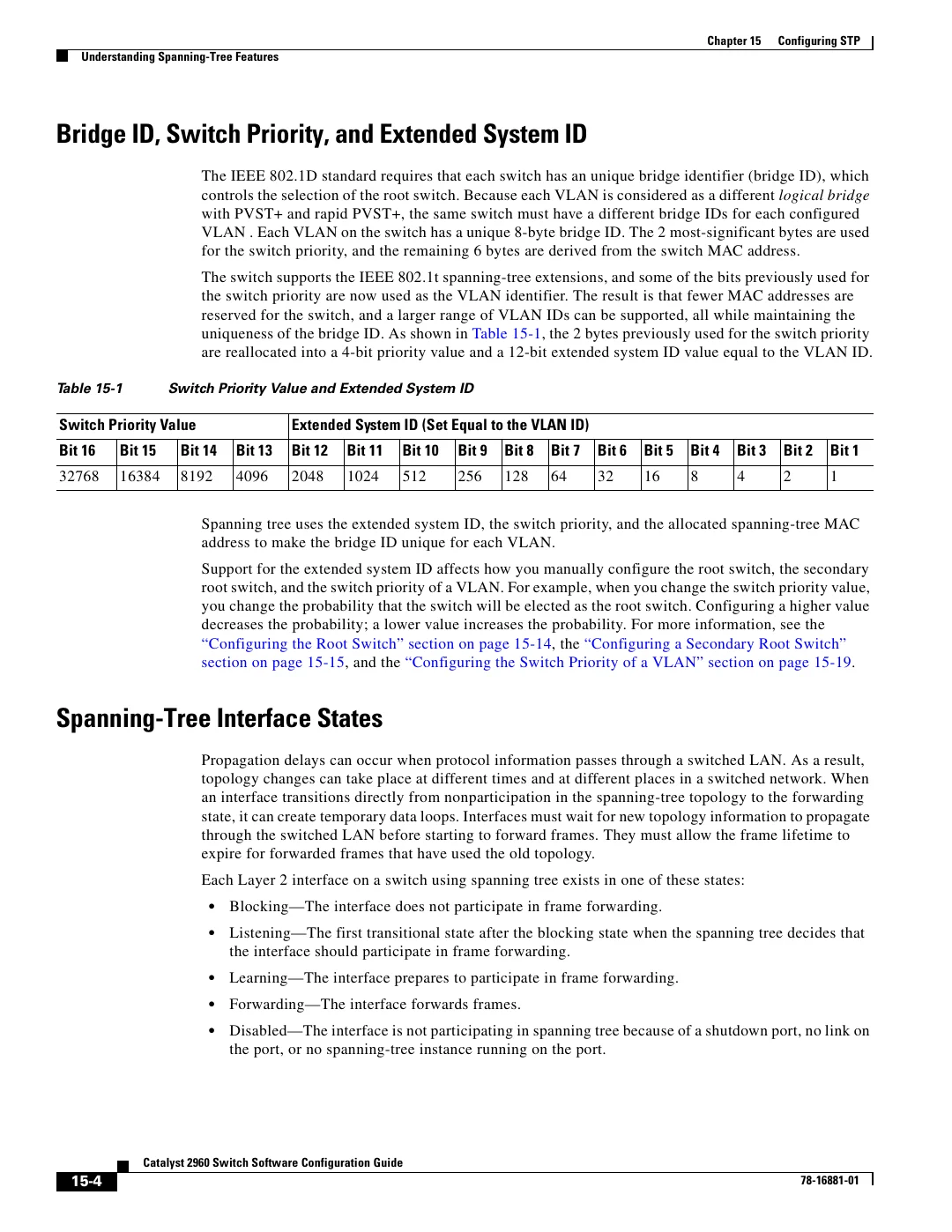
The switch supports the IEEE 802.1t spanning-tree extensions, and some of the bits previously used for 

the switch priority are now used as the VLAN identifier. The result is that fewer MAC addresses are 

reserved for the switch, and a larger range of VLAN IDs can be supported, all while maintaining the 

uniqueness of the bridge ID. As shown in 

Table 15-1

, the 2 bytes previously used for the switch priority 

are reallocated into a 4-bit priority value and a 12-bit extended system ID value equal to the VLAN ID.

Spanning tree uses the extended system ID, the switch priority, and the allocated spanning-tree MAC 

address to make the bridge ID unique for each VLAN.

Support for the extended system ID affects how you manually configure the root switch, the secondary 

root switch, and the switch priority of a VLAN. For example, when you change the switch priority value, 

you change the probability that the switch will be elected as the root switch. Configuring a higher value 

decreases the probability; a lower value increases the probability. For more information, see the 

“Configuring the Root Switch” section on page 15-14

, the 

“Configuring a Secondary Root Switch” 

section on page 15-15

, and the 

“Configuring the Switch Priority of a VLAN” section on page 15-19

.

Spanning-Tree Interface States

Propagation delays can occur when protocol information passes through a switched LAN. As a result, 

topology changes can take place at different times and at different places in a switched network. When 

an interface transitions directly from nonparticipation in the spanning-tree topology to the forwarding 

state, it can create temporary data loops. Interfaces must wait for new topology information to propagate 

through the switched LAN before starting to forward frames. They must allow the frame lifetime to 

expire for forwarded frames that have used the old topology.

Each Layer 2 interface on a switch using spanning tree exists in one of these states: 

•

Blocking—The interface does not participate in frame forwarding.

•

Listening—The first transitional state after the blocking state when the spanning tree decides that 

the interface should participate in frame forwarding.

•

Learning—The interface prepares to participate in frame forwarding.

•

Forwarding—The interface forwards frames.

•

Disabled—The interface is not participating in spanning tree because of a shutdown port, no link on 

the port, or no spanning-tree instance running on the port.

Table 15-1

Switch Priority Value and Extended System ID 

Switch Priority Value

Extended System ID (Set Equal to the VLAN ID)

Bit 16

Bit 15

Bit 14

Bit 13

Bit 12

Bit 11

Bit 10

Bit 9

Bit 8

Bit 7

Bit 6

Bit 5

Bit 4

Bit 3

Bit 2

Bit 1

32768

16384

8192

4096

2048

1024

512

256

128

64

32

16

8

4

2

1

Page 278
Image 278
Open full-size image

2960 specifications

Cisco Systems 2960 series switches are a prominent solution in the networking landscape, known for their reliability, scalability, and feature-rich offerings. Ideal for small to medium-sized enterprises, these switches provide a robust foundation for network infrastructure, ensuring optimal performance and connectivity.

One of the standout features of the Cisco 2960 series is its Layer 2 switching capabilities. The switches support multiple VLANs (Virtual Local Area Networks), allowing network administrators to segment traffic efficiently and enhance security protocols. This is crucial in modern networks where managing traffic and isolating sensitive information is a priority.

The Cisco 2960 series also incorporates advanced Quality of Service (QoS) features, enabling the prioritization of critical applications and services. This functionality ensures that time-sensitive data, such as voice and video traffic, maintains a high quality of service even in congested networks. With support for IEEE 802.1p and DSCP marking, administrators can fine-tune their network performance to meet specific organizational needs.

Power over Ethernet (PoE) is another significant characteristic of the Cisco 2960 series. This feature allows switches to deliver electrical power alongside data over Ethernet cables to devices such as IP phones, wireless access points, and surveillance cameras. With PoE, organizations can reduce clutter from power cables and increase deployment flexibility for various devices.

In terms of security, the Cisco 2960 series is equipped with a range of integrated security features. The switch supports port security, 802.1X authentication, and Access Control Lists (ACLs), providing robust defenses against unauthorized access and potential network vulnerabilities. These security measures are essential for protecting sensitive data and ensuring compliance with industry regulations.

Moreover, the Cisco 2960 series offers enhanced network management capabilities with Cisco's Intelligent Network Services. This includes support for Simple Network Management Protocol (SNMP), Cisco Prime, and Embedded Event Manager (EEM), allowing for efficient monitoring, troubleshooting, and policy enforcement across the network.

Additionally, the Cisco 2960 switches provide various models and configurations, catering to different networking needs. Options include models with varying port densities, uplink configurations, and stacking capabilities, making it easy for organizations to choose solutions that align perfectly with their requirements.

In summary, the Cisco 2960 series is a versatile and essential component of modern networking environments. Its advanced features, including Layer 2 support, QoS, PoE, robust security, and diverse management tools, make it an excellent choice for organizations looking to build a strong and secure network infrastructure.