30-4

Catalyst 2960 Switch Software Configuration Guide

78-16881-01

Chapter 30      Configuring EtherChannels

Understanding EtherChannels

Port Aggregation Protocol

The Port Aggregation Protocol (PAgP) is a Cisco-proprietary protocol that can be run only on Cisco 

switches and on those switches licensed by vendors to support PAgP. PAgP facilitates the automatic 

creation of EtherChannels by exchanging PAgP packets between Ethernet ports. 

By using PAgP, the switch learns the identity of partners capable of supporting PAgP and the capabilities 

of each port. It then dynamically groups similarly configured ports into a single logical link (channel or 

aggregate port). Similarly configured ports are grouped based on hardware, administrative, and port 

parameter constraints. For example, PAgP groups the ports with the same speed, duplex mode, native 

VLAN, VLAN range, and trunking status and type. After grouping the links into an EtherChannel, PAgP 

adds the group to the spanning tree as a single switch port.

PAgP Modes 

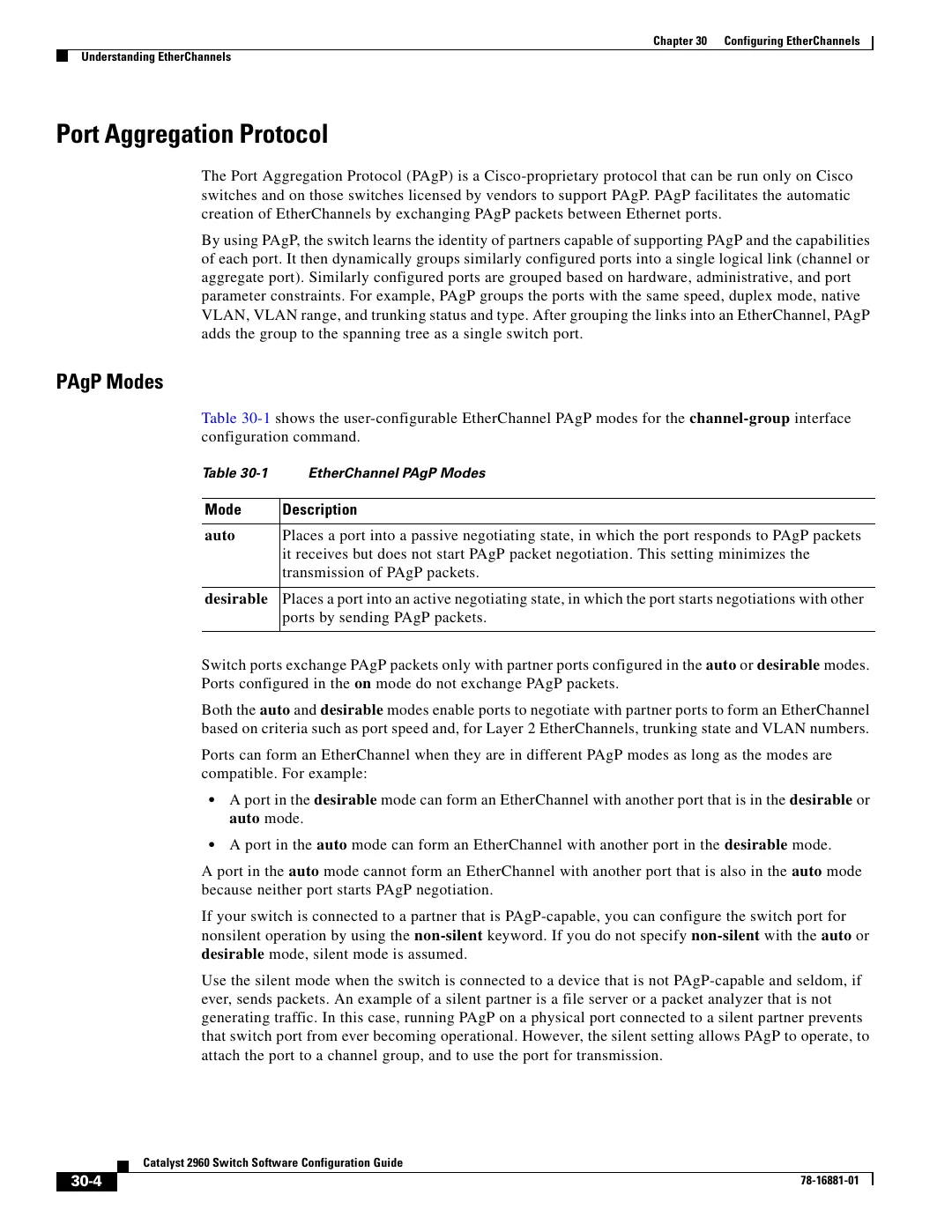
Table 30-1

 shows the user-configurable EtherChannel PAgP modes for the 

channel-group

 interface 

configuration command. 

Switch ports exchange PAgP packets only with partner ports configured in the 

auto

 or 

desirable

 modes. 

Ports configured in the 

on

 mode do not exchange PAgP packets.

Both the 

auto

 and 

desirable

 modes enable ports to negotiate with partner ports to form an EtherChannel 

based on criteria such as port speed and, for Layer 2 EtherChannels, trunking state and VLAN numbers. 

Ports can form an EtherChannel when they are in different PAgP modes as long as the modes are 

compatible. For example:

•

A port in the 

desirable

 mode can form an EtherChannel with another port that is in the 

desirable

 or 

auto

 mode.

•

A port in the 

auto

 mode can form an EtherChannel with another port in the 

desirable

 mode. 

A port in the 

auto

 mode cannot form an EtherChannel with another port that is also in the 

auto

 mode 

because neither port starts PAgP negotiation.

If your switch is connected to a partner that is PAgP-capable, you can configure the switch port for 

nonsilent operation by using the 

non-silent

 keyword. If you do not specify

 non-silent

 with the 

auto

 or 

desirable

 mode, silent mode is assumed. 

Use the silent mode when the switch is connected to a device that is not PAgP-capable and seldom, if 

ever, sends packets. An example of a silent partner is a file server or a packet analyzer that is not 

generating traffic. In this case, running PAgP on a physical port connected to a silent partner prevents 

that switch port from ever becoming operational. However, the silent setting allows PAgP to operate, to 

attach the port to a channel group, and to use the port for transmission.

Table 30-1

EtherChannel PAgP Modes

Mode

Description

auto


Places a port into a passive negotiating state, in which the port responds to PAgP packets 

it receives but does not start PAgP packet negotiation. This setting minimizes the 

transmission of PAgP packets.

desirable

  Places a port into an active negotiating state, in which the port starts negotiations with other 

ports by sending PAgP packets. 

Page 560
Image 560
Open full-size image

2960 specifications

Cisco Systems 2960 series switches are a prominent solution in the networking landscape, known for their reliability, scalability, and feature-rich offerings. Ideal for small to medium-sized enterprises, these switches provide a robust foundation for network infrastructure, ensuring optimal performance and connectivity.

One of the standout features of the Cisco 2960 series is its Layer 2 switching capabilities. The switches support multiple VLANs (Virtual Local Area Networks), allowing network administrators to segment traffic efficiently and enhance security protocols. This is crucial in modern networks where managing traffic and isolating sensitive information is a priority.

The Cisco 2960 series also incorporates advanced Quality of Service (QoS) features, enabling the prioritization of critical applications and services. This functionality ensures that time-sensitive data, such as voice and video traffic, maintains a high quality of service even in congested networks. With support for IEEE 802.1p and DSCP marking, administrators can fine-tune their network performance to meet specific organizational needs.

Power over Ethernet (PoE) is another significant characteristic of the Cisco 2960 series. This feature allows switches to deliver electrical power alongside data over Ethernet cables to devices such as IP phones, wireless access points, and surveillance cameras. With PoE, organizations can reduce clutter from power cables and increase deployment flexibility for various devices.

In terms of security, the Cisco 2960 series is equipped with a range of integrated security features. The switch supports port security, 802.1X authentication, and Access Control Lists (ACLs), providing robust defenses against unauthorized access and potential network vulnerabilities. These security measures are essential for protecting sensitive data and ensuring compliance with industry regulations.

Moreover, the Cisco 2960 series offers enhanced network management capabilities with Cisco's Intelligent Network Services. This includes support for Simple Network Management Protocol (SNMP), Cisco Prime, and Embedded Event Manager (EEM), allowing for efficient monitoring, troubleshooting, and policy enforcement across the network.

Additionally, the Cisco 2960 switches provide various models and configurations, catering to different networking needs. Options include models with varying port densities, uplink configurations, and stacking capabilities, making it easy for organizations to choose solutions that align perfectly with their requirements.

In summary, the Cisco 2960 series is a versatile and essential component of modern networking environments. Its advanced features, including Layer 2 support, QoS, PoE, robust security, and diverse management tools, make it an excellent choice for organizations looking to build a strong and secure network infrastructure.