User Guide
Nokia 8890 User Guide
Copyright information
Contents
Find names in the phone Book
Numbers
Edit revise names Numbers
Call log++
Automatic redial
Call timers
Calling card
Use Voice dialing
Language Set up the clock
Restore factory settings
Keyguard
Security code Fixed dialing
Calendar
Alarm clock
PC Suite Calculator
Tones++
Make an Emergency
For your safety
Your phone’s label
Documentation conventions
Using this guide
Welcome
Terms
Accessing this guide online
Back
Keys and features
Front
Left side
Earpiece volume buttons IR port
Bottom
Charger connection Headset/car kit connection
Cell info display Caller ID Notifications on SIM update
Network services
Customer Service, Canada
Customer Service, USA
Contacting Nokia
Westney Rd. South Ajax, Ontario L1S 4N7 Tel 1
Switch off the phone With the back of the phone facing
Install the SIM card
Before you begin
Preparing your phone for use
If the phone is on, Charging appears Also
Install the battery
Charge the battery
Remove the battery
About your phone
Switch on your phone
Indicators
About indicators and icons
Volume indicator
Phone see Adjust the earpiece volume during a call on
Icons
Numbers by pressing and holding
Making and answering calls
Check the signal strength
Make a call
Use the keypad
Use the sliding cover to answer, end, and reject calls
Use the phone book
Use the sliding cover
Make calls with the sliding cover closed
Adjust the earpiece volume during a call
Advanced calling options
Make a 1-touch call see 1-touch dialing on
Answer a call
End a call
Reject a call
Redial the last-dialed number
Menu
Using the menus
Selection keys
Scroll keys
Help text
Menu shortcuts
Scroll bar
Call log
List of menu shortcuts
Messages
Call cost settings 1 Call cost limit 2 Show costs
Forwarding See your service provider
Settings
Games
Entering letters and numbers
ABC mode
Standard text input
Find the key that is below the letter you want to enter
Enter spaces and punctuation
To switch between uppercase and lowercase letters, press
Erase mistakes
Change letter case
123 mode
ABC mode
Mode
Use special characters in names and phone numbers
Save names and numbers
Phone book
Save a name and number
Save a number only
If your phone book is full
Find names in the phone book
From the Start screen
While in a call
Erase names and numbers
Edit revise names and numbers
Erase stored names and numbers
Erase your entire phone book
Call log++
Switch between internal memory and SIM memory
Two types of memory
Look up received calls
Look up dialed calls
Check for missed calls
After missing a call
Options in call lists
Clearing call lists
At any time
Voice mail++
Work with two phone lines
Save the voice mailbox number
Listen to your voice messages
Select profiles
Profiles
Active call options
Activate/cancel call waiting
Use call waiting++
Confirm call waiting status
Reject a waiting call
Switch between calls
End the active call
Third call waiting
Put a call on hold
Use in-call options
Make a new call
Scroll to End all calls
Send touch tones
Switch between two calls in progress
Set touch-tone length
Save touch tone strings
Access menus
Access the phone book
End all calls
Mute/unmute the microphone
While in a conference call, press Options
Conference calls++
Transfer a call++
Call forwarding++
Activate call forwarding
Cancel call forwarding
Forward all voice calls
Select Voice Mail Select Other number
Calling card
Automatic redial
Check call forwarding status
Activate automatic redial
Save calling card information
Access no
+ Phone no
+ Card no
Choose a calling card
Use Voice dialing
Make a calling card call
Add a voice tag to a phone book entry
Advanced calling features
Play back a voice tag
Make a call using voice recognition
Change a voice tag
Phone displays Press Start, then speak after tone
Erase a voice tag
Touch dialing
Call a 1-touch dial number
Assign a number to a 1-touch dial key
Change 1-touch dialing numbers
Erase 1-touch dialing numbers
Use the phone book
Make an international call
Add names to a caller group
Caller groups
Remove names from a caller group
Assign a ringing tone to a caller group
Assign group graphics
Rename a caller group
Send a graphic to someone else
Follow steps 1 through 3 above
Reset call timers to
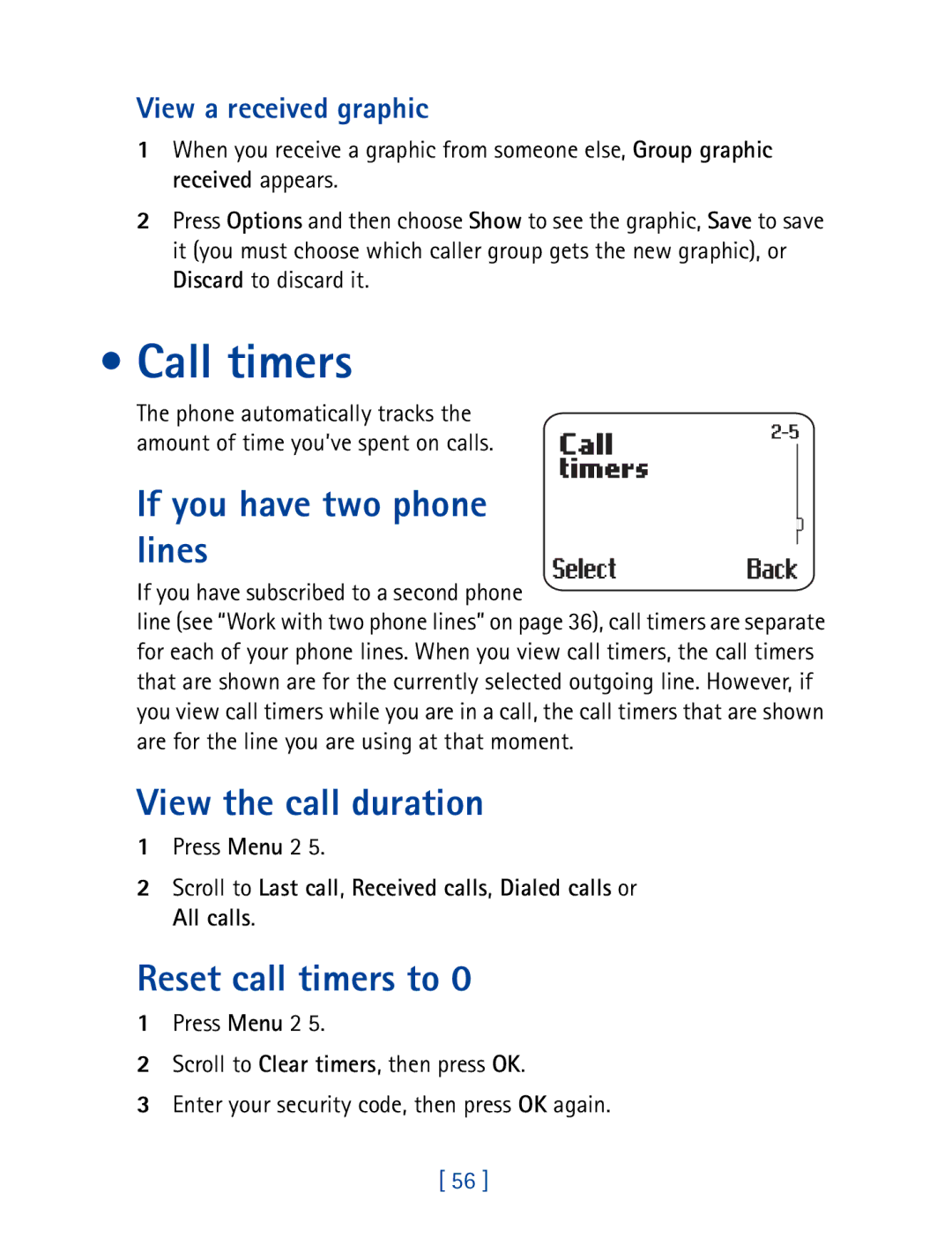
Call timers
If you have two phone lines
View the call duration
Use call cost limits
Show call timer during calls
Set a call cost limit
Remove a call cost limit
Show costs in++
Show call costs++
View call costs
Clear call cost counters
Customize the profile
Profiles
Select a profile
Ringing tone
Ringing options
Vibrating alert
Ringing volume
Keypad tones
Message alert tone
Rename a profile
Accessory profiles
Headset and Car profiles
Set for automatic answer
Set up the clock
Restore factory settings
Set up car profile
Choose the display language
Select the time format
Set automatic update of date and time++
Display the clock
Press Menu 4 2 Scroll to 24-houror am/pm Press OK
Lock the keypad Keyguard
Security features
Lock/unlock the keys using the sliding cover
PIN codes
PIN and PUK codes
Set SIM card security
PUK codes
Change your PIN or PIN2 code
PIN code blocked appears
Security code
Unblock a PIN code
Turn fixed dialing on or off
Fixed dialing
Add numbers to the fixed dialing list
Scroll to Change security code and press Select
Turn on call restrictions
Restricting calls++
Set up a closed user group++
Scroll to Automatic or Manual, then press Select
Select a system
Text messages++
Set up text messaging
Save your message center number
Message center number appears
Writing messages
Using standard text input
Using predictive text input
Select a language and turn on predictive text input
Predictive text input tools
Spell
Clear
Writing the word
Turn off predictive text input
Write with predictive text input
If the word is correct
Add the desired word to the match list
If the word is not correct
If the ? character appears after the word
Save messages in the outbox
Insert symbols
Send the text message
Insert numbers
Resend a message from the outbox
Erase a message
Read text messages
Read new text messages now
Read new text messages later
Use number
Reply to a message
Forward a message
Change settings for some messages
Message settings
Press Menu 1
Scroll to one of these options
Message storage
Change common settings for all messages
Picture messages
Send picture messages
Scroll to Picture Messages and press Select
Send picture messages with text
Other picture message options
Receive picture messages
Calendar
Your personal digital assistant
View the calendar
Enter the date
Make note
When Set an alarm for the note? appears, choose Yes or No
View day notes
Erase notes
Send/receive calendar notes
View all notes
Go to date
Set the alarm clock
Alarm clock
View received calendar notes
Save received calendar notes
Turn off the alarm clock
Manage the alarm
Business cards
Send a business card
View a received business card
Send a business card using IR
Save a viewed business card
Scroll to Send bus. card
Calculator
PC Suite
Delete a viewed business card
Use the calculator
Convert a currency amount
Convert currency
Set the exchange rate
Fax and data calls++
Your phone and other devices
Make a fax or data call
Receive a data or fax call
Send data via the IR port
Send information via IR
Receive data via the IR port
When is not displayed, no IR connection exists
Print using IR
Check the status of an IR connection
Print text messages
Scroll to Print via IR
Print phone book entries
Games
Fun and games
Snake
Logic
Memory
Download ringing tones++
Rotation
Notification of received ringing tone
Discard received ringing tones
Save received ringing tones
Reference information
Batteries, chargers, and accessories
Reference information
Traffic safety
Important safety information
Remember Safety-Your most important call
Operating environment
Pacemakers
Electronic devices
Hearing aids
Other medical devices
Posted facilities
Potentially explosive atmospheres
Vehicles
Vehicles
Emergency calls
Make an Emergency Call
Radio Frequency RF Signals
Care and maintenance
Few practical rules for accessory operation
Accessories
Standby and Talk Times
Batteries
Charging Times
Standard Travel Charger ACP-7U
Chargers and other accessories
Rapid Travel Charger ACP-8U
For discharged batteries are shown in Charging Times on
Calls are possible during charging. a green
Rapid Cigarette Lighter Charger LCH-9
Compact Desktop Charging Stand DCV-1
Technical information
My phone isn’t
Troubleshooting
Charging
Calls
How do I unlock my phone?
What is my lock code?
How do I lock my phone?
How do I lock the keypad?
What is my security code?
How do I unlock the keypad?
How do I make the ringing louder?
How do I store my voice mailbox number?
How do I change the ringing tone?
How do I find my phone’s model number?
How do I redial the last-dialed number?
How do I find out how many memory locations the phone has?
How do I assign a key to 1-touch dialing?
How do I find my phone’s Imei number?
How can I change the contrast of my phone’s display?
Nokia One-Year Limited Warranty
122
123
124
125
Clock alarm
Call costs features 57 call forwarding 44 call log
Index
Emergency calls 107 END key
Missed calls Network services Phone book
FAQ Fixed dialing Games
Sending Sending with text 85 viewing Power key
Keyguard
Recognition Play back a voice tag 50 voice mail
Volume earpiece 13 keypad tones 59 ringing Welcome note
129
130
131
132