B-28

Catalyst 2960 Switch Software Configuration Guide

78-16881-01

Appendix B      Working with the Cisco IOS File System, Configuration Files, and Software Images

  Working with Software Images

The algorithm installs the downloaded image onto the system board flash device (flash:). The image is 

placed into a new directory named with the software version string, and the BOOT environment variable 

is updated to point to the newly installed image.

If you kept the old image during the download process (you specified the 

/leave-old-sw

 keyword), you 

can remove it by entering the 

delete /force /recursive 

filesystem

:/

file-url

 privileged EXEC command. 

For 

filesystem

, use 

flash:

 for the system board flash device. For 

file-url

, enter the directory name of the 

old software image. All the files in the directory and the directory are removed.

Caution

For the download and upload algorithms to operate properly, do 

not

 rename image names.

Uploading an Image File By Using FTP

You can upload an image from the switch to an FTP server. You can later download this image to the 

same switch or to another switch of the same type.

Use the upload feature only if the web management pages associated with the embedded device manager 

have been installed with the existing image.

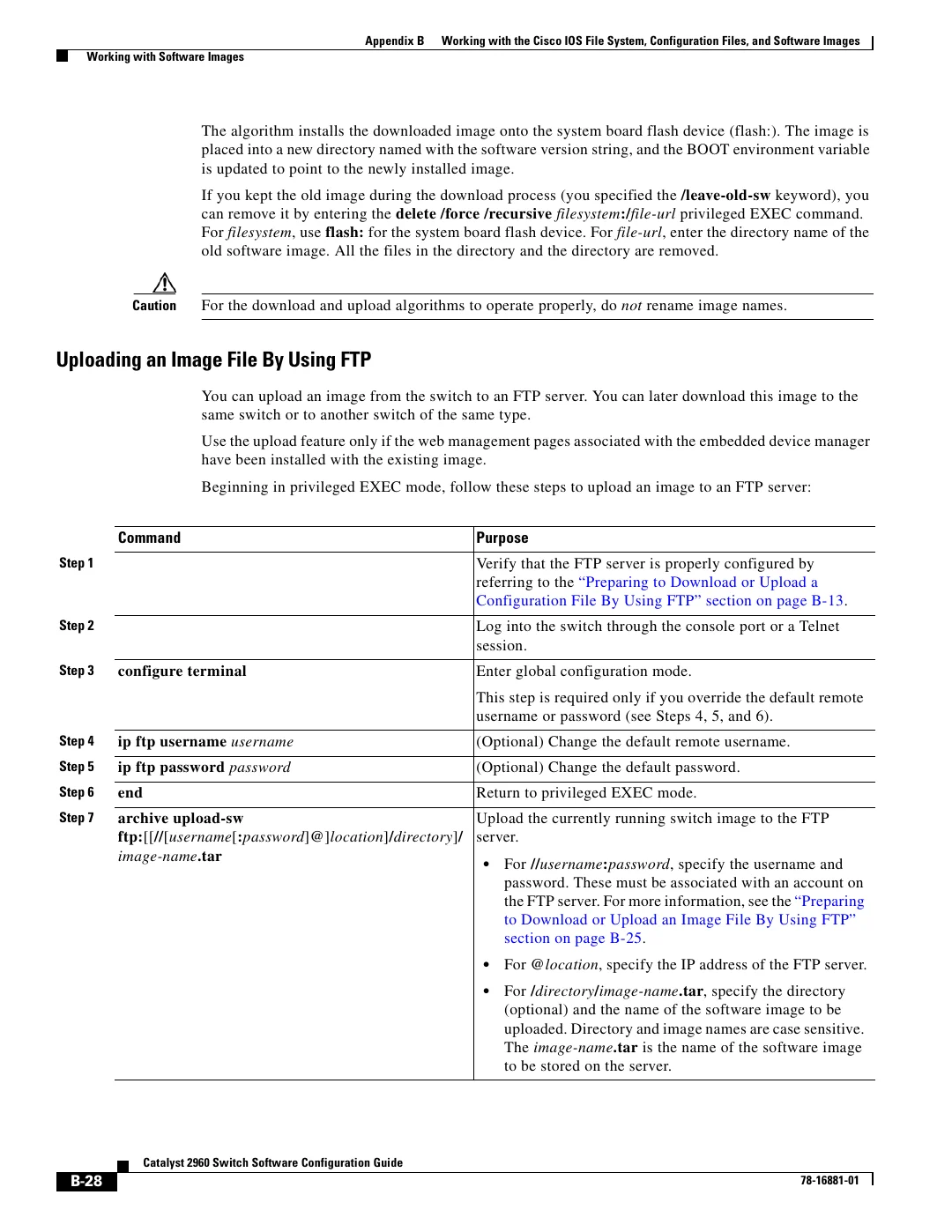
Beginning in privileged EXEC mode, follow these steps to upload an image to an FTP server:

Command

Purpose

Step 1

Verify that the FTP server is properly configured by 

referring to the 

“Preparing to Download or Upload a 

Configuration File By Using FTP” section on page B-13

.

Step 2

Log into the switch through the console port or a Telnet 

session.

Step 3

configure terminal

Enter global configuration mode.

This step is required only if you override the default remote 

username or password (see Steps 4, 5, and 6). 

Step 4

ip ftp username


username

(Optional) Change the default remote username.

Step 5

ip ftp password


password

(Optional) Change the default password.

Step 6

end

Return to privileged EXEC mode. 

Step 7

archive upload-sw 

ftp:

[[

//

[

username

[

:

password

]

@

]

location

]

/

directory

]

/

image-name

.tar


Upload the currently running switch image to the FTP 

server. 

•

For 

//

username

:

password

, specify the username and 

password. These must be associated with an account on 

the FTP server. For more information, see the 

“Preparing 

to Download or Upload an Image File By Using FTP” 

section on page B-25

.

•

For 

@

location

, specify the IP address of the FTP server.

•

For 

/

directory

/

image-name

.tar

, specify the directory 

(optional) and the name of the software image to be 

uploaded. Directory and image names are case sensitive. 

The 

image-name

.tar

 is the name of the software image 

to be stored on the server.

Page 628
Image 628
Open full-size image

2960 specifications

Cisco Systems 2960 series switches are a prominent solution in the networking landscape, known for their reliability, scalability, and feature-rich offerings. Ideal for small to medium-sized enterprises, these switches provide a robust foundation for network infrastructure, ensuring optimal performance and connectivity.

One of the standout features of the Cisco 2960 series is its Layer 2 switching capabilities. The switches support multiple VLANs (Virtual Local Area Networks), allowing network administrators to segment traffic efficiently and enhance security protocols. This is crucial in modern networks where managing traffic and isolating sensitive information is a priority.

The Cisco 2960 series also incorporates advanced Quality of Service (QoS) features, enabling the prioritization of critical applications and services. This functionality ensures that time-sensitive data, such as voice and video traffic, maintains a high quality of service even in congested networks. With support for IEEE 802.1p and DSCP marking, administrators can fine-tune their network performance to meet specific organizational needs.

Power over Ethernet (PoE) is another significant characteristic of the Cisco 2960 series. This feature allows switches to deliver electrical power alongside data over Ethernet cables to devices such as IP phones, wireless access points, and surveillance cameras. With PoE, organizations can reduce clutter from power cables and increase deployment flexibility for various devices.

In terms of security, the Cisco 2960 series is equipped with a range of integrated security features. The switch supports port security, 802.1X authentication, and Access Control Lists (ACLs), providing robust defenses against unauthorized access and potential network vulnerabilities. These security measures are essential for protecting sensitive data and ensuring compliance with industry regulations.

Moreover, the Cisco 2960 series offers enhanced network management capabilities with Cisco's Intelligent Network Services. This includes support for Simple Network Management Protocol (SNMP), Cisco Prime, and Embedded Event Manager (EEM), allowing for efficient monitoring, troubleshooting, and policy enforcement across the network.

Additionally, the Cisco 2960 switches provide various models and configurations, catering to different networking needs. Options include models with varying port densities, uplink configurations, and stacking capabilities, making it easy for organizations to choose solutions that align perfectly with their requirements.

In summary, the Cisco 2960 series is a versatile and essential component of modern networking environments. Its advanced features, including Layer 2 support, QoS, PoE, robust security, and diverse management tools, make it an excellent choice for organizations looking to build a strong and secure network infrastructure.