HP Fortran allocates static storage for the following variables:
•Variables specified in a COMMON or EQUIVALENCE statement.
•Variables initialized in a type declaration statement or in a DATA statement.
•Variables specified in a SAVE or STATIC statement. A SAVE statement without a variable list specifies static storage for all variables in the scoping unit.
•Variables in program files that have been compiled with the +saveor
Static variables have two characteristics that are of special interest:
•They are set to 0 or null value at
•They do not require
Static variables have several disadvantages. In Fortran programs that use recursion, static variables can defeat one purpose of
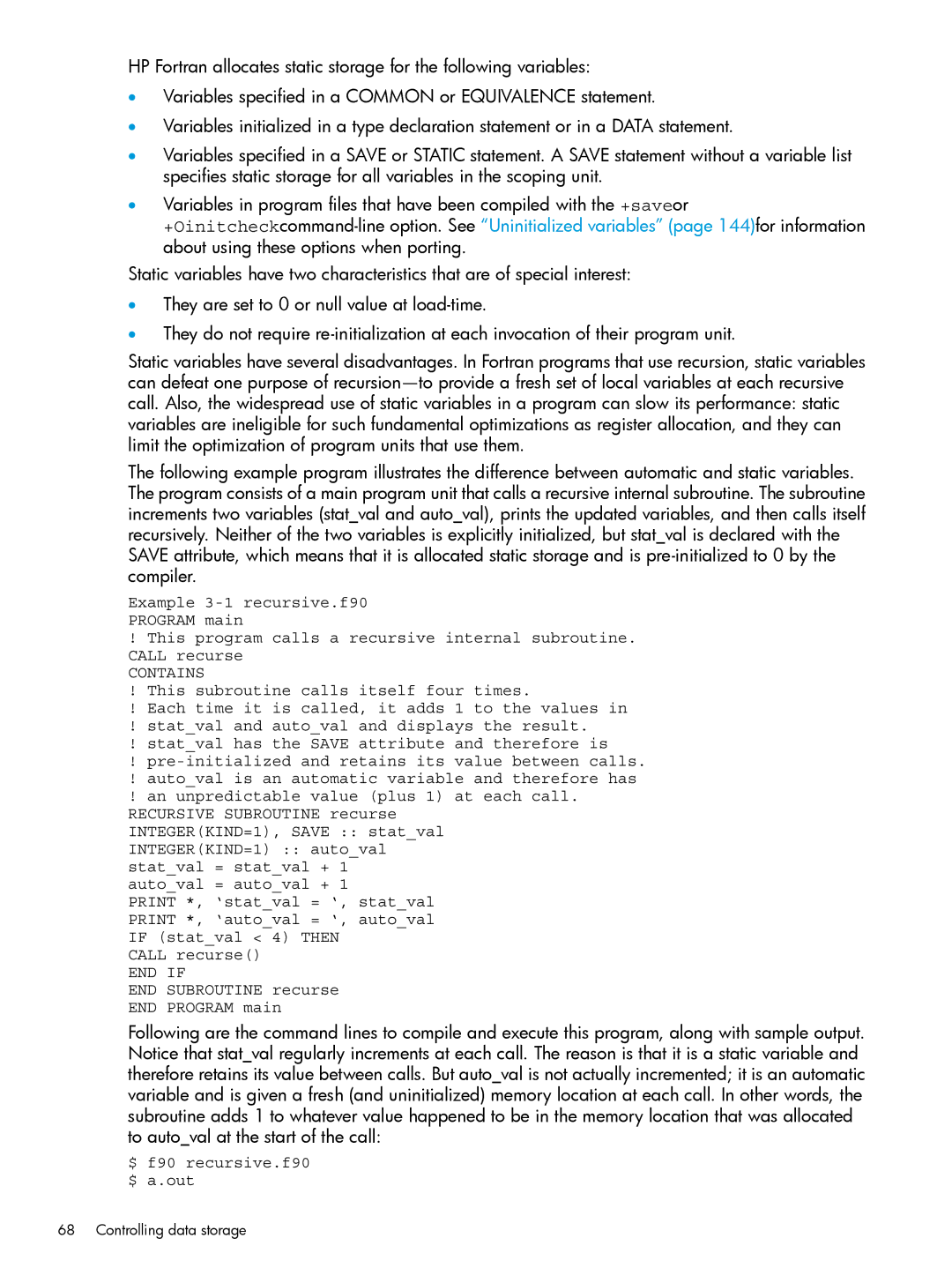
The following example program illustrates the difference between automatic and static variables. The program consists of a main program unit that calls a recursive internal subroutine. The subroutine increments two variables (stat_val and auto_val), prints the updated variables, and then calls itself recursively. Neither of the two variables is explicitly initialized, but stat_val is declared with the SAVE attribute, which means that it is allocated static storage and is
Example
PROGRAM main
!This program calls a recursive internal subroutine. CALL recurse
CONTAINS
!This subroutine calls itself four times.
!Each time it is called, it adds 1 to the values in
!stat_val and auto_val and displays the result.
!stat_val has the SAVE attribute and therefore is
!
!auto_val is an automatic variable and therefore has
!an unpredictable value (plus 1) at each call. RECURSIVE SUBROUTINE recurse INTEGER(KIND=1), SAVE :: stat_val INTEGER(KIND=1) :: auto_val
stat_val = stat_val + 1 auto_val = auto_val + 1
PRINT *, ‘stat_val = ‘, stat_val PRINT *, ‘auto_val = ‘, auto_val IF (stat_val < 4) THEN
CALL recurse()
END IF
END SUBROUTINE recurse END PROGRAM main
Following are the command lines to compile and execute this program, along with sample output. Notice that stat_val regularly increments at each call. The reason is that it is a static variable and therefore retains its value between calls. But auto_val is not actually incremented; it is an automatic variable and is given a fresh (and uninitialized) memory location at each call. In other words, the subroutine adds 1 to whatever value happened to be in the memory location that was allocated to auto_val at the start of the call:
$ f90 recursive.f90 $ a.out