Program Execution Controls |
DO loops may be nested, that is, a DO loop can contain another DO loop, etc. If a DO statement appears within the range of another DO loop, the loop specified by the second DO statement must be within the range of the outer DO loop. DO loops can share the same last statement.
If a DO statement lies within an IF block, ELSE IF block, or ELSE block, the range of the DO loop must be entirely within that block.
I f a block IF statement is within the range of a DO loop, its corresponding END IF statement must also be within the range of the DO loop.
Examples:
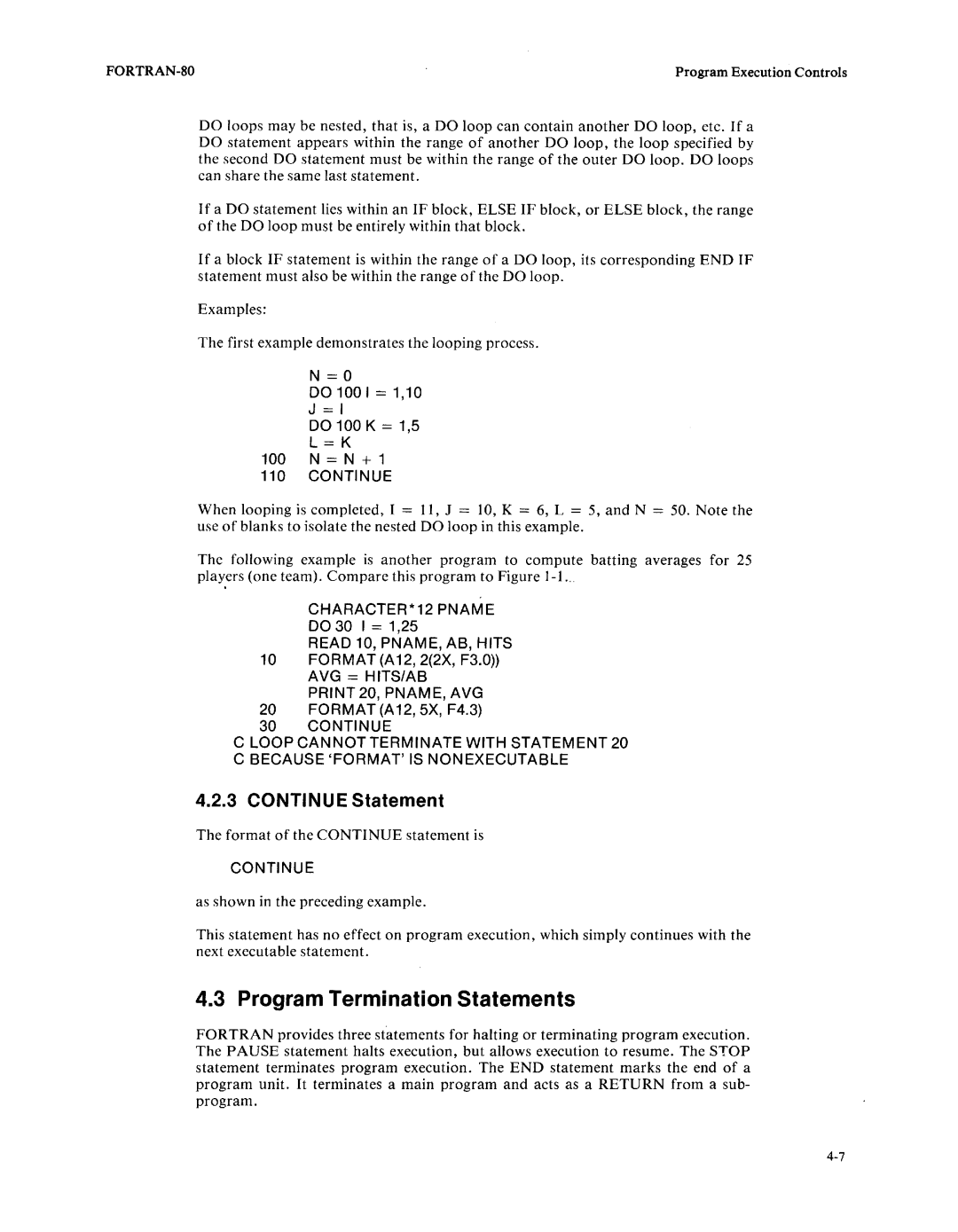
The first example demonstrates the looping process.
N=O
DO 100 I == 1,10
J = I
DO 100 K = 1,5
L=K
100N = N + 1
110CONTINUE
When looping is completed~ I = 11, J = 10, K = 6, L = 5, and N = 50. Note the use of blanks to isolate the nested DO loop in this example.
The following example is another program to compute batting averages for 25
players (one team). Compare this program to Figure
CHARACTER*12 PNAME
DO 30 1=1,25
READ 10, PNAME, AB, HITS
10FORMAT (A12, 2(2X, F3.0))
AVG = HITS/AB
PRINT 20, PNAME, AVG
20FORMAT (A12, 5X, F4.3)
30CONTINUE
CLOOP CAN NOT TERM INATE WITH STATEM ENT 20 C BECAUSE 'FORMAT'IS NONEXECUTABLE
4.2.3CONTINUE Statement
The format of the CONTINUE statement is
CONTINUE
as shown in the preceding example.
This statement has no effect on program execution, which simply continues with the next executable statement.
4.3 Program Termination Statements
FORTRAN provides three statements for halting or terminating program execution. The PAUSE statement halts execution, but allows execution to resume. The STOP statement terminates program execution. The END statement marks the end of a program unit. It terminates a main program and acts as a RETURN from a sub- program.