Fluke 196C/199C
Page
Limited Warranty & Limitation of Liability
Service Centers
Table of Contents
Using The Recorder Functions
Using The Multimeter
Using Replay, Zoom and Cursors
Fluke 196C/199C
Iii
Specifications
Manufacturer
Declaration of Conformity
Statement of Conformity
Sample tests
ScopeMeter Test Tool Kit
Unpacking the Test Tool Kit
# Description
Battery Charger country dependent
Safety Information Read First
Safety Information Read First
Use of the test tool in a manner not specified may
If Safety Features are Impaired
Impair the protection provided by the equipment
Powering the Test Tool
Using The Scope
About this Chapter
Screen After Reset
Resetting the Test Tool
Open the Waveform Options
Navigating a Menu
Input Connections
Hiding Key Labels and Menus
Scope Connections
Making Scope Connections
Screen After an Auto Set
Displaying an Unknown Signal with Connect-and-View
Making Automatic Scope Measurements
Hz and V peak-peak as Scope Readings
Freezing the Screen
Using Average for Smoothing Waveforms
Using Average, Persistence and Glitch Capture
Open the Waveform Options menu
Persistence... menu
Using Persistence to Display Waveforms
Digital Persistence Infinite
Envelope Off
Suppressing High Frequency Noise
Displaying Glitches
Selecting AC-Coupling
Acquiring Waveforms
Reversing the Polarity of the Displayed Waveform
Open the Input a Options
Variable Input Sensitivity
Menu
Select and accept Variable
Working with Noisy Waveforms
Using Waveform Mathematics Functions
Select 10kHz HF reject to
Comparing Waveforms
Analyzing Waveforms
Making Meter Connections
Using The Multimeter
Measuring Resistance Values
Making Multimeter Measurements
Open the Measurement menu
Making a Current Measurement
Highlight a ac
Open the Current Probe
Ampere Measurement Readings
Selecting Auto/Manual Ranges
Freezing the Readings
Activate manual ranging
Increase or decrease the range
Making a Relative Measurement
Making Relative Measurements
Opening the Recorder Main Menu
Using The Recorder Functions
Starting a TrendPlot Function
Plotting Measurements Over Time TrendPlot
Highlight Trend Plot Scope
TrendPlot Reading
Displaying Recorded Data
Turning Off the TrendPlot Display
Changing the Recorder Options
Open the Recorder Options
Exit the recorder function
Starting a Scope Record Function
Recording Scope Waveforms In Deep Memory Scope Record
Highlight Scope Record
Using ScopeRecord in Single Sweep Mode
Using External Triggering to Start or Stop Scope Record
Triggered Single Sweep Recording
Analyzing a TrendPlot or Scope Record
Replaying the 100 Most Recent Scope Screens
Using Replay, Zoom and Cursors
Replaying a Waveform
Replaying Step-by-Step
Turning Off the Replay Function
Replaying Continuously
Capturing 100 Intermittents Automatically
Zooming in a Waveform
Zooming in on a Waveform
Turning Off the Zoom Function
Displaying the Zoomed Waveform
Making Cursor Measurements
Using Horizontal Cursors on a Waveform
Turn off the cursors
Using Vertical Cursors on a Waveform
Making Rise Time Measurements
Using Cursors on a A+B, A-B or A*B Waveform
Triggering on Waveforms
Screen with all Trigger Information Adjust the trigger level
Setting Trigger Level and Slope
Trigger Delay or Pre-trigger View
Using Trigger Delay or Pre-trigger
Open the Trigger Options menu
Automatic Trigger Options
Open the Automatic Trigger
Open the Trigger Options menu Open the Trigger on Edge menu
Triggering on Edges
Select Free Run, jump to Noise
Reject Filter
Making a Single Acquisition
Triggering on Noisy Waveforms
Making a Single Shot Measurement
Select 1.2V under the Ext Level
Triggering on External Waveforms
Label
Select Video on a to open
Triggering on Video Signals
Trigger on Video menu
Triggering on Video Frames
Enable video line selection
Triggering on Video Lines
Choose Field
Detecting Narrow Pulses
Triggering on Pulses
Select Pulse Width on A... to
Open the Trigger on Pulse Width
Tip
Finding Missing Pulses
Triggering on Missing Pulses
Saving and Recalling
Using Memory, PC and Printer
Highlight SCREEN+SETUP location
Saving Screens with Associated Setups
Display the SAVE/PRINT key labels
Save the actual screen
Open the Recall menu
Recalling a Setup Configuration
Documenting Screens
Connecting to a Computer
Viewing Stored Screens
Open the View... menu
Connecting a Serial Printer
Connecting to a Printer
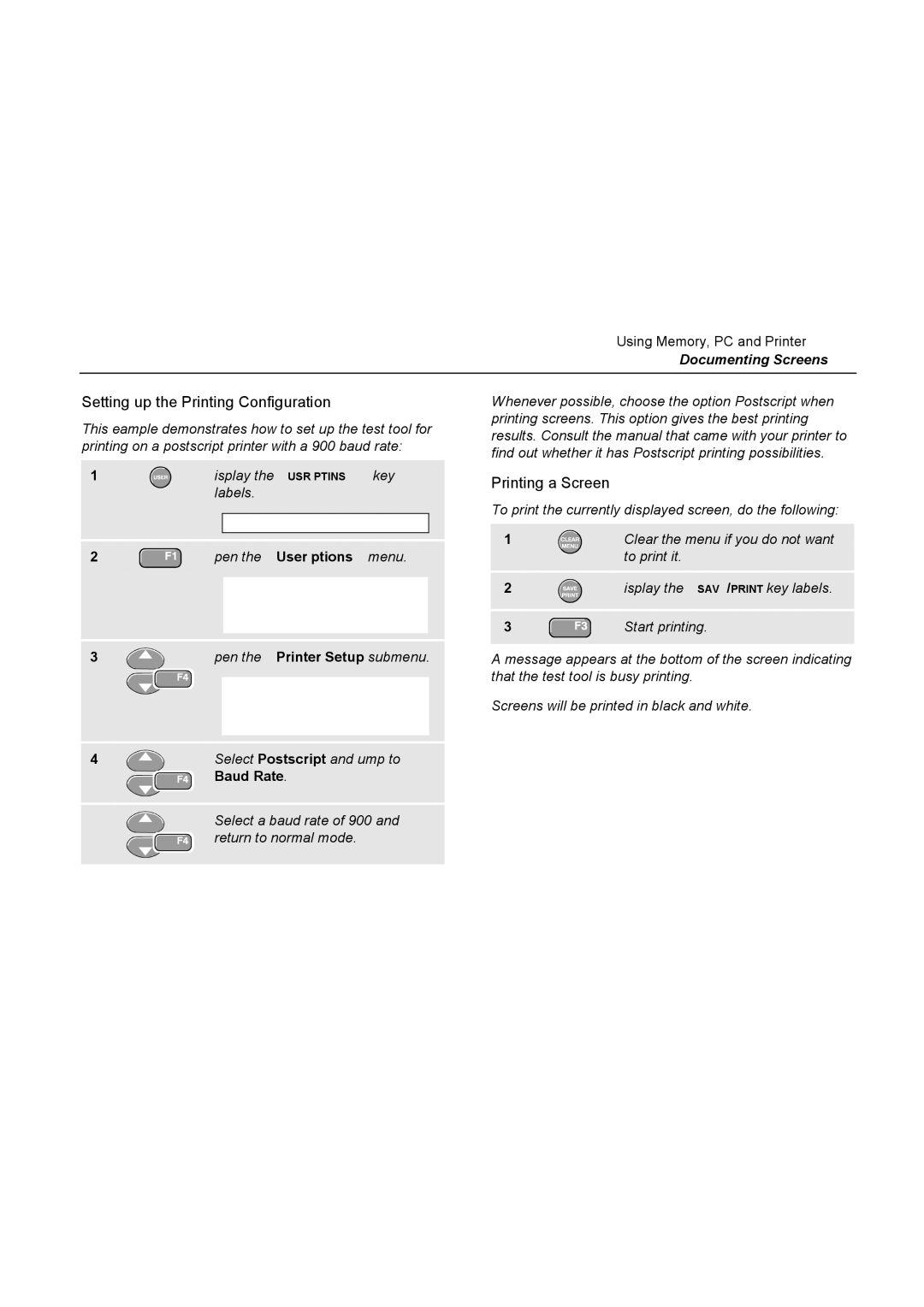
Open the Printer Setup submenu
Setting up the Printing Configuration
Printing a Screen
Baud Rate
Fluke 196C/199C
Tips
Using the Standard Accessories
Heavy Duty Fixed Connections for Scope
Probing Using 2-mm Heavy Duty Test Probes
Tips
Measuring Using Independently Floating Isolated Inputs
Using the Independently Floating Isolated Inputs
Parasitic capacitance between analog Digital reference
Suppressing Key Labels and Menu’s
Using the Tilt Stand
Turn the test tool off
Press and hold
Changing the Information Language
Adjusting the Contrast and Brightness
Open the Language Select
Accept French as the language
Changing the Display Color
Open Display Options menu Open Date Adjust menu
Changing Date and Time
Setting the Power Down Timer
Saving Battery Life
Changing the Auto Set Options
Open the Auto Set Adjust menu
To Coupling
Select Unchanged
Maintaining the Test Tool
Cleaning the Test Tool
Storing the Test Tool
Charging the Batteries
Charging the Batteries
Start the refresh cycle
Extending Battery Operation Time
Calibrating the Voltage Probes
Replacing the NiMH Battery Pack BP190
Start the probe calibration
Maintaining the Test Tool
Standard Accessories
Parts and Accessories
Displaying Calibration Information
Open the Version & Calibration
Standard Accessories Ordering Code
TL24 General Purpose Leads
Ordering Code
Ordering Code
SW90W
Optional Accessories
Troubleshooting
FlukeView Does Not Recognize The Test Tool
Battery Operated Fluke Accessories Do Not Function
Performance Characteristics
Specifications
Safety Characteristics
Introduction
Isolated Inputs a and B Vertical
Dual Input Oscilloscope
Horizontal
Automatic Connect-and-View Trigger
Trigger and Delay
Edge Trigger
Isolated External Trigger
Automatic Scope Measurements