Planning the Network
Infrastructure Network Types
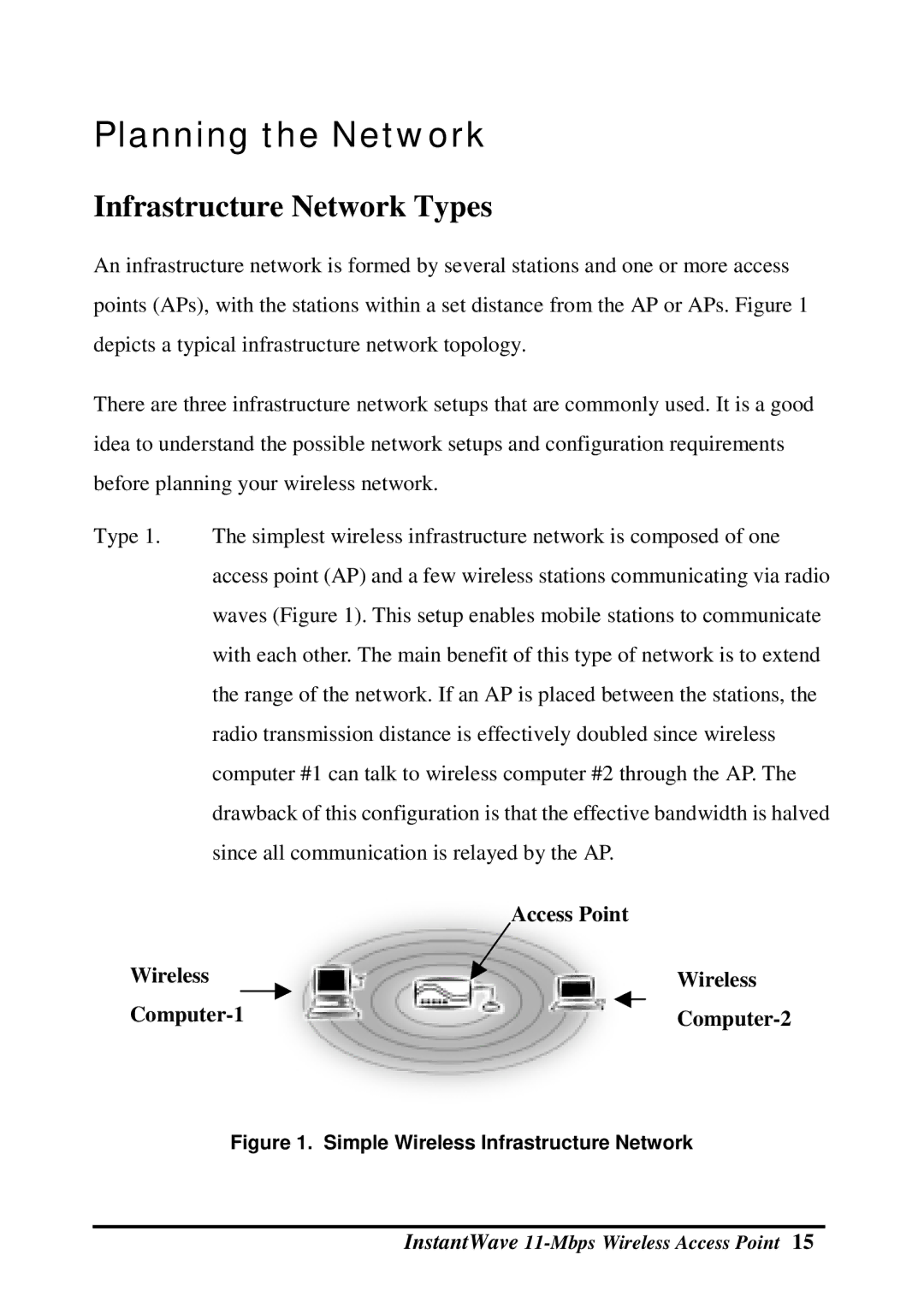
An infrastructure network is formed by several stations and one or more access points (APs), with the stations within a set distance from the AP or APs. Figure 1 depicts a typical infrastructure network topology.
There are three infrastructure network setups that are commonly used. It is a good idea to understand the possible network setups and configuration requirements before planning your wireless network.
Type 1. The simplest wireless infrastructure network is composed of one access point (AP) and a few wireless stations communicating via radio waves (Figure 1). This setup enables mobile stations to communicate with each other. The main benefit of this type of network is to extend the range of the network. If an AP is placed between the stations, the radio transmission distance is effectively doubled since wireless computer #1 can talk to wireless computer #2 through the AP. The drawback of this configuration is that the effective bandwidth is halved since all communication is relayed by the AP.
|
| Access Point | ||
Wireless |
|
|
| Wireless |
|
|
|
| |
|
| |||
Figure 1. Simple Wireless Infrastructure Network
InstantWave