Registration Assistance
Sony Pictures Digital Inc
Table of Contents
Toolbars
Command descriptions Meters
Main screen
Data window
Editing audio
Using undo and redo
Creating a new data window
Saving a file
Zooming and magnifying
Selecting audio using start and end values
Selecting audio during playback Fine-tuning a selection
Creating and using views
Changing the bit depth
Why use markers, regions, and the playlist?
Using markers
Using command markers in streaming media files
Recording audio
Using regions
Using the Regions List
Using the playlist
Burning CDs
Finding and repairing audio glitches
Applying presets
Extracting audio from CDs
DC Offset
Sound Forge processes Auto Trim/Crop
Bit-Depth Converter
Channel Converter
Adding a chain of effects
Swap Channels Time Stretch Volume
Adjusting envelopes
Adding an effect
What is Wave Hammer?
What is Acoustic Mirror?
Using impulse files in creative ways
Troubleshooting Acoustic Mirror
Samplers
Using the Midi Keyboard
Midi triggers
Sound Forge and Midi timecode synchronization
Crossfading loops
Loops
Looping techniques
Editing loops
Working in the frequency domain
Using a spectrum graph
Using a sonogram
Adjusting Spectrum Analysis settings
Saving files
About Ircam files About Bicsf and Ebicsf files Opening files
Full version of Sound Forge versus Screenblast Sound Forge
Introduction
Introducing Sound Forge
Sample files
Online help
Installing Sound Forge
System requirements
Getting help within Sound Forge
What’s This? help
About your rights in Sound Forge software
Help on the Web
About Your Privacy Proper Use of Software
Increasing total buffer size
Optimizing for
Sound Forge
Defragmenting your hard drive
Turning on passive updating for video and time displays
Increasing preload size
Turning off the playback cursor and record counter
Turning off the play output meters
Turning on passive updating for video displays
Optimizing for Sound Forge
Learning the Sound
Using the mouse
Forge Workspace
Main screen
Using the mouse wheel
Main screen components
Floating and docking windows
Shortcut key Description
Component Description
Data window
Playbar
Displaying data window components
Displaying a toolbar
Toolbars
Docking a toolbar
Floating a toolbar
Transport bar
Standard toolbar
Views toolbar
Navigation toolbar
Regions/Playlist toolbar
Status/Selection toolbar
Process toolbar
Effects toolbar
Levels toolbar
Tools toolbar
Acid Loop Creation Tools toolbar
Turning off ToolTips
Command descriptions
ToolTips
Play Device toolbar
Meters
Resetting clipping indicators
Scaling meters
Scale Integration time
Displaying VU/PPM meters
Showing labels
Holding peaks and valleys
Faders and sliders
Controls
Envelope graphs
To select or clear all envelope points
Displaying the waveform on an envelope graph
Stereo files
Working with stereo files
Selecting data in stereo files
Toggling channel selections
Single-channel editing
Creating a project
Getting Started
Getting media files
Using the Open dialog
Using the Explorer window
Peak files
Working with video files
Viewing the current position
Playing a file
Playing a file from a specified point
Playing a selection
Playing in Loop Playback mode
Viewing selection status
Viewing selection statistics
Creating a new data window
Active data windows vs. inactive data windows
Saving a file
Copying data to a new file
Using the Save As dialog
Saving all open audio files
Creating custom templates
Saving files as a workspace
Editing audio
Copying
Cutting
Pasting
Deleting
Mixing
Trimming/Cropping
Using undo and redo
Using the Undo/Redo History window
Play the pre-mix file
Format name Description
Selecting status formats
Experimenting with status formats
Configuring the Measures & Beats format
Exporting to Net MD devices
Rendering files
Exporting to Clié handheld devices
Recovering files
Recovering files after a crash
Deleting recovered files
Navigating Zooming, Selecting
Setting the cursor position
Previewing audio with pre-roll
Using the overview bar
Understanding the overview bar
Navigating in the overview bar
Playing audio in the overview bar
Zooming and magnifying
Navigating with the audio event locator
Zooming the time ruler horizontal
Full
Zooming the level ruler vertical
Formatting the level ruler
Using custom zoom settings
Using the Magnify tool
Using zooming shortcuts
Zooming the time ruler with the Magnify tool
Using the Set Selection dialog
Selecting audio using start and end values
Selecting audio during playback
Fine-tuning a selection
Adjusting a selection with the mouse
Adjusting a selection with the keyboard
Understanding snapping
Creating and using views
Creating views
Displaying the Views toolbar
NAVIGATING, ZOOMING, and Selecting
Editing attributes in the status bar
Changing File Attributes Formats
Editing file attributes
Editing attributes in the Properties dialog
Changing the bit depth
Changing the sample rate
Increasing bit depth
Understanding dither and noise shaping
Decreasing bit depth
Minimizing quantization error
Converting from mono to stereo
Converting mono/stereo channels
Save as type
Using the Channel Converter
Converting file formats
Converting from stereo to mono
Viewing and editing summary information
Adding summary information
Viewing extended summary information
Saving summary information
Editing extended summary information
Including additional embedded information
Why use markers, regions, and the playlist?
Using Markers Regions, Playlist/Cutlist
Inserting markers
Using markers
Naming markers
Customizing automatic labeling
Changing the marker position
Detecting and marking clipping
Using markers to create regions
Defining streaming media commands
Using command markers in streaming media files
Command Player type Description
Inserting command markers
Defining Scott Studios data commands
Command Description
Deleting command markers
Editing command properties
Saving command properties as a custom template
Moving the cursor to a command marker
Auto Trim/Crop controls
Using Auto Trim/Crop
Preset Description
Auto Trim/Crop
Minimum inter-phrase silence
Bit-Depth Converter
Converting a file’s bit depth
Channel Converter
Control Description
Channel Converter controls
Estimating DC Offset
DC Offset
DC Offset controls
Creating a graphic fade
Fade Graphic fade
Creating a custom graphic fade
Fade Fade
Graphic Fade Controls
Insert Silence controls
Fade Fade Out
Insert Silence
Inserting silence into a file
Muting an audio selection
Invert/Flip
Mute
Normalize
Normalize Controls
Normalizing Audio
Normalize to
Option Description
Pan/Expand
Creating a custom pan
Creating a pan
Pan/Expand controls
Resample
Upsampling audio
Downsampling audio
Resample controls
Smooth/Enhance
Reverse
Time Stretch
Volume
Increasing the volume of a selection
Swap Channels
Volume control
168
Adding an effect
Applying Effects
Adding a chain of effects
Saving effect settings as a custom preset
Applying effects using the Plug-In Chainer
Adding plug-ins to a chain
Selecting the processing mode for audio tail data
Bypassing effects
Arranging plug-ins on a chain
Saving plug-in chains
Configuring chained plug-ins
Saving individual plug-in settings as a custom preset
Removing plug-ins from a chain
Managing effects
Using the Plug-In Manager window
Loading plug-in chains
Organizing effects in the DX Favorites menu
Using the Preset Manager
Automating Effect Parameters
Adding a volume or panning envelope
Adding an effect automation envelope
Showing or hiding effect automation envelopes
Adjusting effect parameters with envelopes
Previewing effect automation
Applying effects automation
Flipping an envelope
Adjusting envelopes
Removing effect automation envelopes
Adding envelope points
Cutting, copying, and pasting envelope points
Setting fade properties
Copying an envelope to another data window
182
Adding an acoustic signature to an audio file
What is Acoustic Mirror?
Acoustic signature
Adjusting the acoustic signature
General tab controls
Acoustic Mirror dialog
Envelope tab controls
Summary tab controls
Forge CD-ROM
Recover tab controls
What you need to create custom impulses
Creating impulse files
Recording the impulse through an electronic device
Recording the impulse in an acoustic space
Recovering the impulse
Adding summary information to your impulse file
Trimming the impulse file
Adding realistic stereo to mono recordings
Using impulse files in creative ways
Using the new impulse file
Processing individual audio elements
Panning with head-related transfer functions
Recreating spaces for foley effects and dialog replacement
File Name Impulse positioning
Impulses do not recover properly
Troubleshooting Acoustic Mirror
Stuttering during real-time previewing
Error message explanations
Recovered impulse is too noisy
Compressor tab
What is Wave Hammer?
Wave Hammer dialog
Displaying Wave Hammer
Attack time
Updating a spectrum graph
Changing the zoom level
Viewing multiple spectrum graphs
Printing the graph
Displaying a sonogram
Using a sonogram
Updating a sonogram
Tuning a sonogram
Returning to a spectrum graph
Adjusting Spectrum Analysis settings
Printing the sonogram
Frequency minimum
Saving spectrum graph settings
256
Keyboard shortcuts
Project file commands
Magnification and view commands
Shortcuts
+ P
Data window edit commands
259
Press
Press Cursor moves to
Cursor movement
+ +
+ L
Selecting data
Press To select from cursor to
+ Z
+ F7
Navigation and playback
Record dialog keyboard shortcuts
+ K
Regions List
Plug-In Chainer
Playlist
Additional mouse shortcuts
Mouse wheel shortcuts
Mouse wheel action Result
Hold Ctrl and click to preview a Cut operation. Hold
266
Audio data compression and decompression
Microsoft Audio Compression Manager
268
Smpte Non-Drop Frame 29.97 fps, Video
Smpte Timecode
Smpte 25 EBU 25 fps, Video
Smpte Drop Frame 29.97 fps, Video
Smpte Film Sync 24 fps
Smpte 30 30 fps, Audio
About Bicsf and Ebicsf files
Using Csound
Ebicsf Files
About Ircam files
Saving files
122
Index
Cursor position Custom graphic fade
Csound
Iii
MIDI/SDS SCSI/SMDI
Index
Plug-ins,See Effects
Preload size Pre-roll to cursor Preset Manager
Vii
Viii
Displaying Effects Levels Navigation Play Device
SCSI/SMDI

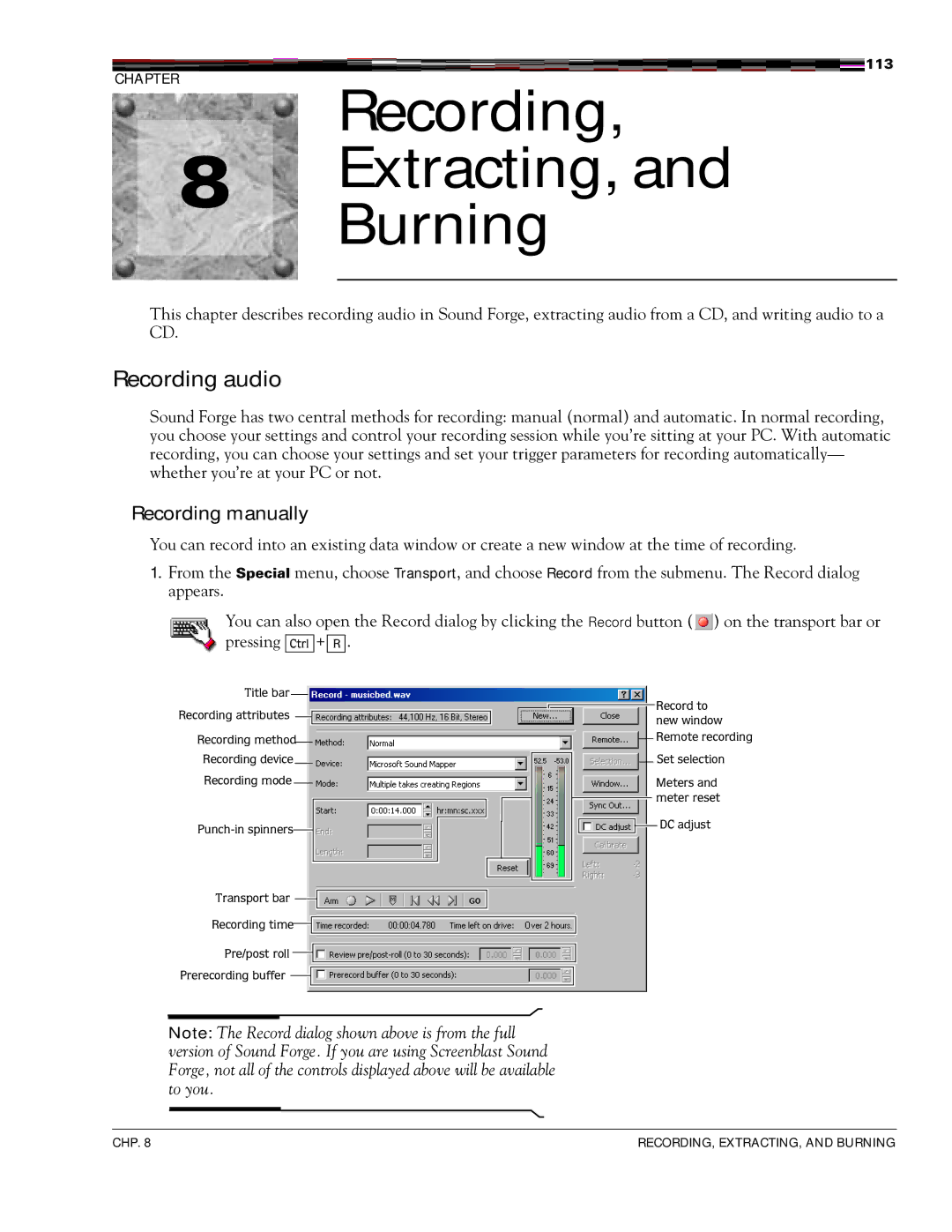
 ) on the transport bar or pressing Ctrl + R .