|
| Security Service Commands |
|
| |
TABLE | (Continued) | |
| Command | Definition |
|
|
|
| Deletes an XSLT transformation rule of a given web service. | |
|
|
|
| Lists all the transformation rules of a given web service in the order | |
|
| they are applied. |
|
|
|
| Publishes the web service artifacts to registries. | |
|
|
|
| Unpublishes the web service artifacts from the registries. | |
|
|
|
| Displays a list of configured web service registry access points. | |
|
|
|
Security Service Commands
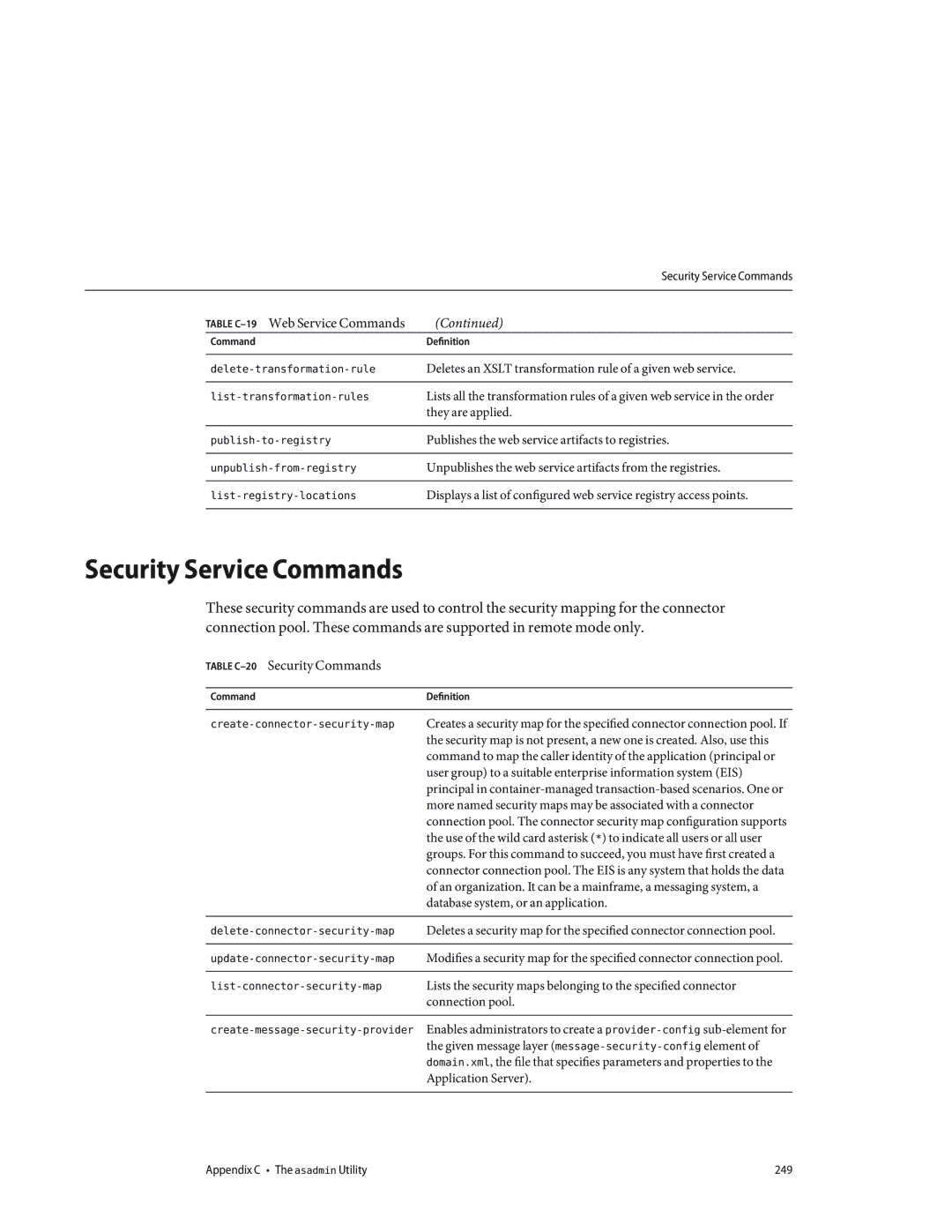
These security commands are used to control the security mapping for the connector connection pool. These commands are supported in remote mode only.
TABLE C–20 Security Commands
Command | Definition |
|
|
Creates a security map for the specified connector connection pool. If | |
| the security map is not present, a new one is created. Also, use this |
| command to map the caller identity of the application (principal or |
| user group) to a suitable enterprise information system (EIS) |
| principal in |
| more named security maps may be associated with a connector |
| connection pool. The connector security map configuration supports |
| the use of the wild card asterisk (*) to indicate all users or all user |
| groups. For this command to succeed, you must have first created a |
| connector connection pool. The EIS is any system that holds the data |
| of an organization. It can be a mainframe, a messaging system, a |
| database system, or an application. |
|
|
Deletes a security map for the specified connector connection pool. | |
|
|
Modifies a security map for the specified connector connection pool. | |
|
|
Lists the security maps belonging to the specified connector | |
| connection pool. |
|
|
Enables administrators to create a | |
| the given message layer |
| domain.xml, the file that specifies parameters and properties to the |
| Application Server). |
|
|
Appendix C • The asadmin Utility | 249 |