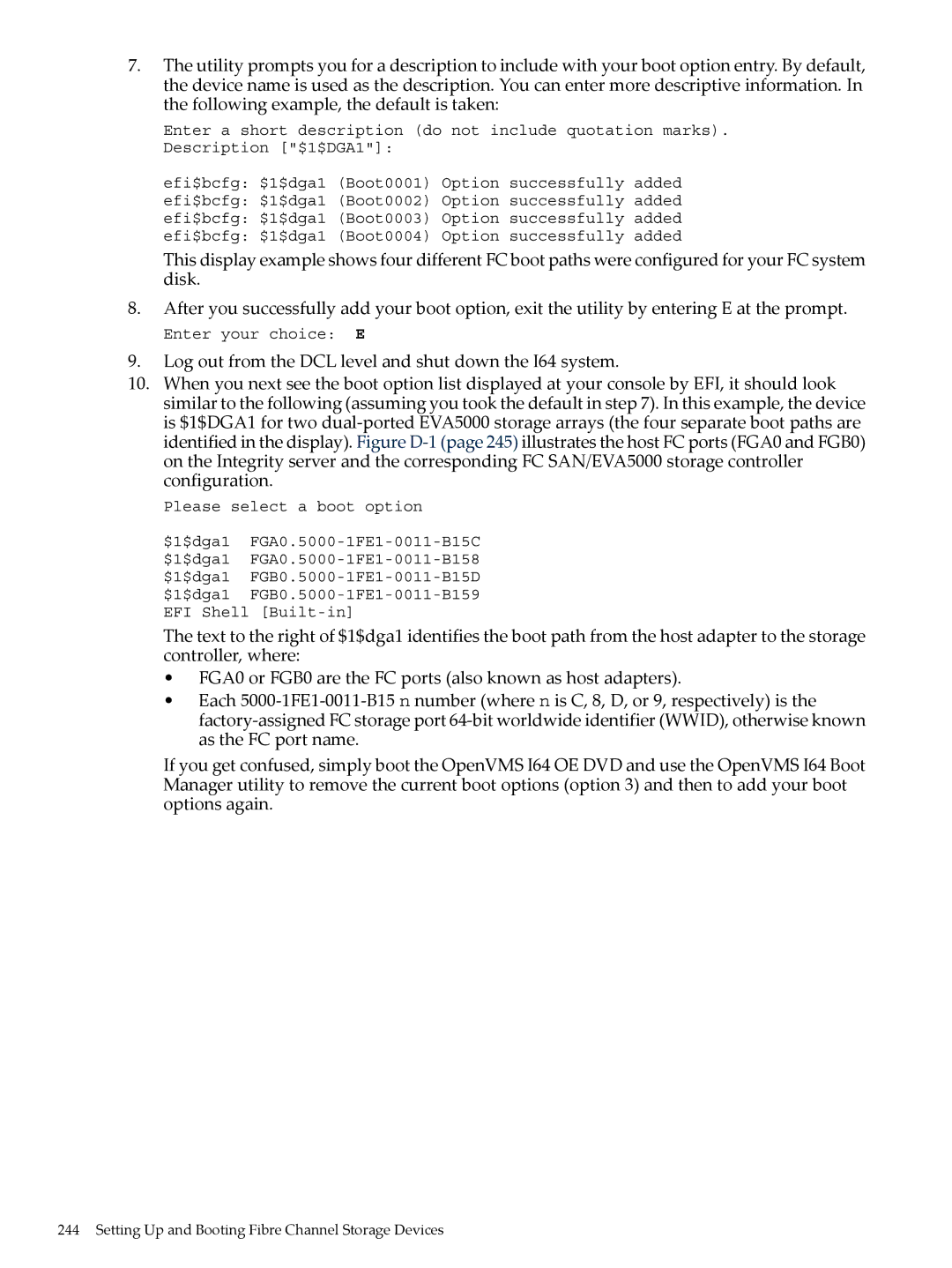
7.The utility prompts you for a description to include with your boot option entry. By default, the device name is used as the description. You can enter more descriptive information. In the following example, the default is taken:
Enter a short description (do not include quotation marks). Description ["$1$DGA1"]:
efi$bcfg: $1$dga1 (Boot0001) Option successfully added
efi$bcfg: $1$dga1 (Boot0002) Option successfully added
efi$bcfg: $1$dga1 (Boot0003) Option successfully added
efi$bcfg: $1$dga1 (Boot0004) Option successfully added
This display example shows four different FC boot paths were configured for your FC system disk.
8.After you successfully add your boot option, exit the utility by entering E at the prompt.
Enter your choice: E
9.Log out from the DCL level and shut down the I64 system.
10.When you next see the boot option list displayed at your console by EFI, it should look similar to the following (assuming you took the default in step 7). In this example, the device is $1$DGA1 for two
Please select a boot option
$1$dga1
The text to the right of $1$dga1 identifies the boot path from the host adapter to the storage controller, where:
•FGA0 or FGB0 are the FC ports (also known as host adapters).
•Each
If you get confused, simply boot the OpenVMS I64 OE DVD and use the OpenVMS I64 Boot Manager utility to remove the current boot options (option 3) and then to add your boot options again.
244 Setting Up and Booting Fibre Channel Storage Devices