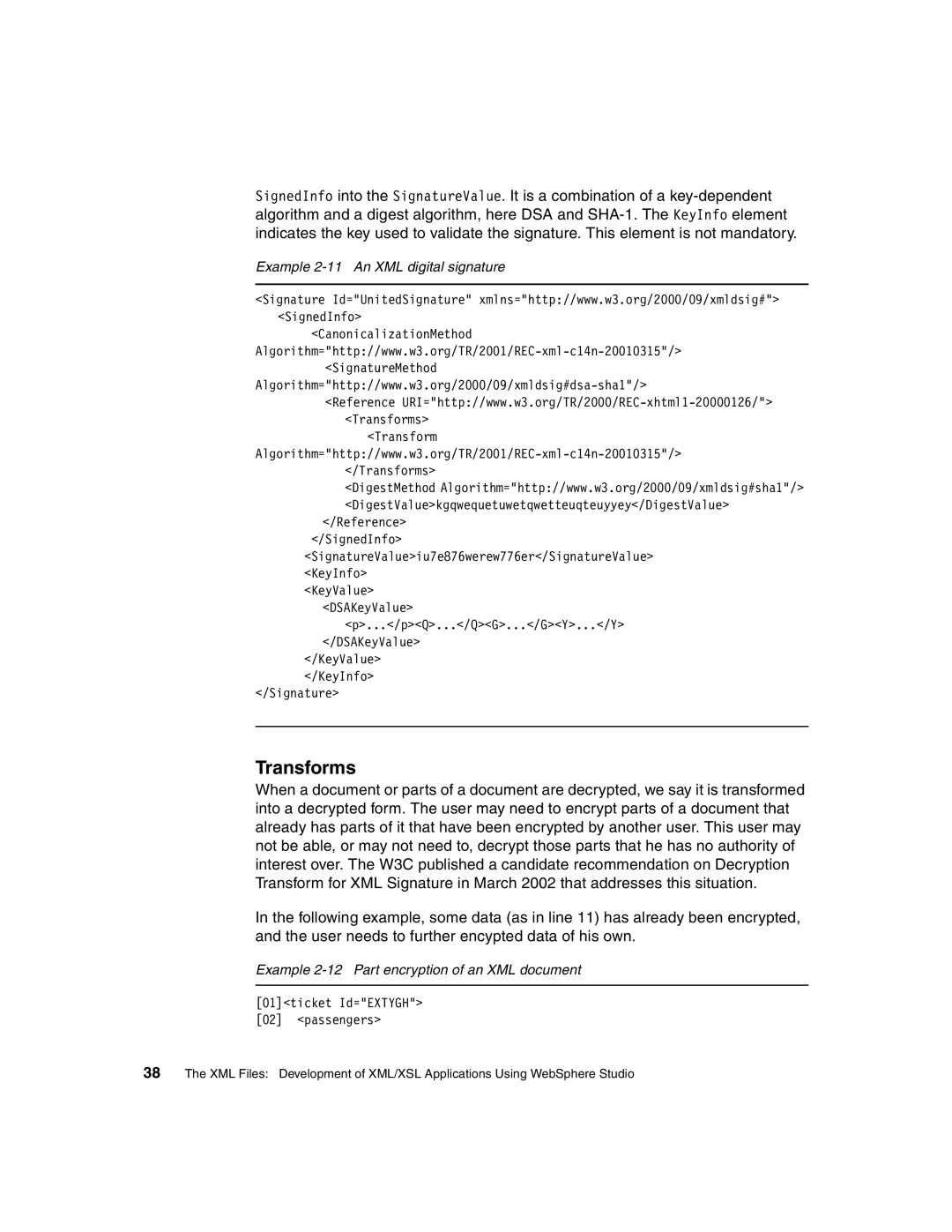
SignedInfo into the SignatureValue. It is a combination of a
Example 2-11 An XML digital signature
<Signature Id="UnitedSignature" xmlns="http://www.w3.org/2000/09/xmldsig#"> <SignedInfo>
<CanonicalizationMethod
<SignatureMethod
<Reference
<Transform
</Transforms>
<DigestMethod Algorithm="http://www.w3.org/2000/09/xmldsig#sha1"/> <DigestValue>kgqwequetuwetqwetteuqteuyyey</DigestValue>
</Reference>
</SignedInfo>
<SignatureValue>iu7e876werew776er</SignatureValue>
<KeyInfo>
<KeyValue>
<DSAKeyValue> <p>...</p><Q>...</Q><G>...</G><Y>...</Y>
</DSAKeyValue>
</KeyValue>
</KeyInfo>
</Signature>
Transforms
When a document or parts of a document are decrypted, we say it is transformed into a decrypted form. The user may need to encrypt parts of a document that already has parts of it that have been encrypted by another user. This user may not be able, or may not need to, decrypt those parts that he has no authority of interest over. The W3C published a candidate recommendation on Decryption Transform for XML Signature in March 2002 that addresses this situation.
In the following example, some data (as in line 11) has already been encrypted, and the user needs to further encypted data of his own.
Example 2-12 Part encryption of an XML document
[01]<ticket Id="EXTYGH">
[02]<passengers>
38 The XML Files: Development of XML/XSL Applications Using WebSphere Studio