MST Specifications
Using 802.1s Multiple Spanning Tree
page 6-2
OmniSwitch 6600 Family Network Configuration Guide
April 2006
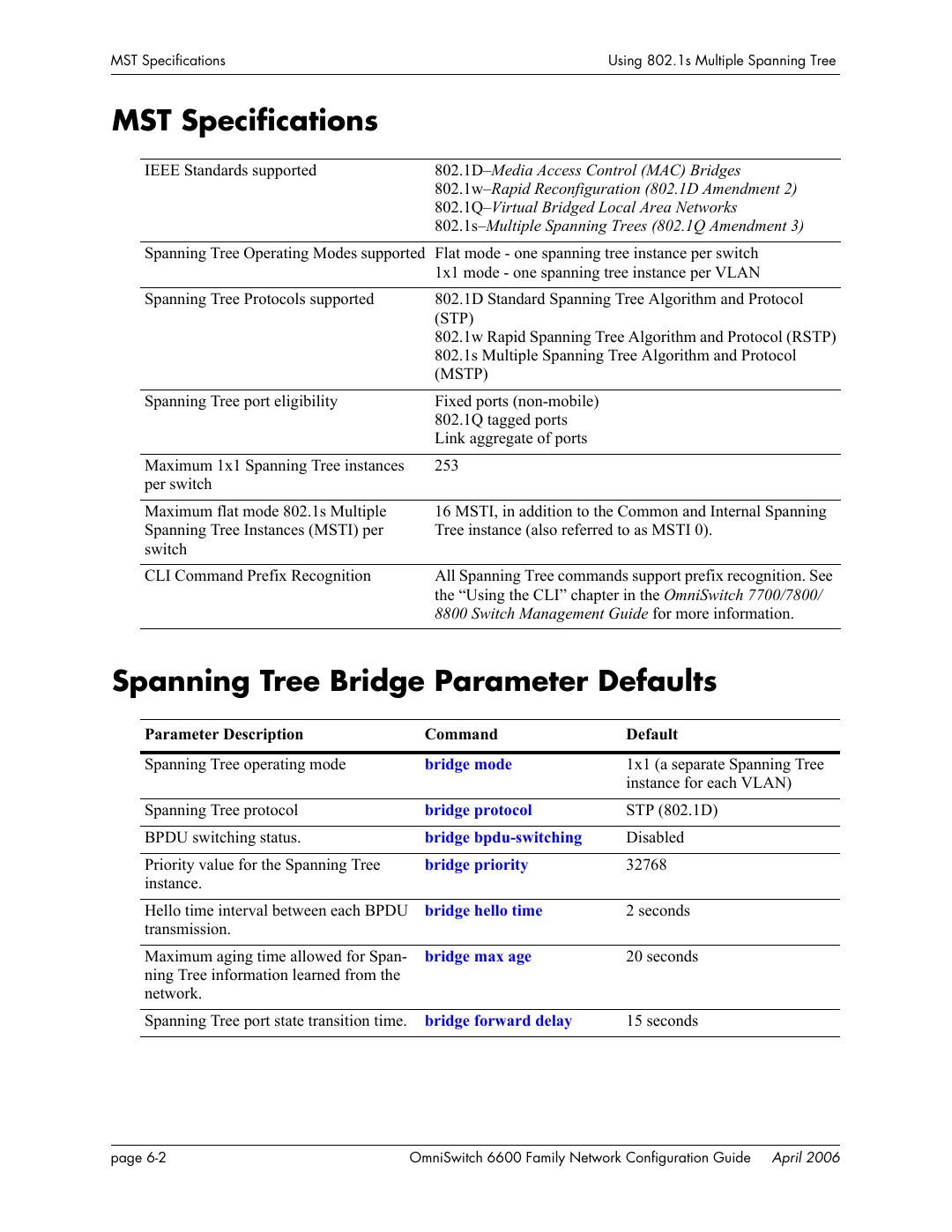
MST Specifications
Spanning Tree Bridge Parameter Defaults
IEEE Standards supported
802.1D–
Media Access Control (MAC) Bridges
802.1w–
Rapid Reconfiguration (802.1D Amendment 2)
802.1Q–
Virtual Bridged Local Area Networks
802.1s–
Multiple Spanning Trees (802.1Q Amendment 3)
Spanning Tree Operating Modes supported Flat mode - one spanning tree instance per switch
1x1 mode - one spanning tree instance per VLAN
Spanning Tree Protocols supported
802.1D Standard Spanning Tree Algorithm and Protocol
(STP)
802.1w Rapid Spanning Tree Algorithm and Protocol (RSTP)
802.1s Multiple Spanning Tree Algorithm and Protocol
(MSTP)
Spanning Tree port eligibility
Fixed ports (non-mobile)
802.1Q tagged ports
Link aggregate of ports
Maximum 1x1 Spanning Tree instances
per switch
253
Maximum flat mode 802.1s Multiple
Spanning Tree Instances (MSTI) per
switch
16 MSTI, in addition to the Common and Internal Spanning
Tree instance (also referred to as MSTI 0).
CLI Command Prefix Recognition
All Spanning Tree commands support prefix recognition. See
the “Using the CLI” chapter in the
OmniSwitch 7700/7800/
8800 Switch Management Guide
for more information.
Parameter Description
Command
Default
Spanning Tree operating mode
1x1 (a separate Spanning Tree
instance for each VLAN)
Spanning Tree protocol
STP (802.1D)
BPDU switching status.
Disabled
Priority value for the Spanning Tree
instance.
32768
Hello time interval between each BPDU
transmission.
2 seconds
Maximum aging time allowed for Span-
ning Tree information learned from the
network.
20 seconds
Spanning Tree port state transition time.
15 seconds