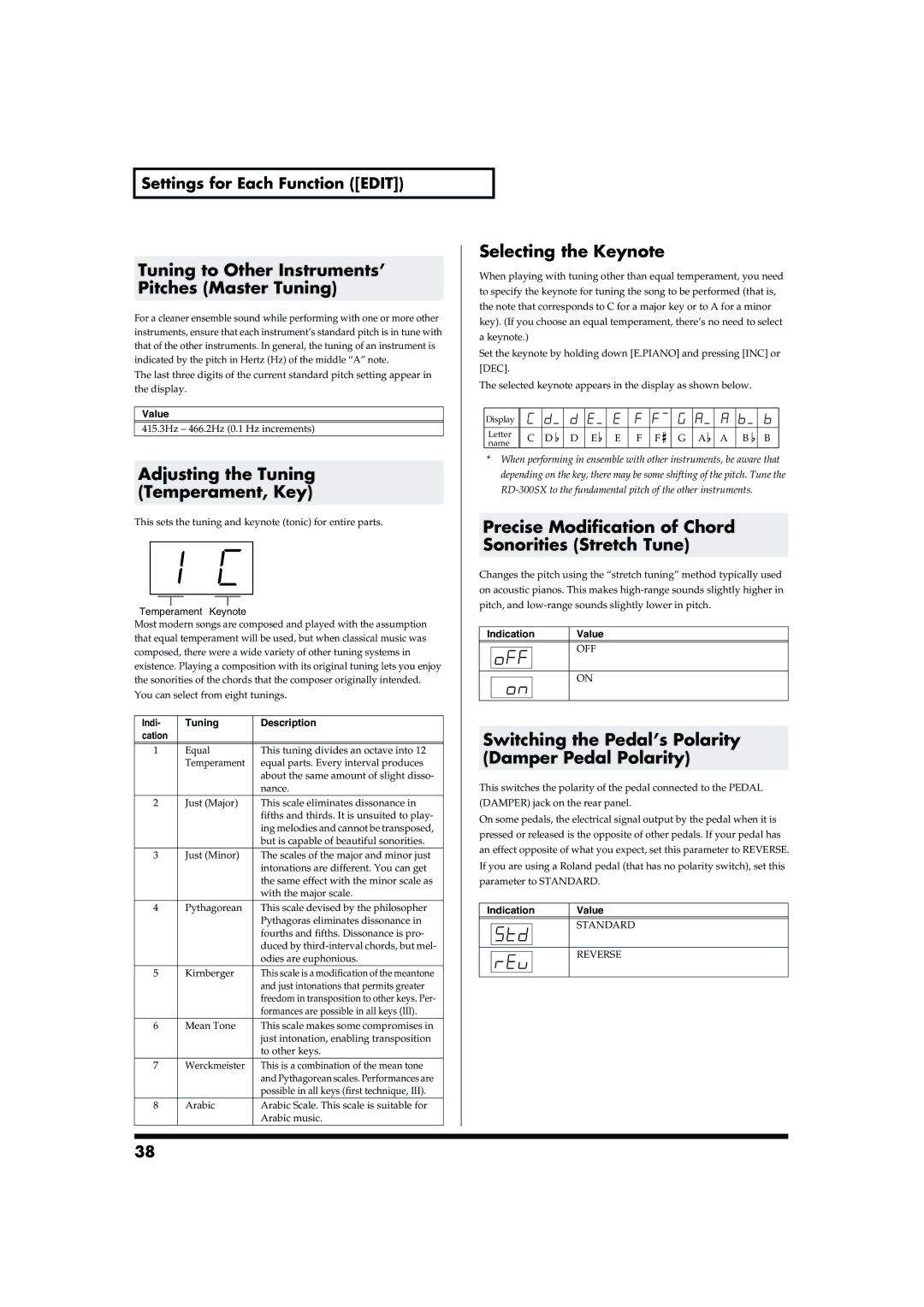
Settings for Each Function ([EDIT])
Tuning to Other Instruments’ Pitches (Master Tuning)
For a cleaner ensemble sound while performing with one or more other instruments, ensure that each instrument’s standard pitch is in tune with that of the other instruments. In general, the tuning of an instrument is indicated by the pitch in Hertz (Hz) of the middle “A” note.
The last three digits of the current standard pitch setting appear in the display.
Value
415.3Hz – 466.2Hz (0.1 Hz increments)
Adjusting the Tuning
(Temperament, Key)
This sets the tuning and keynote (tonic) for entire parts.
fig.disp.1-C
Temperament Keynote
Most modern songs are composed and played with the assumption that equal temperament will be used, but when classical music was composed, there were a wide variety of other tuning systems in existence. Playing a composition with its original tuning lets you enjoy the sonorities of the chords that the composer originally intended. You can select from eight tunings.
Indi- | Tuning | Description |
cation |
|
|
|
|
|
1 | Equal | This tuning divides an octave into 12 |
| Temperament | equal parts. Every interval produces |
|
| about the same amount of slight disso- |
|
| nance. |
2 | Just (Major) | This scale eliminates dissonance in |
|
| fifths and thirds. It is unsuited to play- |
|
| ing melodies and cannot be transposed, |
|
| but is capable of beautiful sonorities. |
3 | Just (Minor) | The scales of the major and minor just |
|
| intonations are different. You can get |
|
| the same effect with the minor scale as |
|
| with the major scale. |
4 | Pythagorean | This scale devised by the philosopher |
|
| Pythagoras eliminates dissonance in |
|
| fourths and fifths. Dissonance is pro- |
|
| duced by |
|
| odies are euphonious. |
5 | Kirnberger | This scale is a modification of the meantone |
|
| and just intonations that permits greater |
|
| freedom in transposition to other keys. Per- |
|
| formances are possible in all keys (III). |
6 | Mean Tone | This scale makes some compromises in |
|
| just intonation, enabling transposition |
|
| to other keys. |
7 | Werckmeister | This is a combination of the mean tone |
|
| and Pythagorean scales. Performances are |
|
| possible in all keys (first technique, III). |
8 | Arabic | Arabic Scale. This scale is suitable for |
|
| Arabic music. |
Selecting the Keynote
When playing with tuning other than equal temperament, you need to specify the keynote for tuning the song to be performed (that is, the note that corresponds to C for a major key or to A for a minor key). (If you choose an equal temperament, there’s no need to select a keynote.)
Set the keynote by holding down [E.PIANO] and pressing [INC] or [DEC].
The selected keynote appears in the display as shown below.
Display |
|
|
|
|
|
|
|
|
|
|
|
| |
|
|
|
|
|
|
|
|
|
|
|
|
| |
Letter | C | D | D | E | E | F | F | G | A | A | B | B | |
name | |||||||||||||
|
|
|
|
|
|
|
|
|
|
|
|
*When performing in ensemble with other instruments, be aware that depending on the key, there may be some shifting of the pitch. Tune the
Precise Modification of Chord Sonorities (Stretch Tune)
Changes the pitch using the “stretch tuning” method typically used on acoustic pianos. This makes
Indication | Value | ||
|
|
|
|
|
|
| OFF |
|
|
| |
|
|
|
|
|
|
|
|
|
|
| ON |
|
|
| |
|
|
|
|
|
|
|
|
Switching the Pedal’s Polarity (Damper Pedal Polarity)
This switches the polarity of the pedal connected to the PEDAL (DAMPER) jack on the rear panel.
On some pedals, the electrical signal output by the pedal when it is pressed or released is the opposite of other pedals. If your pedal has an effect opposite of what you expect, set this parameter to REVERSE. If you are using a Roland pedal (that has no polarity switch), set this parameter to STANDARD.
Indication | Value | ||
|
|
|
|
|
|
| STANDARD |
|
|
| |
|
|
|
|
|
|
|
|
|
|
| REVERSE |
|
|
| |
|
|
|
|
|
|
|
|
38