1-12

Catalyst 2960 Switch Software Configuration Guide

78-16881-01

Chapter 1      Overview

Network Configuration Examples

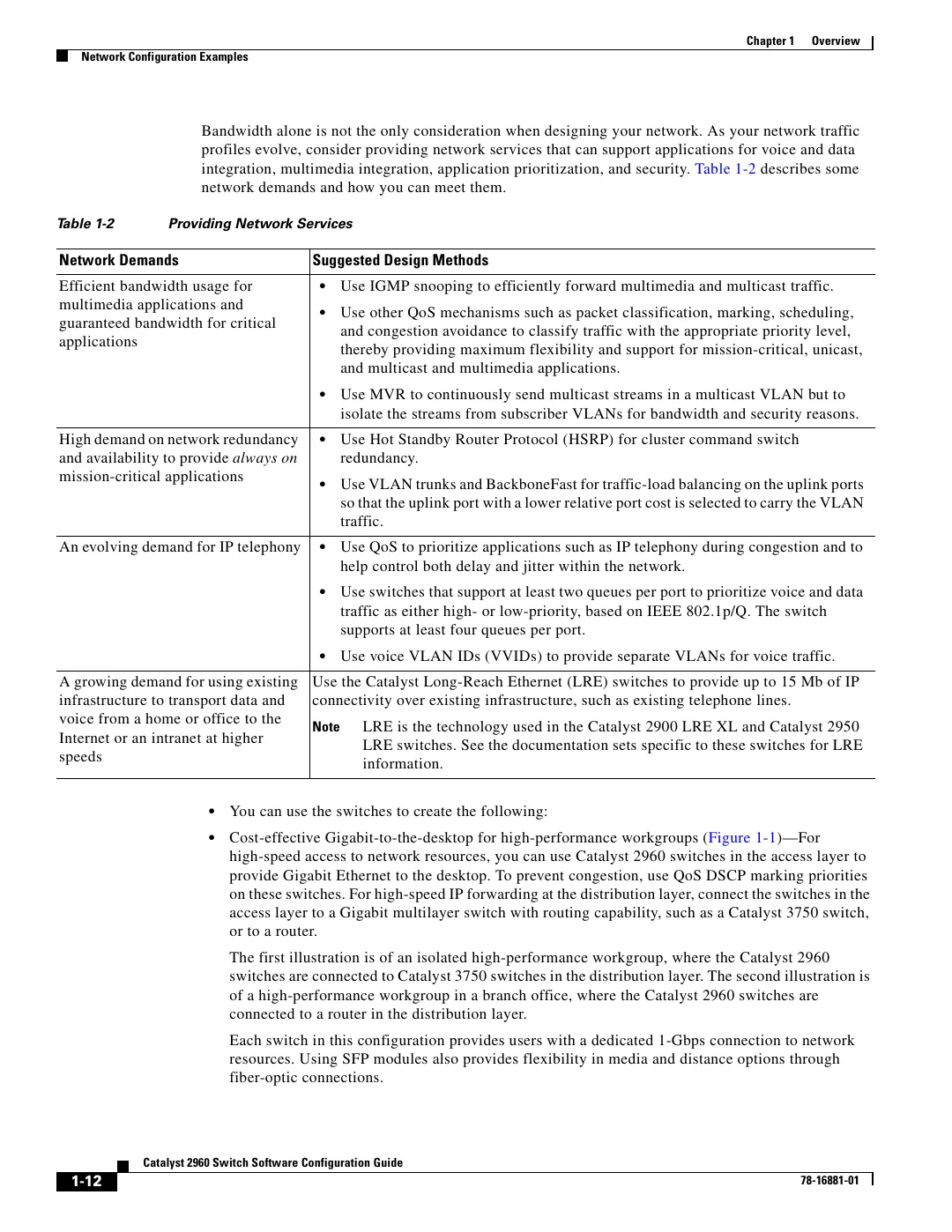
Bandwidth alone is not the only consideration when designing your network. As your network traffic 

profiles evolve, consider providing network services that can support applications for voice and data 

integration, multimedia integration, application prioritization, and security. 

Table 1-2

 describes some 

network demands and how you can meet them.

•

You can use the switches to create the following:

•

Cost-effective Gigabit-to-the-desktop for high-performance workgroups (

Figure 1-1

)—For 

high-speed access to network resources, you can use Catalyst 2960 switches in the access layer to 

provide Gigabit Ethernet to the desktop. To prevent congestion, use QoS DSCP marking priorities 

on these switches. For high-speed IP forwarding at the distribution layer, connect the switches in the 

access layer to a Gigabit multilayer switch with routing capability, such as a Catalyst 3750 switch, 

or to a router. 

The first illustration is of an isolated high-performance workgroup, where the Catalyst 2960 

switches are connected to Catalyst 3750 switches in the distribution layer. The second illustration is 

of a high-performance workgroup in a branch office, where the Catalyst 2960 switches are 

connected to a router in the distribution layer.

Each switch in this configuration provides users with a dedicated 1-Gbps connection to network 

resources. Using SFP modules also provides flexibility in media and distance options through 

fiber-optic connections.

Table 1-2

Providing Network Services

Network Demands

Suggested Design Methods

Efficient bandwidth usage for 

multimedia applications and 

guaranteed bandwidth for critical 

applications

•

Use IGMP snooping to efficiently forward multimedia and multicast traffic.

•

Use other QoS mechanisms such as packet classification, marking, scheduling, 

and congestion avoidance to classify traffic with the appropriate priority level, 

thereby providing maximum flexibility and support for mission-critical, unicast, 

and multicast and multimedia applications.

•

Use MVR to continuously send multicast streams in a multicast VLAN but to 

isolate the streams from subscriber VLANs for bandwidth and security reasons.

High demand on network redundancy 

and availability to provide 

always on


mission-critical applications

•

Use Hot Standby Router Protocol (HSRP) for cluster command switch 

redundancy.

•

Use VLAN trunks and BackboneFast for traffic-load balancing on the uplink ports 

so that the uplink port with a lower relative port cost is selected to carry the VLAN 

traffic.

An evolving demand for IP telephony

•

Use QoS to prioritize applications such as IP telephony during congestion and to 

help control both delay and jitter within the network. 

•

Use switches that support at least two queues per port to prioritize voice and data 

traffic as either high- or low-priority, based on IEEE 802.1p/Q. The switch 

supports at least four queues per port.

•

Use voice VLAN IDs (VVIDs) to provide separate VLANs for voice traffic.

A growing demand for using existing 

infrastructure to transport data and 

voice from a home or office to the 

Internet or an intranet at higher 

speeds

Use the Catalyst Long-Reach Ethernet (LRE) switches to provide up to 15 Mb of IP 

connectivity over existing infrastructure, such as existing telephone lines.

Note

LRE is the technology used in the Catalyst 2900 LRE XL and Catalyst 2950 

LRE switches. See the documentation sets specific to these switches for LRE 

information.

Page 46
Image 46
Open full-size image

2960 specifications

Cisco Systems 2960 series switches are a prominent solution in the networking landscape, known for their reliability, scalability, and feature-rich offerings. Ideal for small to medium-sized enterprises, these switches provide a robust foundation for network infrastructure, ensuring optimal performance and connectivity.

One of the standout features of the Cisco 2960 series is its Layer 2 switching capabilities. The switches support multiple VLANs (Virtual Local Area Networks), allowing network administrators to segment traffic efficiently and enhance security protocols. This is crucial in modern networks where managing traffic and isolating sensitive information is a priority.

The Cisco 2960 series also incorporates advanced Quality of Service (QoS) features, enabling the prioritization of critical applications and services. This functionality ensures that time-sensitive data, such as voice and video traffic, maintains a high quality of service even in congested networks. With support for IEEE 802.1p and DSCP marking, administrators can fine-tune their network performance to meet specific organizational needs.

Power over Ethernet (PoE) is another significant characteristic of the Cisco 2960 series. This feature allows switches to deliver electrical power alongside data over Ethernet cables to devices such as IP phones, wireless access points, and surveillance cameras. With PoE, organizations can reduce clutter from power cables and increase deployment flexibility for various devices.

In terms of security, the Cisco 2960 series is equipped with a range of integrated security features. The switch supports port security, 802.1X authentication, and Access Control Lists (ACLs), providing robust defenses against unauthorized access and potential network vulnerabilities. These security measures are essential for protecting sensitive data and ensuring compliance with industry regulations.

Moreover, the Cisco 2960 series offers enhanced network management capabilities with Cisco's Intelligent Network Services. This includes support for Simple Network Management Protocol (SNMP), Cisco Prime, and Embedded Event Manager (EEM), allowing for efficient monitoring, troubleshooting, and policy enforcement across the network.

Additionally, the Cisco 2960 switches provide various models and configurations, catering to different networking needs. Options include models with varying port densities, uplink configurations, and stacking capabilities, making it easy for organizations to choose solutions that align perfectly with their requirements.

In summary, the Cisco 2960 series is a versatile and essential component of modern networking environments. Its advanced features, including Layer 2 support, QoS, PoE, robust security, and diverse management tools, make it an excellent choice for organizations looking to build a strong and secure network infrastructure.