User Guide
Page
Contents
Printing
Maintenance
Index
Features1
Front View
Parts of the Printer
Internal Components
Rear View
Features Configuration
Printer Configurations
Standard Features
Available Configurations
Options
Control Panel Layout
Control Panel
Information Pages
Configuration
Menu Map
Information Source
More Information
Network Basics
Overview of Network Setup and Configuration
Choosing a Connection Method
Connecting via Ethernet Recommended
Network Connection
USB Connection
Connecting via USB
TCP/IP and IP Addresses
Configuring the Network Address
Using the Embedded Web Server
Automatically Setting the Printer’s IP Address
Dynamic Methods of Setting the Printer’s IP Address
Using the Control Panel
Using Host Names with the Domain Name Service DNS
Manually Setting the Printer’s IP Address
Information Required for Manual IP Addressing
Click Properties
Embedded Web Server
Printer Management Software
Printer Driver Description
Available Printer Drivers
Windows 2000 or Later
Quick CD Install Steps
Preliminary Steps
Adding the Printer
Other Methods of Installation
Microsoft TCP/IP Protocol
Right-clickLocal Area Connection, then click Properties
Obtaining the Printer’s URL Network Path
Configuring the Printer
Microsoft IPP Port
Printing a Test
Creating an IPP Printer
Windows 64-Bit Server to 32-Bit Client Installation
Double-click on Printers and Faxes
Select Intel Box for Windows XP, then click Next
Windows 2000 or Later Troubleshooting
Verifying Settings
Verifying Driver Installation
Printing a Test
Click Start Settings Printers
Macintosh OS X, Version
Macintosh OS X, Version 10.3 and Higher
Bonjour Rendezvous Connection
Macintosh OS X, Version 10.4 and Higher
Open the Printer Setup Utility
LPD/LPR Connection
Mac OS X, Version 10.3 and Higher Troubleshooting
Macintosh Troubleshooting Mac OS X, Version 10.3 and Higher
From Your Computer
Quick Install Steps
Unix Linux
From the Printer
Click the PPD Files using Cups Printing Services link
Installing the Printer When Using Cups as the Print Spooler
Enabling IPv6
IPv6
Resetting the TCP/IP Configuration
Setting the Interface ID
DHCPv6
Automatic Address Assignment
Select/deselect Use router supplied prefixes
Manual Address Assignment
Setting DHCPv6 Options with the Control Panel
Setting DHCPv6 Options Using the Embedded Web Server
Setting the IPv6 Address with the Control Panel
Address Precedence
Setting the IPv6 Address Using the Embedded Web Server
Printing3
Printing Overview
General Media Loading Guidelines
Supported Media
Ordering Media
Paper Storage Guidelines
Media That Can Damage Your Printer
Loading Paper in Tray 1 MPT
Loading Media
Long-Edge Feed
Adjust the paper guides to fit the paper loaded in the tray
Short-Edge Feed
Adjust the guides to fit the paper
Loading Paper in Trays
Using Manual Feed in Tray 1 MPT
Selecting Manual Feed Using Windows
Selecting Manual Feed Using Macintosh
Fan the paper to release sheets that are stuck together
7130-122
Push the tray completely into the printer
Short-Edge Feed
7130-057
7130-059
Printing
Printing on Transparencies
Printing on Special Media
Guidelines
Printing on Labels
Printing on Envelopes
Printing on Glossy Paper
Select Custom Paper Types
Using Custom Paper Types
Windows 2000 or newer
Mac OS X version
Using Custom Size Paper
Tray 1 MPT Trays
Mac OS X version 10.4 and newer
Printing Options for Windows
Selecting Printing Options
Tab Printing Options
Selecting Printing Options for an Individual Job in Windows
Setting Default Printing Options for Windows
Saving a Set of Commonly Used Printing Options in Windows
Selecting Options for an Individual Job for Macintosh
Printing Options for Macintosh
Sided Printing Guidelines
Printing on Both Sides of the Paper
Operating System Steps
Printing a 2-Sided Document
Tray 1 MPT
Trays
Windows and Macintosh
Layout Options
Macintosh OS X 10.3 and newer
Selecting Paper Type to Use
Selecting Paper Type to Use for a Supported Driver
Windows 2000 and newer
Mac OS X version 10.3 and newer
Printing N-Up Using a supported Driver
Printing Multiple Pages to a Single Sheet N-Up
Windows 2000 or newer
Select the Layout/Watermark tab
Printing Booklets
Selecting Booklet Printing in a Supported Driver
Windows 2000 or newer and PostScript driver
Mac OS X
Windows 2000 or newer driver
Using Color Corrections
Making Color Adjustments in a Supported Driver
Selecting Color Correction in a Supported Driver
Color Cast
Select Image Options, and select Color Configuration
Making Custom Color Adjustments
Custom Automatic Description Color
Printing in Black and White
Printing Black and White Using a Supported Driver
Select Black and White
Printing Insert Pages in a Supported Driver
Printing Separators
Select Separators from the Paper Menu
Cover Print Option Pages Printed on Cover
Printing Cover Pages
Print Option Last Blank Pages Text
Mac OS X 10.3 and and higher
Printing Cover Pages in a Supported Driver
Printing Watermarks
Selecting Mirror Image in a Supported Driver
Printing Mirror Images
Select Yes for Mirrored Output under Image Options
Windows 2000 or later
Printing Special Job Types
Printing or Deleting Secure Print Jobs
Sending Print With Jobs
Printing or Deleting Proof and Saved Print Jobs
Printing or Deleting Personal Print Jobs
Printing or Deleting Personal Saved Jobs
Printing
Maintenance4
General Precautions
Maintenance and Cleaning
Locating the Serial Number and the Service Tag
Printing Meters
Cleaning the Exterior
Cleaning the Printer
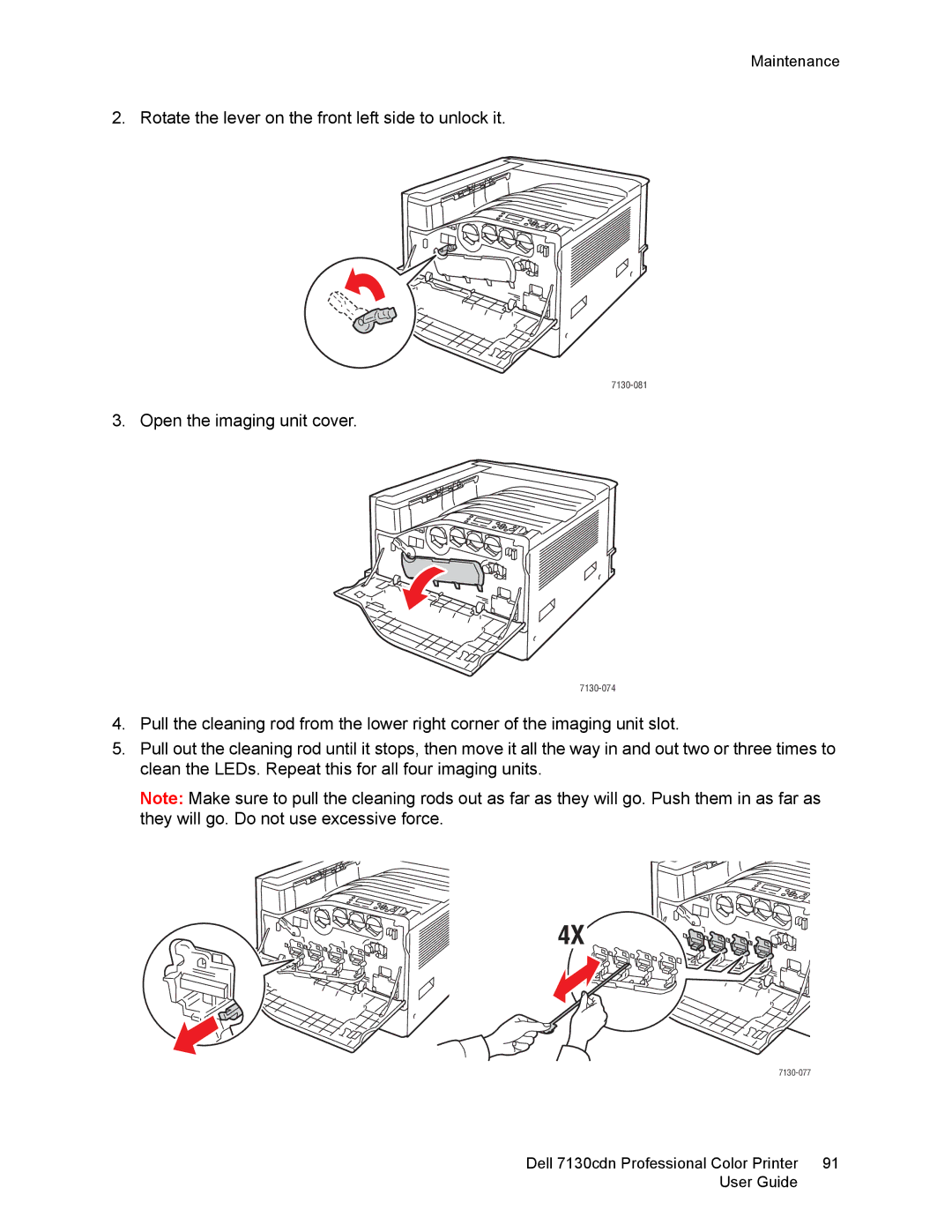
Cleaning the LEDs
Rotate the lever on the front left side to unlock it
Close the imaging unit cover
Ordering Supplies
Routine Maintenance Items
Consumables
Customer Replaceable Parts
When to Order Supplies
Recycling Supplies
Moving the Printer
Symbol Description
Printer Symbols
Troubleshooting
Probable Causes Solutions
General Troubleshooting
Printer Does Not Turn On
Printing Takes Too Long
Printer Resets or Turns Off Frequently
Front Door Will Not Close
Duplex Problems
Printer Is Making Unusual Noises
Date and Time Are Incorrect