56K V.92 Data, Fax, and Voice Chipset
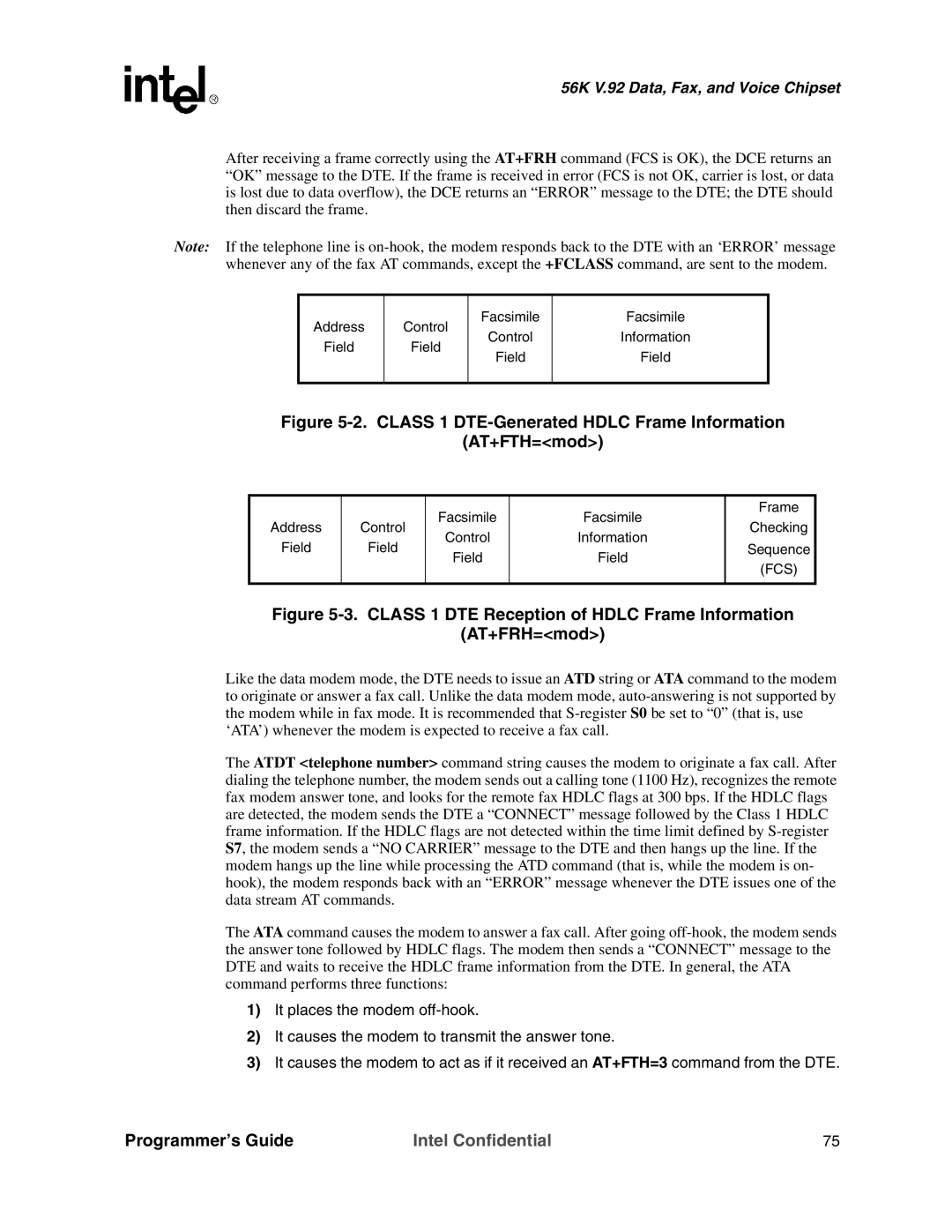
After receiving a frame correctly using the AT+FRH command (FCS is OK), the DCE returns an “OK” message to the DTE. If the frame is received in error (FCS is not OK, carrier is lost, or data is lost due to data overflow), the DCE returns an “ERROR” message to the DTE; the DTE should then discard the frame.
Note: If the telephone line is
Address
Field
Control
Field
Facsimile
Control
Field
Facsimile
Information
Field
Figure 5-2. CLASS 1 DTE-Generated HDLC Frame Information
(AT+FTH=<mod>)
|
| Facsimile | Facsimile | Frame | |
Address | Control | Checking | |||
Control | Information | ||||
Field | Field | Sequence | |||
Field | Field | ||||
|
| (FCS) | |||
|
|
|
| ||
|
|
|
|
|
Figure 5-3. CLASS 1 DTE Reception of HDLC Frame Information
(AT+FRH=<mod>)
Like the data modem mode, the DTE needs to issue an ATD string or ATA command to the modem to originate or answer a fax call. Unlike the data modem mode,
The ATDT <telephone number> command string causes the modem to originate a fax call. After dialing the telephone number, the modem sends out a calling tone (1100 Hz), recognizes the remote fax modem answer tone, and looks for the remote fax HDLC flags at 300 bps. If the HDLC flags are detected, the modem sends the DTE a “CONNECT” message followed by the Class 1 HDLC frame information. If the HDLC flags are not detected within the time limit defined by
The ATA command causes the modem to answer a fax call. After going
1)It places the modem
2)It causes the modem to transmit the answer tone.
3)It causes the modem to act as if it received an AT+FTH=3 command from the DTE.
Programmer’s Guide | Intel Confidential | 75 |