Features Overview
Note: Performance of the IDE interface may be impacted by the DMA mode and type of DMA transfers used. Even though the BIOS automatically sets the DMA mode/type, the OS could downgrade the DMA transfer mode. Check the operating system documentation to see what DMA mode is used by default and whether it is possible to change to a higher performance DMA mode.
2.2.2.3Intel® 82870P2 64-bit PCI/PCI-X Controller Hub 2 (U14, U24)
The two P64H2 devices provide the system’s
•
• PCI Specification 2.2 compliance
•
• PCI Hot Plug 1.0 compliance
• I/O APIC supporting up to 24 interrupts (16 external pins)
• PCI
• SMBus target for
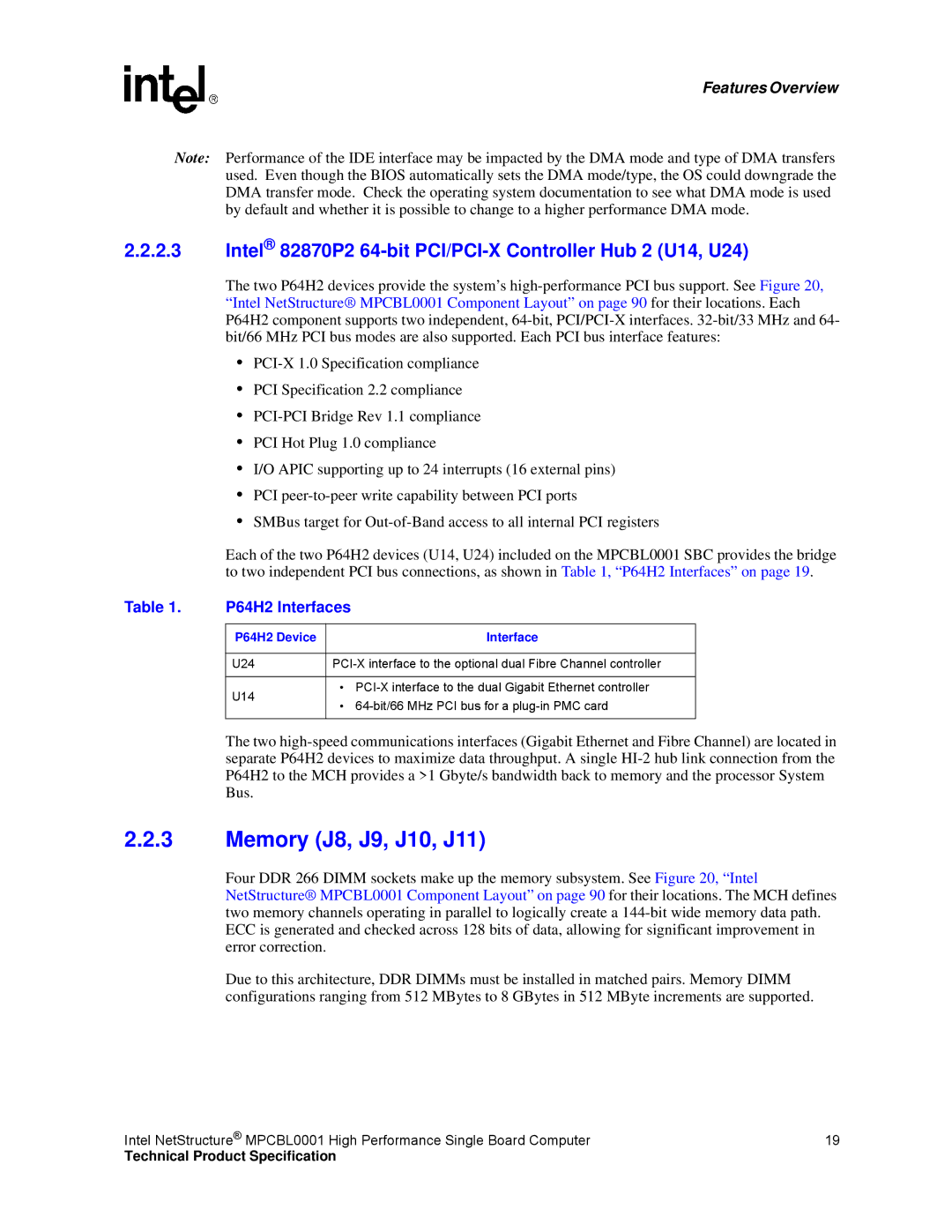
Each of the two P64H2 devices (U14, U24) included on the MPCBL0001 SBC provides the bridge to two independent PCI bus connections, as shown in Table 1, “P64H2 Interfaces” on page 19.
Table 1. | P64H2 Interfaces | ||
|
|
|
|
| P64H2 Device | Interface |
|
|
|
|
|
| U24 |
| |
|
|
|
|
| U14 | • |
|
| • |
| |
|
|
| |
|
|
|
|
| The two | ||
| separate P64H2 devices to maximize data throughput. A single | ||
| P64H2 to the MCH provides a >1 Gbyte/s bandwidth back to memory and the processor System | ||
| Bus. |
|
|
2.2.3Memory (J8, J9, J10, J11)
Four DDR 266 DIMM sockets make up the memory subsystem. See Figure 20, “Intel NetStructure® MPCBL0001 Component Layout” on page 90 for their locations. The MCH defines two memory channels operating in parallel to logically create a
Due to this architecture, DDR DIMMs must be installed in matched pairs. Memory DIMM configurations ranging from 512 MBytes to 8 GBytes in 512 MByte increments are supported.
Intel NetStructure® MPCBL0001 High Performance Single Board Computer | 19 |