Special Applications
This chapter describes some special types of applications that represent unique conditions. For the MLC 52 to operate properly in these situations, it is important that the controller be configured correctly. On the following pages, three application examples are described, along with their requirements for the MLC 52.
Application 1: Using Multiple Sources with an MLC 52
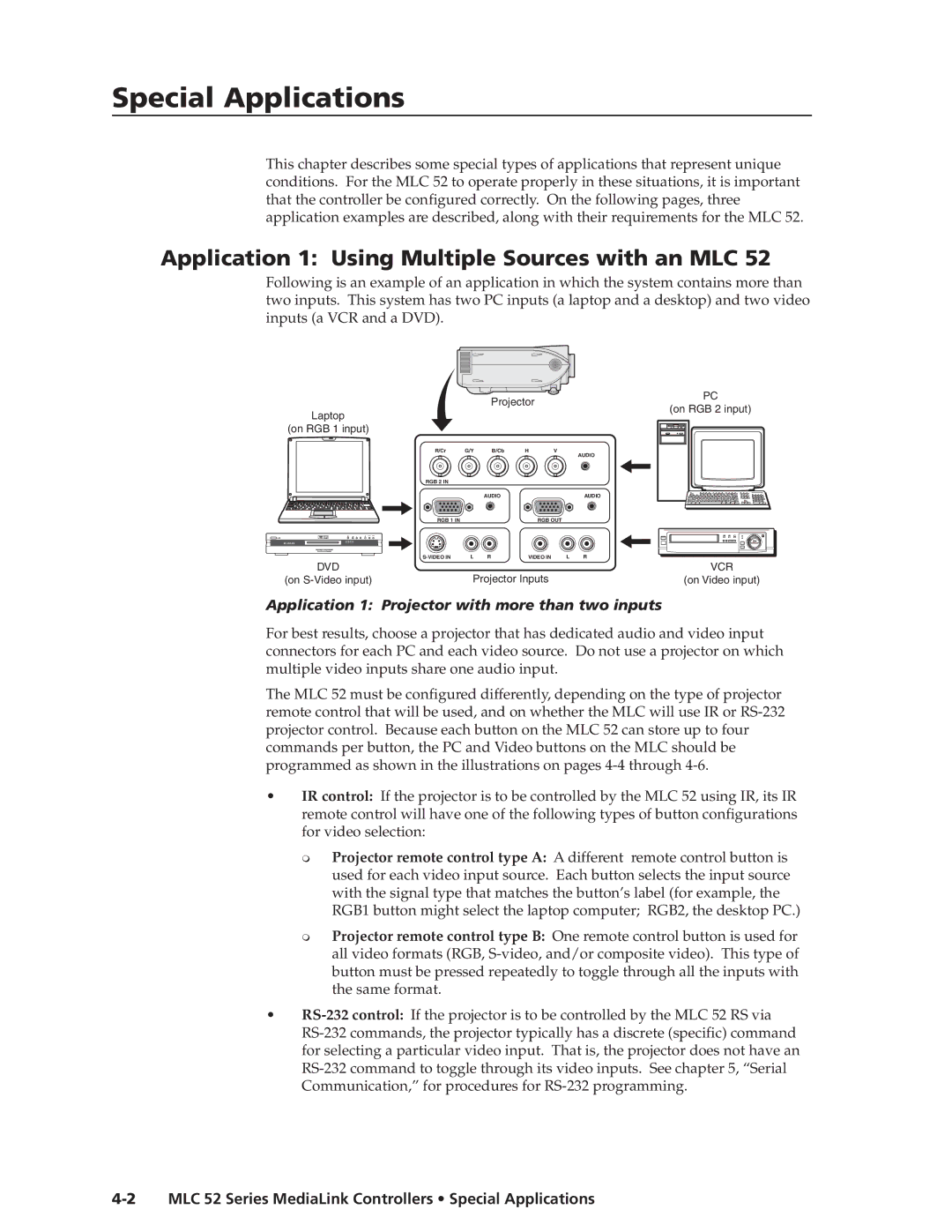
Following is an example of an application in which the system contains more than two inputs. This system has two PC inputs (a laptop and a desktop) and two video inputs (a VCR and a DVD).
|
| Projector | PC | |
|
| (on RGB 2 input) | ||
Laptop |
|
|
| |
|
|
|
| |
(on RGB 1 input) |
|
|
|
|
R/Cr | G/Y | B/Cb | H | V |
|
|
|
| AUDIO |
RGB 2 IN |
|
|
|
|
|
| AUDIO |
| AUDIO |
RGB 1 IN |
|
| RGB OUT | |
L | R | VIDEO IN | L R | |
DVD | Projector Inputs | VCR | ||
(on | (on Video input) | |||
Application 1: Projector with more than two inputs
For best results, choose a projector that has dedicated audio and video input connectors for each PC and each video source. Do not use a projector on which multiple video inputs share one audio input.
The MLC 52 must be configured differently, depending on the type of projector remote control that will be used, and on whether the MLC will use IR or
•IR control: If the projector is to be controlled by the MLC 52 using IR, its IR remote control will have one of the following types of button configurations for video selection:
Projector remote control type A: A different remote control button is used for each video input source. Each button selects the input source with the signal type that matches the button’s label (for example, the RGB1 button might select the laptop computer; RGB2, the desktop PC.)
Projector remote control type B: One remote control button is used for all video formats (RGB,
•