Baby Monitor
Page
PIN PRG
Page
SCD
General description Fig
English
Introduction
Baby unit
English
Preparing for use
Preparing for dial-up mode Baby unit
Battery operation
Mains operation
Parent unit
Programming for dial-up mode with the PRG button
Programming for dial-up mode with Quick Install
Operating range
Using the appliance
Regular baby monitor mode
System Check alarm
Features in regular baby monitor mode Channel selection
Dry materials Material thickness Loss of range
Microphone sensitivity
Setting the baby monitor up for dial-up mode
Dial-up mode
Nightlight
Answering a call of the baby monitor
Cleaning and maintenance
Resetting the baby unit
Replacement
Clearing telephone numbers from the memory
Environment
Guarantee and service
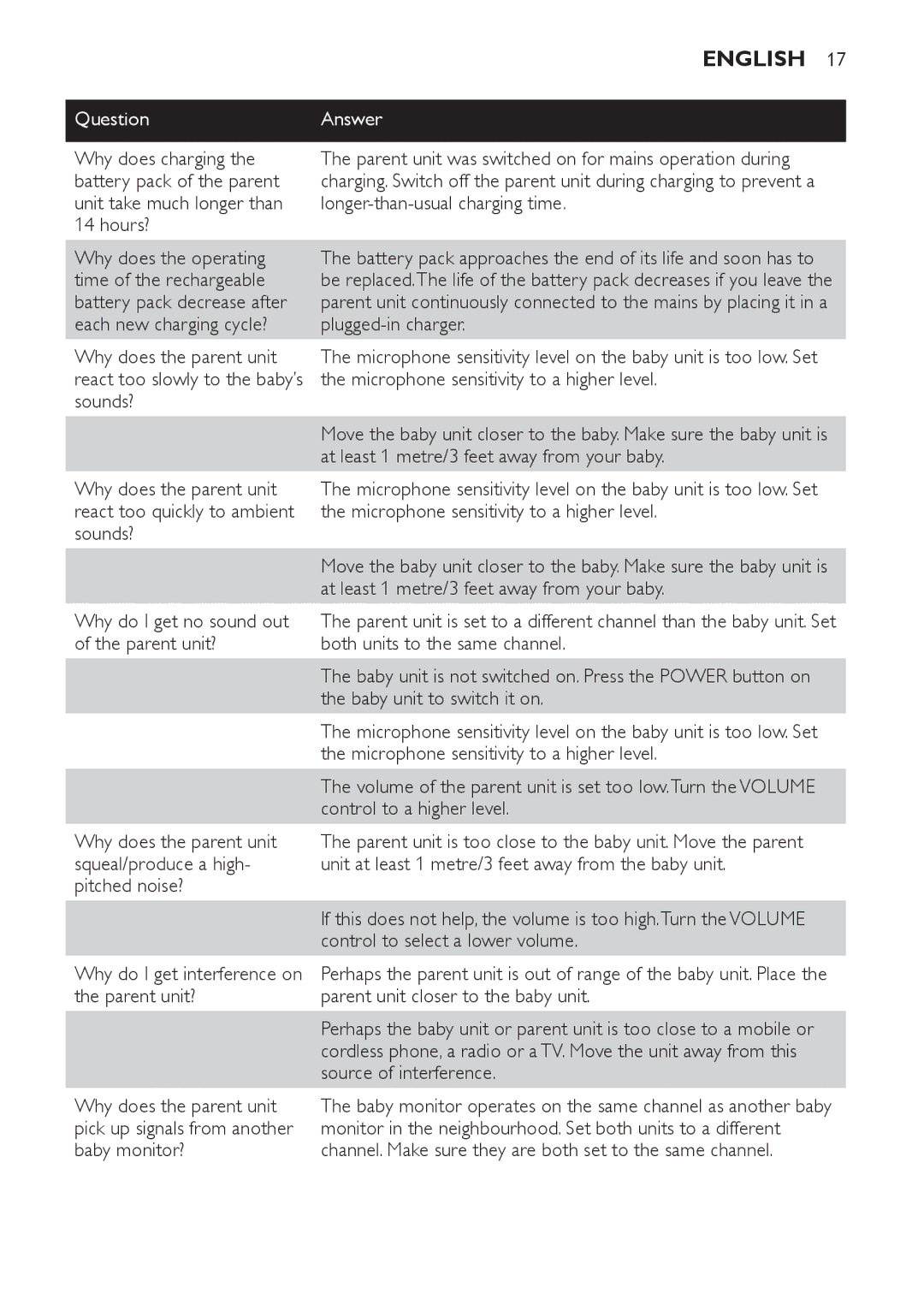
Question Answer
Frequently asked questions
Level
Battery pack
QuestionAnswer
Why does the baby unit not answer my call?
Introduktion
Dansk
Generel beskrivelse fig
Angiver, at der er indtastet en PIN-kode
Vigtigt
Dansk
Klargøring
Babyenheden
Strøm fra batterier
Strøm fra lysnettet
Hovedenhed
Klargøring til opkald Babyenheden
Tryk på OK-knappen for at bekræfte dit valg
Programmering til opkald med Quick Install
Programmering af opkald med PRG-knappen
Senderrækkevidde
Sådan bruges apparatet
Almindelig overvågning
Systemkontrolalarm
Funktioner i tilstanden almindelig babyalarm Valg af kanal
Tørre materialer Materialets tykkelse Tab af rækkevidde
Mikrofonens følsomhed
Sådan besvares opkald fra babyalarmen
Indstilling af babyalarmen til opkald
Ring op til babyalarmen for at høre barnet
Nattelys
Ændring af følsomhed
Slet telefonnumre fra hukommelsen
Nulstil babyenheden
Rengøring og vedligeholdelse
Miljøhensyn
Garanti og service
Spørgsmål Svar
Ofte stillede spørgsmål
SpørgsmålSvar
Sæt begge enheder til den samme kanal
Anden babyalarm? Enheder er indstillet til samme kanal
Tænde for den
Mikrofonens følsomhed på babyenheden er for lav. Sæt
Ikke til tilstanden opkald?
Hvis displayet viser Ç, har du sikkert glemt at forbinde
Hvorfor kan babyenheden
Ikke ringe op til et Vælge tilstanden opkald Telefonnummer?
Allgemeine Beschreibung Abb
Deutsch
Einführung
Wichtig
Deutsch
Babyeinheit
Für den Gebrauch vorbereiten
Netzbetrieb
Akkubetrieb
Den Wählmodus mithilfe der PRG-Taste programmieren
Für den Wählmodus mit Quick Install programmieren
Für den Wählmodus vorbereiten Babyeinheit
Normaler Babyphone-Modus
Das Gerät benutzen
Trockene Materialien Materialstärke Empfangsverlust
Empfangsbereich
Funktionen im normalen Babyphone-Modus Kanalwahl
Mikrofonempfindlichkeit
Stumme Babyüberwachung
Systemcheck-Alarm
Nachtlicht
Wählmodus
Telefonnummern aus dem Speicher löschen
Einen Babyphone-Anruf beantworten
Das Babyphone zur Kontrolle des Kindes anrufen
Die Babyeinheit zurückstellen
Die Reaktionszeit ändern
Reinigung und Wartung
Ersatz
Was geschieht bei einem Stromausfall?
Umweltschutz
Garantie und Kundendienst Häufig gestellte Fragen
Deutsch
Warum ertönt an der Elterneinheit ein Tonsignal?
Warum schaltet die Babyeinheit nicht in den Wählmodus?
Weshalb ist die Elterneinheit gestört?
Deutsch
Γενική περιγραφή Εικ
46 Ελληνικά
Εισαγωγή
Σημαντικό
Ελληνικά
Προετοιμασία για χρήση Μονάδα μωρού
48 Ελληνικά
Λειτουργία με ρεύμα
Λειτουργία με μπαταρίες
Προετοιμασία για λειτουργία κλήσης Μονάδα μωρού
PIN
50 Ελληνικά
Απλή λειτουργία παρακολούθησης μωρού
Χρήση της συσκευής
Εμβέλεια λειτουργίας
Στεγνά υλικά Πάχος υλικών Απώλεια εμβέλειας
Ευαισθησία μικροφώνου
52 Ελληνικά
Μπορείτε να χρησιμοποιήσετε τη φωνή σας ως αναφορά ήχου
Αθόρυβη παρακολούθηση μωρού
Λειτουργία κλήσης
Νυχτερινό φως
Ρύθμιση του βρεφικού μόνιτορ για τη λειτουργία κλήσης
Απάντηση σε κλήση του βρεφικού μόνιτορ
Κλήση στο βρεφικό μόνιτορ για έλεγχο του μωρού σας
54 Ελληνικά
Διαγραφή αριθμών τηλεφώνου από τη μνήμη
Αλλαγή του χρόνου ευαισθησίας
Αντικατάσταση Μονάδα γονέα
Μηδενισμός της μονάδας μωρού
Καθαρισμός και συντήρηση
Περιβάλλον
56 Ελληνικά
Εγγύηση και σέρβις Συχνές ερωτήσεις
Ερώτηση Απάντηση
Χρησιμοποιήσω
Γιατί δεν μπορώ να
Ενδέχεται να έχει μειωθεί. Τοποθετήστε τη μονάδα γονέα στο
Φορτιστή για να επαναφορτίσετε τις μπαταρίες
58 Ελληνικά
Γιατί δεν φορτίζουν οι μπαταρίες της μονάδας γονέα
ΕρώτησηΑπάντηση
60 Ελληνικά
Αποθηκεύστε τον σε κάποια από τις θέσεις μνήμης. Δείτε την
Μονάδας μωρού. Εισαγάγετε έναν αριθμό τηλεφώνου και
Ενότητα Προετοιμασία του βρεφικού μόνιτορ για λειτουργία
Σας συνιστούμε να ελέγξετε αν λειτουργεί σωστά η λειτουργία
Descripción general fig
Español
Introducción
Consultarlas en el futuro
Español
Importante
Unidad del bebé
Preparación para su uso
Funcionamiento conectado a la red
Funcionamiento a pilas
Programación del modo telefónico con el botón PRG
Preparación para el modo telefónico Unidad del bebé
Programación del modo teléfónico con Instalación Rápida
Uso del aparato
Pulse el botón OK para confirmar su elección
Modo vigilabebés normal
Está en modo Instalación Rápida
Materiales secos Grosor del material Pérdida de alcance
Alcance de funcionamiento
30 cm 10% Metal, cables o plomo
Sensibilidad del micrófono
Configuración del vigilabebés para el modo de teléfono
Alarma de Comprobación del Sistema
Luz nocturna
Modo telefónico
Llamar al vigilabebés para escuchar a su bebé
Contestar una llamada del vigilabebés
Borrado de números de teléfono de la memoria
Cambio del tiempo de reacción
Sustitución
Reinicio de la unidad del bebé
Limpieza y mantenimiento
Pregunta Respuesta
Medio ambiente
Garantía y servicio Preguntas más frecuentes
Las pilas están agotadas. Sustitúyalas
PreguntaRespuesta
Las pilas están bajas. Sustitúyalas
La batería de la unidad de padres está baja. Recárguela
Las pilas de la unidad del bebé están bajas. Sustitúyalas
Español
¿Por qué la unidad del bebé no marca el número correcto?
Laitteen osat Kuva
Suomi
Johdanto
Tärkeää
Suomi
Käyttöönotto
Lapsen yksikkö
Puhelinyhteystilan käyttöönotto Lapsen yksikkö
Paristokäyttö
Vanhemman yksikkö
Puhelinyhteystilan ohjelmointi PRG-painikkeella
Puhelinyhteyden ohjelmointi pika-asennustoiminnolla
Normaali itkuhälytintila
Käyttö
Kuuluvuusalue
Huonekalut Seinät ja muut esteet Huono kuuluvuus
Mikrofonin herkkyys
Normaalin itkuhälytintilan toiminnot Kanavanvalinta
Mykistetty itkuhälytin
Järjestelmätarkistuksen hälytin
Itkuhälyttimen määrittäminen puhelinyhteystilaan
Puhelinyhteystila
Itkuhälyttimen soittoon vastaaminen
Lapsen tilan tarkistaminen soittamalla itkuhälyttimeen
Lapsen yksikön nollaaminen
Viiveen muuttaminen
Puhdistus ja hoito
Varaosat
Kysymys Vastaus
Ympäristöasiaa
Takuu ja huolto Tavallisimmat kysymykset
KysymysVastaus
Lataaminen ei auta, vaihda akku
Vilkkuu punaisena?
Virtapainiketta
Miksi vanhemman yksikön
Yksiköstä
Kuuluu kimeä ääni?
Kauemmaksi häiriön aiheuttajasta
Miksi lapsen yksikkö ei vastaa soittoon?
Tunnista PIN-tunnusta? Oikea tunnus
Miksi lapsen yksikkö ei
PIN-tunnus. Lisätietoja on kohdan Käyttöönotto kohdassa
Puhelinyhteyden käyttöönotto
Description générale fig
Français
Baby-Care Philips, prendre soin de bébé ensemble
Français
Unité bébé
Avant utilisation
Utilisation sur secteur
Fonctionnement sur piles
Programmation du mode d’appel téléphonique via la touche PRG
Avant utilisation en mode d’appel téléphonique Unité bébé
Utilisation de l’appareil
Mode babyphone classique
Portée
Utilisation du babyphone en mode silencieux
Matériaux secs
Perte de portée
Veilleuse
Alarme de contrôle du système
Mode d’appel téléphonique
Appel vers le babyphone pour surveiller votre bébé
Réponse à un appel du babyphone
Suppression de numéros de téléphones de la mémoire
Modification du délai de sensibilité
Nettoyage et entretien
Remplacement
Réinitialisation de l’unité bébé
Environnement
Garantie et service
Foire aux questions
Question Réponse
Les piles sont faibles. Remplacez-les
QuestionRéponse
Les piles sont épuisées. Remplacez-les
Arrêt de l’unité bébé pour l’allumer
La batterie de l’unité parents est faible. Rechargez-la
Pourquoi le voyant de
Pourquoi la batterie de
Français
Activez le mode de numérotation par tonalité. Suivez les
’emplacement de mémoire approprié M1-M5
Instructions du mode d’emploi du téléphone
Vous avez peut-être oublié de sélectionner un numéro de
Descrizione generale fig
Italiano
Introduzione
Italiano
Unità bambino
Predisposizione dell’apparecchio
Funzionamento a corrente
Funzionamento a batteria
Preparazione della modalità di chiamata Unità bambino
Modalità normale baby monitor
Per confermare la scelta, premete il pulsante OK
Modalità d’uso dell’apparecchio
Controllo silenzioso bambino
Portata effettiva
Sensibilità del microfono
Luce notturna
Allarme System Check
Modalità di chiamata
Bambino è collegata
Risposta a una chiamata del baby monitor
Cancellazione di numeri di telefono dalla memoria
Controllo del bambino chiamando il baby monitor
Modifica del tempo di sensibilità
Sostituzione
Reimpostazione dell’unità bambino
Pulizia e manutenzione
Garanzia e assistenza
Tutela dell’ambiente
Domande frequenti
Domanda Risposta
DomandaRisposta
Bambino
La ricarica non risolve il problema, sostituite le batterie
Perché le batterie dell’unità
Genitore non si caricano?
Basso
Volume su un livello più alto
Produce un rumore acuto? Almeno 1 metro dall’unità bambino
Risponde alle chiamate?
Posizione di memoria M1-M5
Posizione di memoria sbagliata M1-M5
Utilizzate un cellulare
Algemene beschrijving fig
Nederlands
Inleiding
Belangrijk
Nederlands
Babyunit
Klaarmaken voor gebruik
Gebruik op netspanning
Gebruik op batterijen
Programmeren voor belmodus met de PRG-knop
Programmeren voor belmodus met Snelinstallatie
Klaarmaken voor belmodus Babyunit
Normale babyfoonmodus
Het apparaat gebruiken
Hout, pleisterwerk, karton, glas 30 cm 10%
Bereik
Functies in normale babyfoonmodus Kanaalselectie
Gevoeligheid microfoon
Nachtlampje
Systeemcontrolealarm
Belmodus
De babyfoon in belmodus zetten
De babyfoon bellen om naar uw baby te luisteren
Een oproep van de babyfoon beantwoorden
Telefoonnummers uit het geheugen wissen
De gevoeligheidstijd wijzigen
Vervangen
De babyunit resetten
Schoonmaken en onderhoud
Vraag Antwoord
Garantie en service Veelgestelde vragen
Milieu
VraagAntwoord
Minste 1 meter van uw baby verwijderd is
Gebruiksduur van het
Oplaadbare batterijpak
Waarom hoor ik storing op de ouderunit?
Hoog. Draai de volumeregelaar naar een lager volume
Waarom maakt de
Niet naar het goede Geheugenlocatie M1-M5 gekozen Nummer?
Waarom belt de babyunit
Pulsknop op toonbellen of gebruik een mobiele telefoon
Staat op toonbellen. Zet de toon/pulsknop op pulsbellen
Generell beskrivelse fig
Norsk
Innledning
Viktig
Norsk
Før bruk
Babyenhet
Drift med batteri
Drift med strøm
Foreldreenhet
Forberedelser for oppringingsmodus Babyenhet
Programmere oppringingsmodus med Quick Install
Vanlig babymonitormodus
Bruke apparatet
Sett babyenheten minst 1 meter fra babyen. fig
Meter fra babyenheten. fig
Tørre materialer Materialtykkelse Tap av rekkevidde
Systemkontrollalarm
Funksjoner i vanlig babymonitormodus Kanalvalg
Mikrofonfølsomhet
Oppringingsmodus
Nattlys
Stille inn babymonitoren for oppringingsmodus
Svare på en anrop fra babymonitoren
Endre følsomhetstiden
Slette telefonnumre fra minnet
Tilbakestille babyenheten
Rengjøring og vedlikehold
Spørsmål Svar
Miljø
Vanlige spørsmål
Batteriene er tomme, og du må bytte dem
Hvis du har satt batterier i babyenheten, bytter den til
Ladet, begynner foreldreenheten å gå på batterier
SpørsmålSvar
Er minst 1 meter unna babyen
Knappen for å velge riktig minneplassering M1-M5
At du tester oppringingsmodusen før du går
Hvorfor svarer ikke
Babyenheten det riktige M1-M5 Nummeret?
Introdução
Português
Linha Baby-Care da Philips a pensar no seu bebé
Descrição geral fig
Português
Unidade do bebé
Preparação
Funcionamento a corrente
Funcionamento a pilhas
Programar para o modo de marcação telefónica com o botão PRG
Preparar para o modo de marcação telefónica Unidade do bebé
Modo normal do monitor do bebé
Prima o botão OK para confirmar a sua escolha
Utilização do aparelho
Materiais secos
Alcance de funcionamento
Perda de alcance
Funções no modo normal do monitor do bebé Selecção de canal
Pode utilizar a sua própria voz como referência
Alarme de Verificação do Sistema
Monitorização silenciosa do bebé
Modo de marcação telefónica
Eliminar números de telefone da memória
Atender uma chamada do monitor do bebé
Ligar para o monitor do bebé para monitorizar o seu bebé
Alterar o tempo de sensibilidade
Prima ligeiramente o botão C eliminar no teclado. fig
Reiniciar a unidade do bebé
Limpeza e manutenção
Pergunta Resposta
Ambiente
Garantia e assistência Perguntas mais frequentes
Porque é que não posso
Porque é que a pilha da unidade dos pais não carrega?
PerguntaResposta
Aos sons do bebé? Nível mais elevado
Pais reage de forma lenta
Pés de distância do seu bebé
Pais reage demasiado
Porque é que a unidade do bebé não responde à minha chamada?
Português
Allmän beskrivning Bild
Svenska
Philips spädbarnsvård vårda tillsammans
Förberedelser inför användning
Svenska
Viktigt
Batteridrift
Elnätsdrift
Föräldraenhet
Förbereda för uppringningsläge Babyenhet
Bekräfta ditt val genom att trycka på OK
Programmering för uppringningsläge med snabbinstallation
Räckvidd
Använda apparaten
Vanligt babyövervakningsläge
Funktioner i vanligt babyövervakningsläge Kanalval
Torra material Materialtjocklek Sämre räckvidd
Mikrofonkänslighet
Tyst babyövervakning
Uppringningsläge
Nattlampa
Ställa in babyvakten på uppringningsläge
Besvara ett samtal från babyvakten
Ändra känslighetstiden
Rensa telefonnummer ur minnet
Återställa babyenheten
Rengöring och underhåll
Miljön
Garanti och service
Vanliga frågor
Fråga Svar
Laddat går även den över till batteridrift
Vad händer vid strömavbrott?
Batterierna är tomma. Byt ut dem
Batterierna är nästan slut. Byt ut dem
Föräldraenheten närmare babyenheten
Varför piper föräldraenheten?
Batterierna i babyenheten kan vara svaga. Byt ut dem
Föräldraenheten kan inte upprätta en anslutning till
FrågaSvar
Svenska
Giriş
172 Türkçe
Genel açıklamalar Şek
Ana ünite Şarj ediliyor ışığı Şarj Cihazı
Önemli
Türkçe
Cihazın kullanıma hazırlanması
174 Türkçe
PRG düğmesi ile çevirmeli mod için programlama
Hızlı Kurulum ile çevirmeli mod için programlama
Seçiminizi onaylamak için OK düğmesine basın
176 Türkçe
Cihazın Kullanımı
Standart bebek monitörü modu
Çalışma menzili
Sİstem Kontrol alarmı
Standart bebek monitörü modundaki özellikler Kanal seçimi
Mikrofon hassaslığı
Gece ışığı
178 Türkçe
Çevirmeli mod
Bebek monitörünün çevirmeli mod için ayarlanması
Hassaslık süresinin değiştirilmesi
Telefon numaralarının hafızadan silinmesi
Bebek ünitesinin sıfırlanması
Temizlik ve bakım
Değiştirme
180 Türkçe
Çevre
Garanti ve servis
Soru Cevap
Sıkça sorulan sorular
182 Türkçe
Ana ünitede niçin parazit var?
SoruCevap
184 Türkçe
185
186
187 2627
4222.002.6459.1