Dell PowerEdge T310 Systems
July
Contents
Processor Settings Screen
Power Management Screen
Uefi Boot Settings Screen
Other Information You May Need
Entering the BMC Setup Module
Entering the iDRAC Configuration Utility
Removing the Front Bezel Installing the Front Bezel
Removing the Expansion Card Stabilizer Contents
Removing the Cooling Shroud Installing the Cooling Shroud
Installing a Hot-Swap Hard Drive Into a
Installing an Optical or Tape Drive
Removing a Redundant Power Supply
General Memory Module Installation
Replacing the System Battery 130
Removing the RAID Battery 132
108
136
Troubleshooting a Wet System 150 Contents
134
When to Use the Embedded System Diagnostics
154
161
166
177
169
170
Accessing System Features During Startup
Front-Panel Features and Indicators
Information, and system error messages
Displays an error code followed by
Been powered on
Power-on indicator
LCD Panel Features Optional
To enter Bios Progress mode
Home Screen
Select
Right
Setup Menu
View Menu
Hard-Drive Indicator Patterns
Seconds, and off six seconds
Back-Panel Features and Indicators
Rebuild aborted
Redundant power supply
Redundant power supply 400 W
Video connector
Serial connector
Guidelines for Connecting External Devices
NIC Indicator Codes
Power Indicator Codes
Diagnostic Lights Optional
Diagnostic Indicator Codes Causes
Bios checksum failure
Installed in your system
Information only
LCD Status Messages
Viewing Status Messages
Removing LCD Status Messages
Disabled
Range. Power
Battery
Check Battery E1211
E122C CPU Power
Fault. Power
E122A
E122D Memory
CPU configur- unsupported
CPU or Bios
Error. Power
Parity error
Check error
E1610 Power Supply
Check power Supply E1614 Power Supply
Error. Check Power supply E1618 Predictive
E1624 Lost power
E1626 Power Supply
E1629 Power
Config
Error on Bus
Error. Review
E1711 PCI parity
## Device ##
E1715 Fatal I/O
E1716 Chipset Ierr
Bus ## Dev ##
E1717
Fault. Review
Configuratio
Configured
E1810 Hard drive ##
E2013 Bios unable
E2016 Interrupt Controller failure Power cycle AC
E2017 Timer refresh
Timer error
E2019 Parity error
E201A SuperIO
E201B Keyboard
E201C
Configur
During Post Check screen Message E2023 Bios unable
Error on Dimm
E201E Post memory
Disabled on
E2111 SBE log
Dimm ##
Reseat Dimm
System Messages
Rebooting
Alert! Power
Fatal error
Boot
Mode detected
Nvramclr jumper is installed on system board
CPU x installed
Attempt Failed
Current boot mode
Bootable media is
Correct Connectors Gate A20 failure
Is set to Uefi
Configuration
Please run Setup
Accessible USB
Disabled. If
Maximum rank
Count exceeded
Following
Dimm has been
No boot device
Memory set to
Memory tests
Terminated by
No boot sector on
No timer tick
Interrupt PCI Bios failed
To install
Read fault Requested sector not found
Quad rank Dimm
Detected after
Single rank or
Seek error
Sector not found
Seek operation
Shutdown failure
DIMMs should
Match
Following DIMMs should Match in size
Time-of-day
Setup program
Timer chip
Will now reset
Time-of-day not
System Services
Protected mode
Unable to launch
Image. System
Error has caused
System reset
Installed
Code update
Configuration is
Memory Configuration
Degraded. CPU
Not optimal
Diagnostics Messages
Write fault
Write fault on
Selected drive
Alert Messages
Other Information You May Need
About Your System
Using the System Setup Program and Uefi Boot Manager
Choosing the System Boot Mode
Entering the System Setup Program
Responding to Error Messages
Using the System Setup Program Navigation Keys
System if any changes were made
System Setup Options
Main Screen
Option Description Sata Settings
Specify related features and options. See Serial
Power Management
Fans, and memory modules with preconfigured or
Memory Settings Screen
Option Description Report Keyboard Errors
POST. Any critical errors will be displayed
To the system
Processor Settings Screen
Sata Settings Screen
Boot Settings Screen
Integrated Devices Screen
PCI IRQ Assignment Screen
Serial Communication Screen
Select an IRQ value at system startup
Option Description Serial Communication
Power Management Screen
Embedded Server Management Screen Optional
System Security Screen
Enables or disables the NMI feature
Entering the Uefi Boot Manager
Exit Screen
Using the Uefi Boot Manager Navigation Keys
Uefi Boot Manager Screen
System Utilities Screen
System and Setup Password Features
Uefi Boot Settings Screen
Using the System Password
Using the System Setup Program and Uefi Boot Manager
Using the Setup Password
Repeat to step
Embedded System Management
Try again
Baseboard Management Controller Configuration
Entering the BMC Setup Module
IDRAC Configuration Utility
Entering the iDRAC Configuration Utility
Using the System Setup Program and Uefi Boot Manager
Inside the System
Installing System Components
Recommended Tools
Page
Removing the Front Bezel
Tab slots Installing System Components
Front Bezel
Installing the Front Bezel
Insert tab Installing System Components
Front Bezel Inserts
Removing the Front Bezel Insert
Removing an EMI Filler Panel
Installing the Front Bezel Insert
EMI Filler Panel
Installing an EMI Filler Panel
Removing and Installing an EMI Filler Panel EMI filler panel
Opening and Closing the System
Opening the System
Closing the System
System cover Chassis slots
Removing the Expansion Card Stabilizer
Installing the Expansion Card Stabilizer
Expansion Card Stabilizer
Cooling Shroud
Removing the Cooling Shroud
Installing the Cooling Shroud
Removing and Installing the Cooling Shroud Cooling shroud
Hard Drives
Removing a Hard-Drive Blank
See Figure
Remove the front bezel. See Removing the Front Bezel on
Installing a Hard-Drive Blank
Removing a Hot-Swap Hard Drive
Page
Installing a Hot-Swap Hard Drive
Removing a Hot-Swap Hard Drive From a Hard-Drive Carrier
Installing a Hot-Swap Hard Drive Into a Drive Carrier
Removing a Cabled Hard Drive
Hard-drive bracket
Installing a Cabled Hard Drive
Tabs Installing System Components
Removing a Cabled Hard Drive From a Hard-Drive Bracket
Optical and Tape Drives
Removing an Optical or a Tape Drive
Drive bay screw slots
Installing an Optical or Tape Drive
100
101
Installing System Components
103
Power Supplies
Removing a Redundant Power Supply
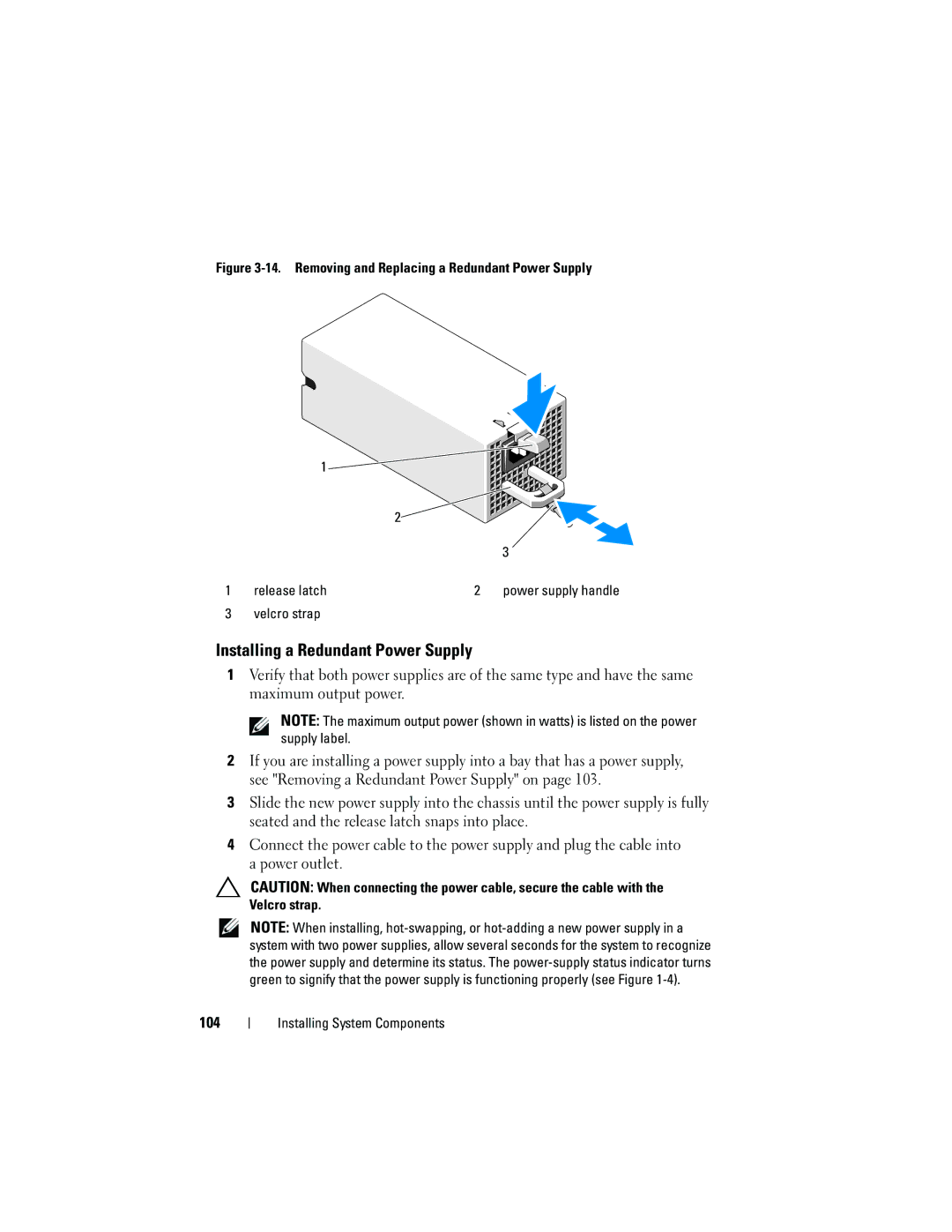
Installing a Redundant Power Supply
Velcro strap
Removing a Non-Redundant Power Supply
105
Removing the System Fan
Installing a Non-Redundant Power Supply
System Fan
System fan
Installing the System Fan
107
General Memory Module Installation Guidelines
System Memory
Mode-Specific Guidelines
109
Available
110
Memory Sockets Processor
Installing Memory Modules
111
Installing System Components
Removing Memory Modules
113
114
Expansion Card Installation Guidelines
Expansion Cards
Installing an Expansion Card
115
Installing System Components
117
Removing an Expansion Card
119
Installing an iDRAC6 Express Card
IDRAC6 Express Card Optional
Removing an iDRAC6 Express Card Optional
Notch
121
Installing an iDRAC6 Enterprise Card
IDRAC6 Enterprise Card Optional
IDRAC6 Enterprise card connector
Removing an iDRAC6 Enterprise Card
123
Installing a VFlash Media
VFlash Media Optional
Internal USB Memory Keys
Removing a VFlash Media
21. Removing or Installing a USB Memory Key USB memory key
125
Processor
Removing a Processor
22. Installing and Removing the Heat Sink Heat sink
127
128
Processor shield ZIF socket Socket key
Installing a Processor
129
System battery is a 3.0-volt V, coin-cell battery
System Battery
Replacing the System Battery
24. Replacing the System Battery
131
RAID Battery Optional
Removing the RAID Battery
Installing a RAID Battery
Battery carrier Battery carrier tabs
RAID battery
133
Chassis Intrusion Switch
Removing the Chassis Intrusion Switch
135
Installing the Chassis Intrusion Switch
Intrusion connector on the system board
Control Panel Assembly
Removing the Control Panel Assembly
137
Removing the SAS Backplane
Installing the Control Panel Assembly
SAS Backplane
139
Removing the Power Distribution Board
Power Distribution Board
Installing the SAS Backplane
141
Replacing the Power Distribution Board
System Board
Removing the System Board
142
143
Installing the System Board
System board
145
146
Troubleshooting Your System
147
Troubleshooting a USB Device
Troubleshooting External Connections
Troubleshooting the Video Subsystem
149
Troubleshooting a Serial I/O Device
Troubleshooting a NIC
Troubleshooting a Wet System
151
152
Troubleshooting a Damaged System
Troubleshooting the System Battery
Troubleshooting Power Supplies
153
Troubleshooting System Cooling Problems
Troubleshooting a Fan
Troubleshooting System Memory
155
Troubleshooting Your System
Troubleshooting an Internal USB Key
157
Troubleshooting an Optical Drive
Troubleshooting a Tape Backup Unit
159
Troubleshooting a Hard Drive
Troubleshooting a SAS or SAS RAID Controller
161
Troubleshooting Expansion Cards
Open the system. See Opening the System on 162
Troubleshooting the Processor
163
Troubleshooting Your System
Using Online Diagnostics
Embedded System Diagnostics Features
Running the System Diagnostics
165
When to Use the Embedded System Diagnostics
Running the Embedded System Diagnostics
System Diagnostics Testing Options
Using the Custom Test Options
Selecting Devices for Testing
Selecting Diagnostics Options
Viewing Information and Results
169
Cycle pins
System Board Jumpers
System Board Connectors
170
171
172
SAS Backplane Board Connectors
Hard drive connectors
SAS a connector Jumpers and Connectors
Front Back
JPWR1 connector JPWR2 connector
Power Distribution Board Connectors
Disabling a Forgotten Password
175
176
Getting Help
Contacting Dell
177
178
179
Amperes AC Alternating current
180
181
182
183
Mm Millimeters Ms Milliseconds
184
185
System memory See RAM
186
TCP/IP Transmission Control Protocol/Internet Protocol
187
188
Index
Using Dell PowerEdge Diagnostics
189
190
Post
191
192
Wet system Uefi Boot Manager entering, 69 main screen
193
194