Chapter 3 — Configuring the Computer
AutoExec
AutoExec (AutoExec.exe) automates operations such as pausing, launching processes, or signaling, and is configured through the AutoExec data file (AutoExec.dat). This script file must be in the same directory as the program itself.
Note: Intermec considers the usage of the AutoExec data file as “Intermec Private.” AutoExec installs Intermec applications such as Data Collection, Security Supplicants, Intermec Management, applets, and shortcuts from components found in the Flash File System. Do not modify the AutoExec data file. Instead, use the AutoRun program to add software components.
Usage:
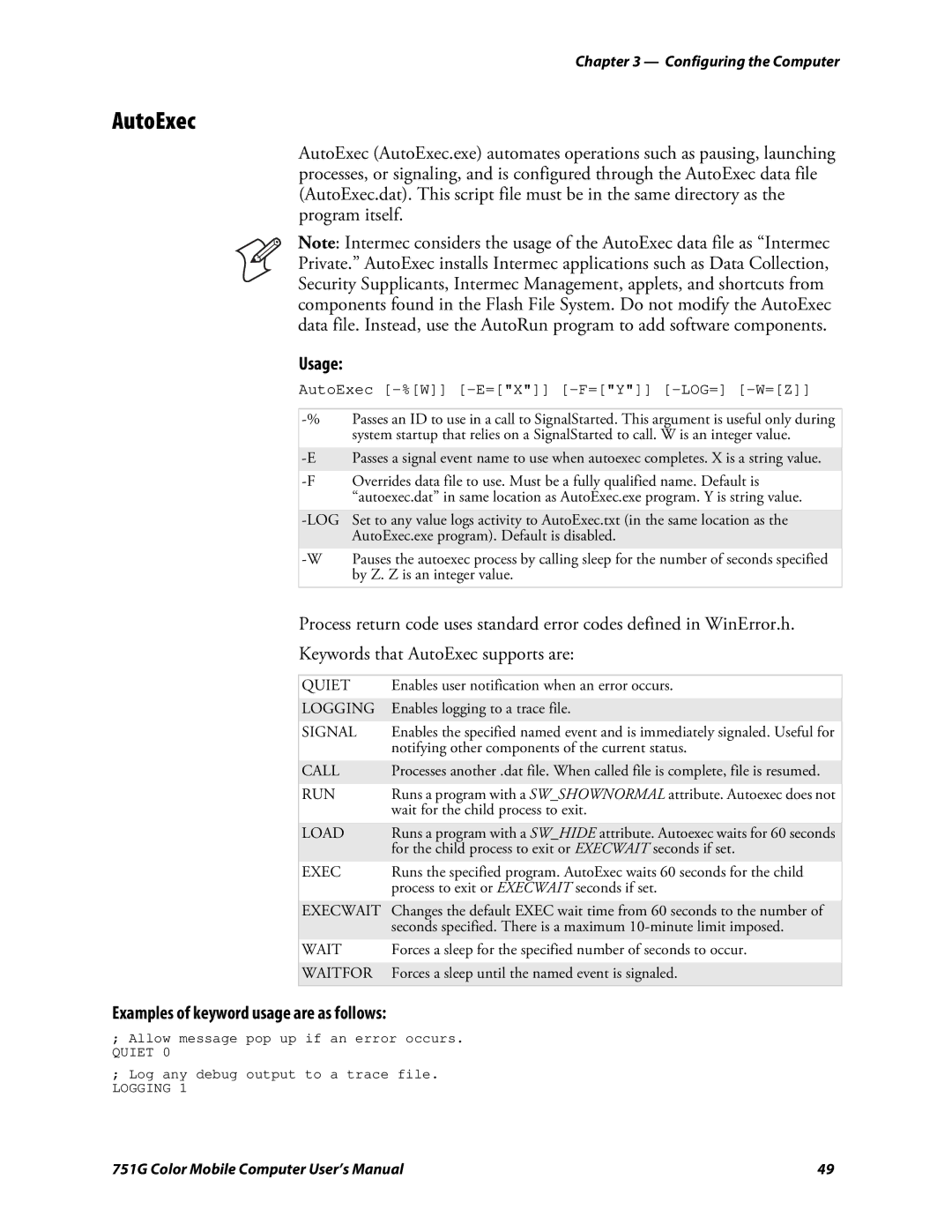
AutoExec
Process return code uses standard error codes defined in WinError.h.
Keywords that AutoExec supports are:
QUIET | Enables user notification when an error occurs. |
|
|
LOGGING | Enables logging to a trace file. |
SIGNAL | Enables the specified named event and is immediately signaled. Useful for |
| notifying other components of the current status. |
CALL | Processes another .dat file. When called file is complete, file is resumed. |
RUN | Runs a program with a SW_SHOWNORMAL attribute. Autoexec does not |
| wait for the child process to exit. |
LOAD | Runs a program with a SW_HIDE attribute. Autoexec waits for 60 seconds |
| for the child process to exit or EXECWAIT seconds if set. |
EXEC | Runs the specified program. AutoExec waits 60 seconds for the child |
| process to exit or EXECWAIT seconds if set. |
EXECWAIT | Changes the default EXEC wait time from 60 seconds to the number of |
| seconds specified. There is a maximum |
WAIT | Forces a sleep for the specified number of seconds to occur. |
|
|
WAITFOR | Forces a sleep until the named event is signaled. |
|
|
Examples of keyword usage are as follows:
;Allow message pop up if an error occurs.
QUIET 0
;Log any debug output to a trace file.
LOGGING 1
751G Color Mobile Computer User’s Manual | 49 |