13.2 Maintenance activities

i NOTICE

2

9

1

43

fan unit and gas valve figure 27

i NOTICE

10

figure 28

Series-ERinnaiInstructions

i

NOTICE


!

DANGER


Servicing&Installation

Clamping rods

figure 29


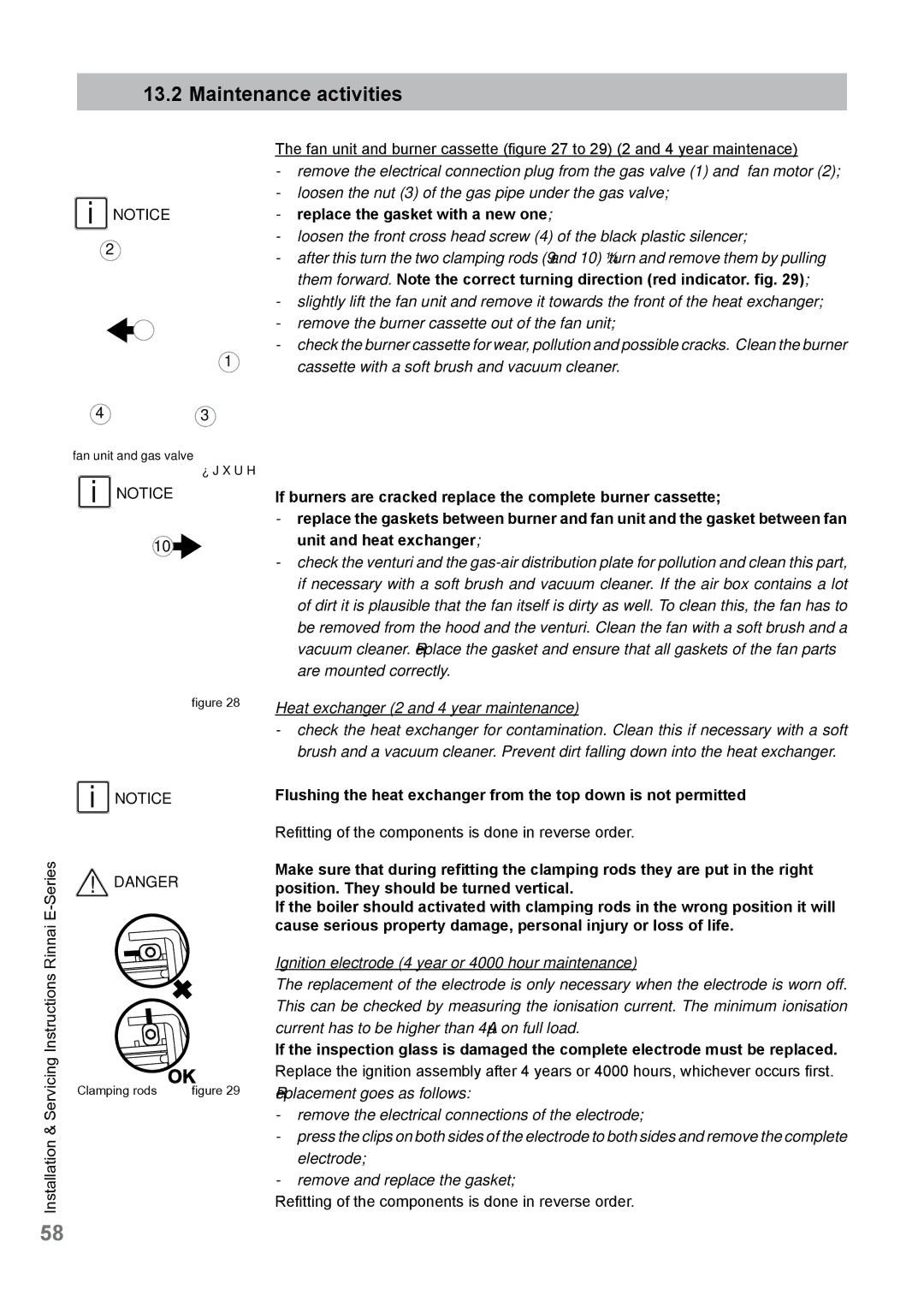
The fan unit and burner cassette (figure 27 to 29) (2 and 4 year maintenace)

-remove the electrical connection plug from the gas valve (1) and fan motor (2);

-loosen the nut (3) of the gas pipe under the gas valve;

-replace the gasket with a new one;

-loosen the front cross head screw (4) of the black plastic silencer;

-after this turn the two clamping rods (9 and 10) ¼ turn and remove them by pulling them forward. Note the correct turning direction (red indicator. fig. 29);

-slightly lift the fan unit and remove it towards the front of the heat exchanger;

-remove the burner cassette out of the fan unit;

-check the burner cassette for wear, pollution and possible cracks. Clean the burner cassette with a soft brush and vacuum cleaner.

If burners are cracked replace the complete burner cassette;

-replace the gaskets between burner and fan unit and the gasket between fan unit and heat exchanger;

-check the venturi and the gas-air distribution plate for pollution and clean this part, if necessary with a soft brush and vacuum cleaner. If the air box contains a lot of dirt it is plausible that the fan itself is dirty as well. To clean this, the fan has to be removed from the hood and the venturi. Clean the fan with a soft brush and a vacuum cleaner. Replace the gasket and ensure that all gaskets of the fan parts are mounted correctly.

Heat exchanger (2 and 4 year maintenance)

-check the heat exchanger for contamination. Clean this if necessary with a soft brush and a vacuum cleaner. Prevent dirt falling down into the heat exchanger.

Flushing the heat exchanger from the top down is not permitted

Refitting of the components is done in reverse order.

Make sure that during refitting the clamping rods they are put in the right position. They should be turned vertical.

If the boiler should activated with clamping rods in the wrong position it will cause serious property damage, personal injury or loss of life.

Ignition electrode (4 year or 4000 hour maintenance)

The replacement of the electrode is only necessary when the electrode is worn off. This can be checked by measuring the ionisation current. The minimum ionisation current has to be higher than 4µA on full load.

If the inspection glass is damaged the complete electrode must be replaced. Replace the ignition assembly after 4 years or 4000 hours, whichever occurs first. Replacement goes as follows:

-remove the electrical connections of the electrode;

-press the clips on both sides of the electrode to both sides and remove the complete electrode;

-remove and replace the gasket;

Refitting of the components is done in reverse order.

58

Page 58
Image 58
Rinnai E110CN, E110CP, E75CN, E75CP user manual Maintenance activities, Replace the gasket with a new one

E75CP, E110CN, E75CN, E110CP specifications

Rinnai is a leading name in the heating industry, recognized for producing highly efficient and reliable tankless water heaters. Among their popular models are the Rinnai E75CN, E75CP, E110CP, and E110CN, each designed to cater to various household needs and preferences.

The Rinnai E75CN and E75CP are both remarkable for their compact size and impressive heating capabilities. The E75CN is a natural gas model, while the E75CP runs on propane. These units are designed to deliver a maximum flow rate of up to 7.5 gallons per minute, ensuring that multiple fixtures can be used simultaneously without a dip in performance.

Both models incorporate advanced temperature control technology, allowing users to set their desired water temperature with precision. The units feature a durable heat exchanger, constructed from high-grade stainless steel, which not only promotes longevity but also helps in preventing corrosion. Additionally, they come with built-in safety features, such as freeze protection and an overheat cut-off system, ensuring safe operation in varying conditions.

Moving on to the Rinnai E110CP and E110CN, these tankless water heaters are designed for larger households with higher hot water demands. The E110CP operates on propane, while the E110CN utilizes natural gas. These units deliver a maximum flow rate of up to 11 gallons per minute, making them ideal for simultaneous use in multiple bathrooms, kitchens, and laundry rooms.

The E110 models showcase Rinnai's Smart Technology, which optimizes energy consumption by adjusting the heating output based on the demand. This not only maximizes efficiency but also significantly reduces energy costs. They are equipped with digital controls and diagnostics, providing users with real-time information and the ability to troubleshoot easily if any issues arise.

In terms of installation, all four models are designed for versatility. They can be installed indoors or outdoors, giving homeowners flexibility based on their space and preference. With their compact design, these units require less space compared to traditional tank heaters, making them a suitable choice for modern homes.

Overall, Rinnai's E75CN, E75CP, E110PC, and E110CN models represent cutting-edge technology in tankless water heating. Their efficiency, safety features, and advanced technology make them an excellent choice for homeowners looking to upgrade their hot water systems. With Rinnai, users can enjoy the convenience of continuous hot water without sacrificing energy efficiency.