Documentation
Trademarks
Important information
Product support on the Internet
Location of the telephone
Contents
Enhanced phone functions
Displaying and assigning call charges
Not for HiPath 500
Using team functions
Testing the phone
Special functions in the LAN
Service
General information
About this manual
Intended use
Telephone type
Speakerphone quality and display legibility
Getting to know your OpenStage phone
User interface of your OpenStage 15 T
Properties of your OpenStage 15 T
OpenStage Key Module
Navigation keys
Keys
Audio keys
Mailbox key and Menu key
Meaning of LED displays on function keys
Programmable function keys
Keypad
Idle mode
Display
Idle menu
Mailbox
Messages
Voicemail
Busy
Caller list
Program/Service
Program/Service menu
Basic functions
Answering a call
Answering a call via the handset
Ending a call
Suggestions for using speakerphone mode
Switching to speakerphone mode
Switching to the handset
Mode
Deactivating
Activating
Dialing with DDS keys
Making calls
Off-hook dialing
On-hook dialing
Redialing a number
Ending a call
Displaying and dialing saved station numbers
Turning the microphone on and off
Reject calls
Combine the calling parties into a three-party con- ference
Switching to the held party alternating
Calling a second party consultation
Return to the first party
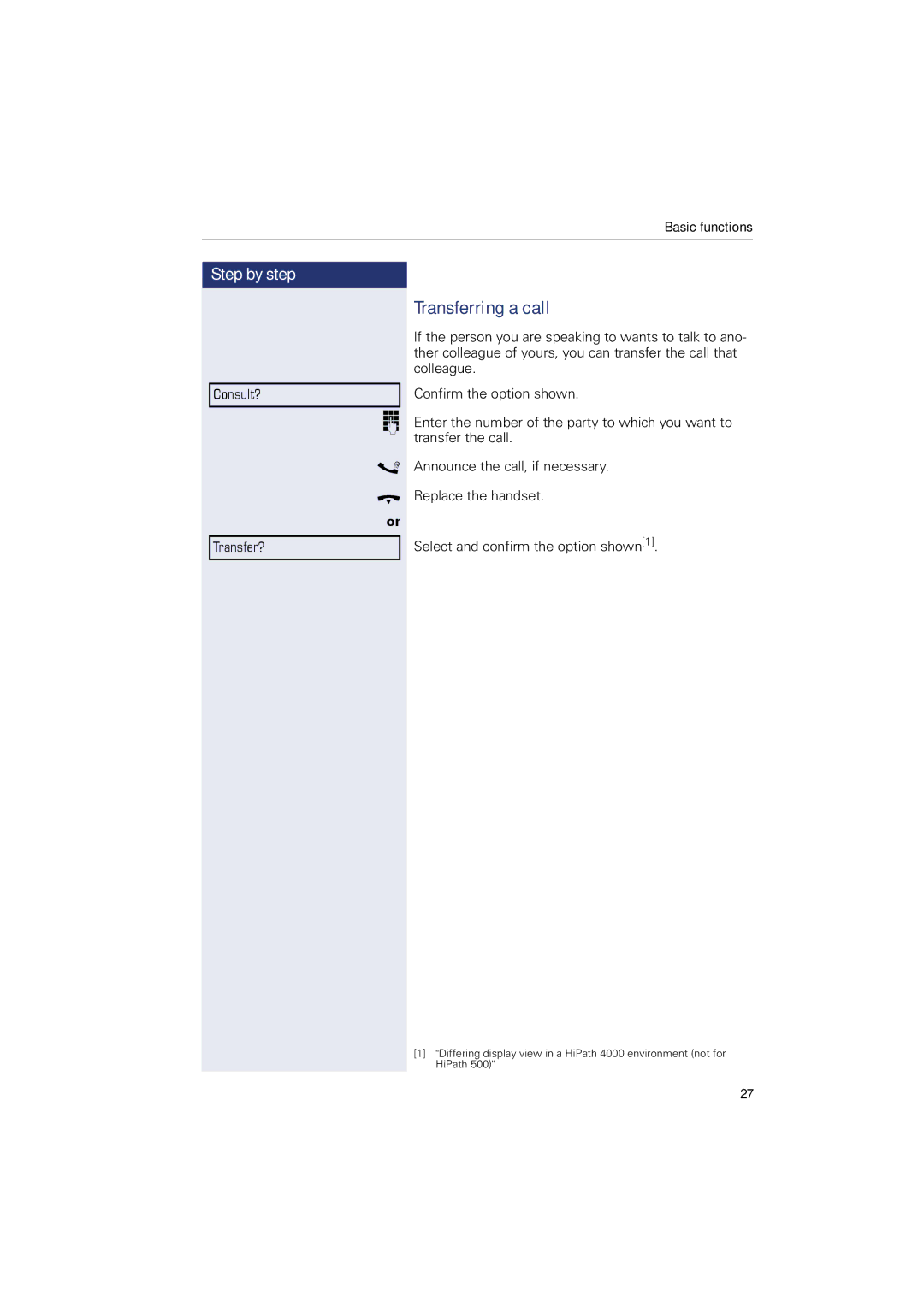
Transferring a call
Using variable call forwarding
Call forwarding
Deactivating call forwarding
Deactivating call forwarding no reply
Using call forwarding no reply Cfnr
Step by step
Using callback
Storing a callback
Accepting a callback
Viewing and deleting a stored callback
Deleting a displayed entry
Ending retrieval
Answering calls
Enhanced phone functions
Enabling and disabling handsfree answerback
Using the speakerphone
Opening the door with a code at the door
Speaking to visitors via the entrance telephone
Deactivating the door opener
Activating the door opener
Correcting numbers entered
Canceling en-bloc sending
En-bloc sending/correcting numbers
Dialing entered/displayed numbers
Dialing a station number from the caller list
Using the caller list
Retrieving the caller list
Displaying the call time
Entry you wish to dial appears on the screen
Dialing a number from the internal directory
Using the Ldap directory not for HiPath
Result is displayed
If no name is found
If too many names are found
Suffix-dialing
Making calls using system speed-dial numbers
Configure a speed-dial key
Dialing with speed-dial keys
If you make a mistake
Talking to your colleague with a speaker call
Assigning a station number not for U.S
Automatic connection setup hotline
Dialing aid from your telephone for another tele- phone
Associated dialing/dialing aid
Dialing aid on the S0 bus
Dialing aid at the a/b T/R port
Ending the second call and resuming the first one
Using call waiting second call
During a call
Ending the first call and answering the waiting call
Preventing and allowing call waiting automatic camp-on
Turning the call waiting tone on and off
Saving a number
Retrieving a parked call
Parking a call
Viewing the conference parties
Conducting a conference
If the second party does not answer
Adding up to five parties to a conference
Leaving a conference
Ending a conference
Removing the Isdn central office party from the conference
HiPath
Differing display view in a
Possible causes
Fixing problems
Responding to error messages
Contact partner in the case of pro- blems
Caring for your telephone
Troubleshooting
Labeling keys
Deleting
Index
106
107
108
UCD
Overview of functions and codes
110
111
112
Siemens Enterprise Communications