(unlike the Microsoft encoder). See Creating Publishing Points and Creating Publishing Points on Helix Universal Servers for more information.
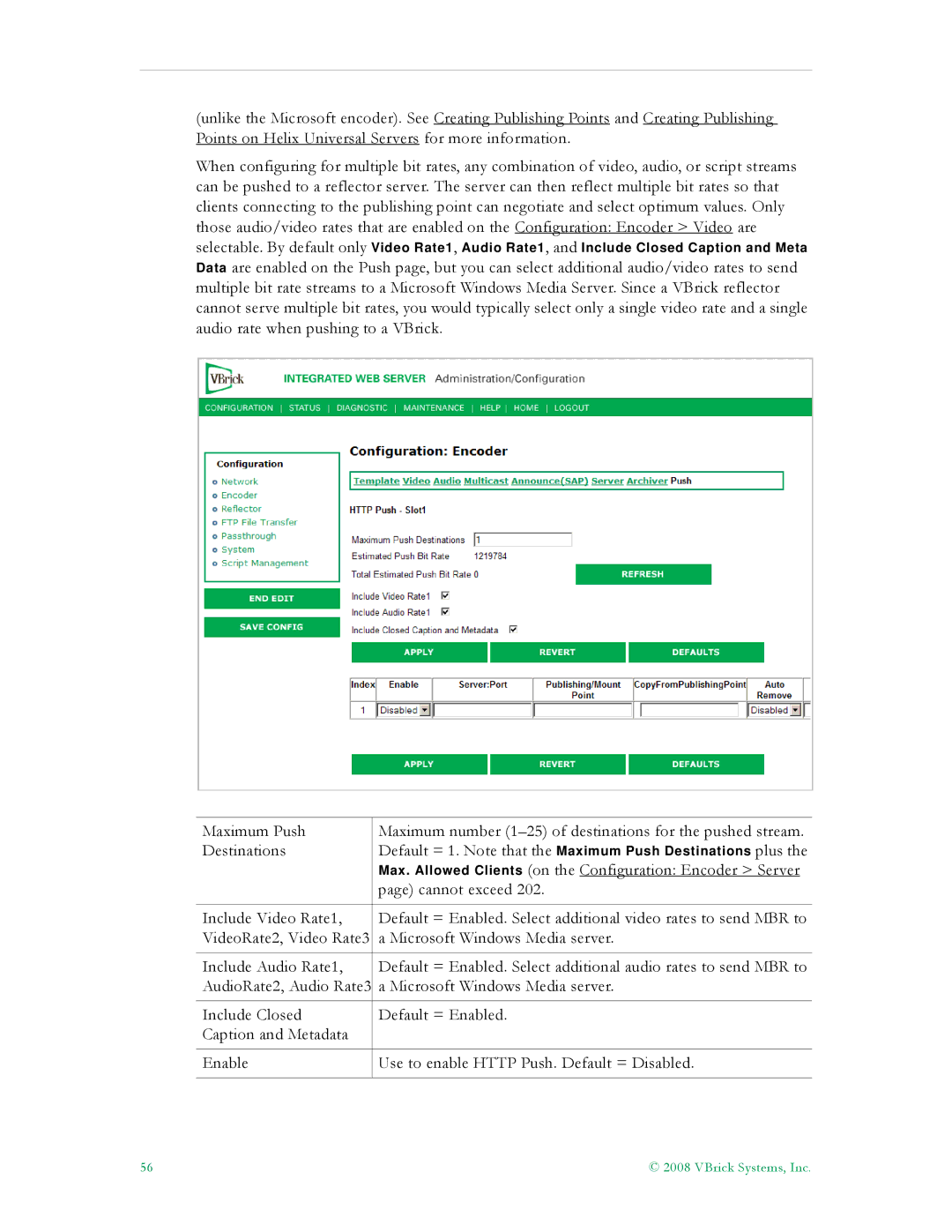
When configuring for multiple bit rates, any combination of video, audio, or script streams can be pushed to a reflector server. The server can then reflect multiple bit rates so that clients connecting to the publishing point can negotiate and select optimum values. Only those audio/video rates that are enabled on the Configuration: Encoder > Video are
selectable. By default only Video Rate1, Audio Rate1, and Include Closed Caption and Meta
Data are enabled on the Push page, but you can select additional audio/video rates to send multiple bit rate streams to a Microsoft Windows Media Server. Since a VBrick reflector cannot serve multiple bit rates, you would typically select only a single video rate and a single audio rate when pushing to a VBrick.
Maximum Push | Maximum number |
Destinations | Default = 1. Note that the Maximum Push Destinations plus the |
| Max. Allowed Clients (on the Configuration: Encoder > Server |
| page) cannot exceed 202. |
|
|
Include Video Rate1, | Default = Enabled. Select additional video rates to send MBR to |
VideoRate2, Video Rate3 | a Microsoft Windows Media server. |
|
|
Include Audio Rate1, | Default = Enabled. Select additional audio rates to send MBR to |
AudioRate2, Audio Rate3 | a Microsoft Windows Media server. |
|
|
Include Closed | Default = Enabled. |
Caption and Metadata |
|
|
|
Enable | Use to enable HTTP Push. Default = Disabled. |
|
|
56 | © 2008 VBrick Systems, Inc. |