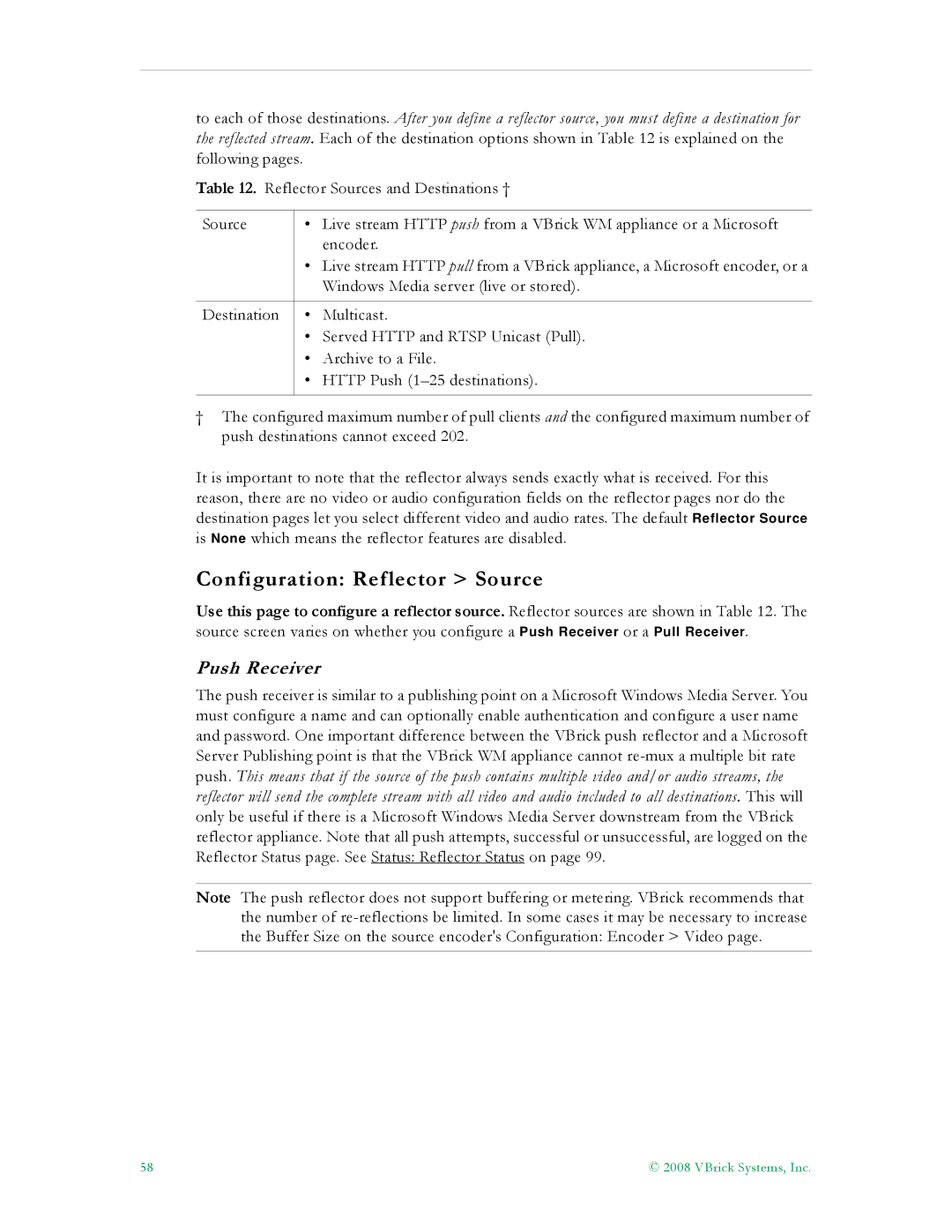
to each of those destinations. After you define a reflector source, you must define a destination for the reflected stream. Each of the destination options shown in Table 12 is explained on the following pages.
Table 12. Reflector Sources and Destinations †
Source | • Live stream HTTP push from a VBrick WM appliance or a Microsoft | |
|
| encoder. |
| • | Live stream HTTP pull from a VBrick appliance, a Microsoft encoder, or a |
|
| Windows Media server (live or stored). |
|
|
|
Destination | • | Multicast. |
•Served HTTP and RTSP Unicast (Pull).
•Archive to a File.
•HTTP Push
†The configured maximum number of pull clients and the configured maximum number of push destinations cannot exceed 202.
It is important to note that the reflector always sends exactly what is received. For this reason, there are no video or audio configuration fields on the reflector pages nor do the destination pages let you select different video and audio rates. The default Reflector Source is None which means the reflector features are disabled.
Configuration: Reflector > Source
Use this page to configure a reflector source. Reflector sources are shown in Table 12. The source screen varies on whether you configure a Push Receiver or a Pull Receiver.
Push Receiver
The push receiver is similar to a publishing point on a Microsoft Windows Media Server. You must configure a name and can optionally enable authentication and configure a user name and password. One important difference between the VBrick push reflector and a Microsoft Server Publishing point is that the VBrick WM appliance cannot
Note The push reflector does not support buffering or metering. VBrick recommends that the number of
58 | © 2008 VBrick Systems, Inc. |