Appendix D: Understanding RAID
●
168
RAID 5 Logical Drives
A RAID 5 logical drive is built from a minimum of three and a
maximum of sixteen disk drives, and uses data striping and parity (see
below) data to provide redundancy. Parity data provides data
protection, and striping improves performance.
Parity data is an error-correcting redundancy that’s used to re-create
data if a disk drive fails. In RAID 5 logical drives, parity data
(represented by Ps in the example below) is striped evenly across the
disk drives with the stored data.
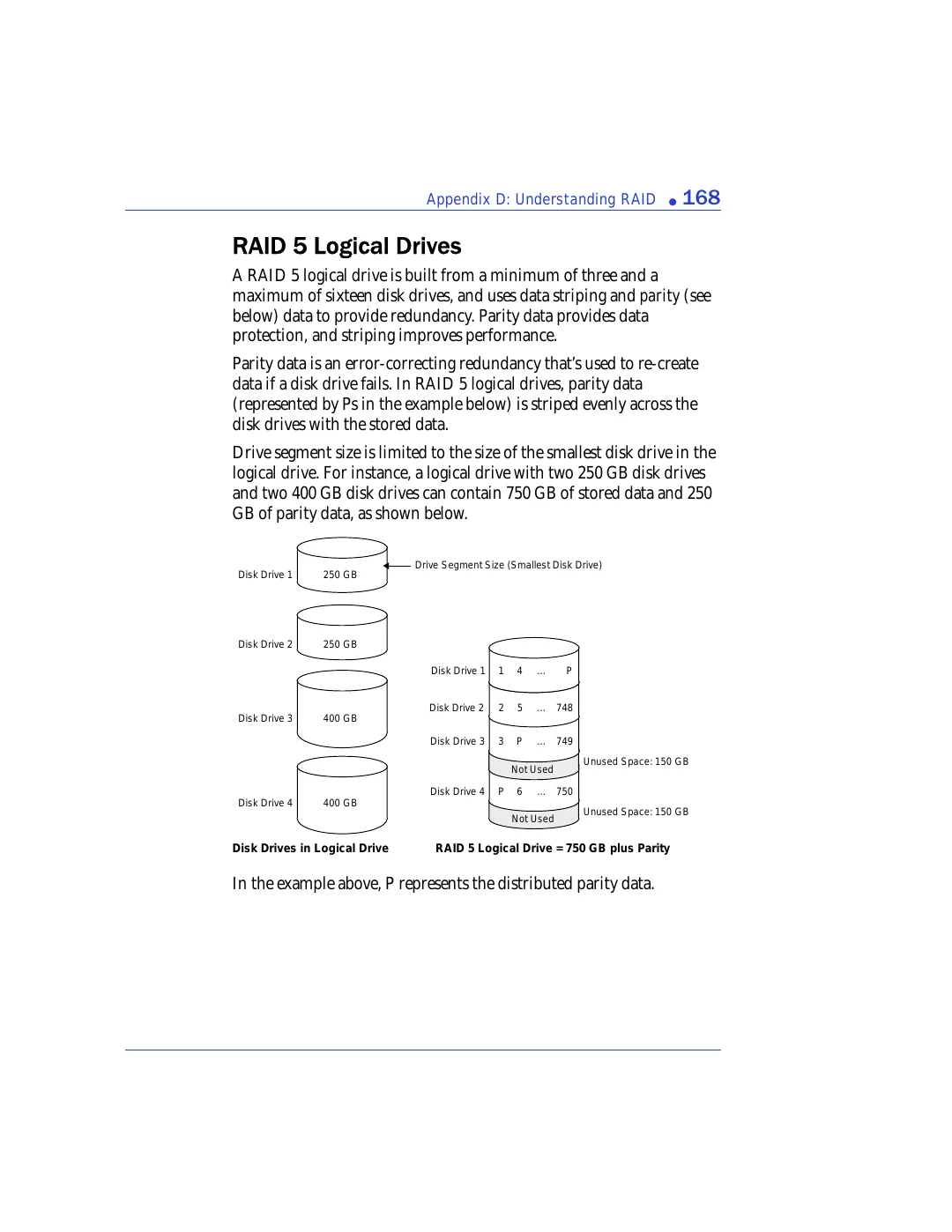
Drive segment size is limited to the size of the smallest disk drive in the
logical drive. For instance, a logical drive with two 250 GB disk drives
and two 400 GB disk drives can contain 750 GB of stored data and 250
GB of parity data, as shown below.
In the example above, P represents the distributed parity data.
Disk Drive 1
Disk Drive 2
Disk Drive 3
Disk Drive 4
250 GB
250 GB
400 GB
400 GB
Disk Drives in Logical Drive
Disk Drive 1
Disk Drive 2
Disk Drive 3
Disk Drive 4
RAID 5 Logical Drive = 750 GB plus Parity
1
2
3
P
Not Used
Not Used
4
5
P
6
750
749
748
P
...
...
...
...
Unused Space: 150 GB
Unused Space: 150 GB
Drive Segment Size (Smallest Disk Drive)