Mode PVC
Disabling a Frame Relay PVC
Enabling a Frame Relay PVC
CRC
Displaying serial port information
Dlci
Displaying Frame Relay information
Integrated service access
Port
Configure the serial interface settings
Check that the Frame Relay settings are correct
Configure the introduced PVCs
T1/E1 port configuration
Enable/Disable T1/E1 port
T1/E1 port configuration task list
Configuring T1/E1 port-type
Mode port e1t1 slot port
Configuring T1/E1 clock-mode
Configuring T1/E1 line-code
Configuring T1/E1 line-build-out T1 only
Configuring T1/E1 framing
Configuring T1/E1 used-connector E1 only
Name prt-e1t1 slot/port# framing
Configuring T1/E1 LOS threshold
Configuring T1/E1 application mode
Configuring T1/E1 encapsulation
Default short-haul
Configuring Channel-Group Timeslots
Be used Mode port e1t1 slot port
Mode channel-group group-name
Configuring Channel-Group Encapsulation
Configuring Hdlc Encapsulation
Configuring Hdlc CRC-Type
T1/E1 Configuration Examples
Default no encapsulation
Example 1 Frame Relay without a channel-group
Example 4 PPP with a channel-group
Example 2 Framerelay with a channel-group
Example 3 PPP without a channel-group
VPN configuration
Encryption
Authentication
Creating an IPsec transformation profile
VPN configuration task list
Transport and tunnel modes
Creating an IPsec policy profile
Procedure To create an IPsec policy profile
Nodecfg#profile ipsec-policy-man
Creating/modifying an outgoing ACL profile for IPsec
Displaying IPsec configuration information
Configuration of an IP interface and the IP router for IPsec
Example Display IPsec policy profiles
Example Display IPsec transformation profiles
Debugging IPsec
Example IPsec Debug Output
IPsec tunnel, DES encryption
Sample configurations
OnSite configuration
Cisco router configuration
Cisco router configuration
VPN configuration
Access control list configuration
Why you should configure access lists
About access control lists
What access lists do
Features of access control lists
When to configure access lists
Mapping out the goals of the access control list
Access control list configuration task list
Nodepf-acl name#permit ip src src-wildcard any
Src-wildcard
Where the syntax is
Type type type type code code cos group
Nodepf-acl name#permit icmp src src-wildcard any
Nodepf-acl name#deny icmp src src-wildcard
Any host src dest dest-wildcard any host dest
Msg name
Where the syntax is as following
Card any host src eq port gt port lt port range
Nodepf-acl name#permit tcp udp sctp src src-wild
Port lt port range from to cos group cos-rtp group
Nodepf-acl name#deny tcp udp sctp src src
Group-data
Where the syntax is
Debugging an access control list profile
Unbind an access control list profile from an interface
Displaying an access control list profile
Control list profile shall be debugged
Denying a specific subnet
Examples
Link scheduler configuration
Configuring access control lists
Applying scheduling at the bottleneck
Configuring quality of service QoS
Using traffic classes
Priority
Weighted fair queuing WFQ
Introduction to Scheduling
Hierarchy
Shaping
Burst tolerant shaping or wfq
Some explanations
Setting the modem rate
Quick references
Command cross reference
Link scheduler configuration task list
Packet classification
Defining the access control list profile
Scenario with Web server regarded as a single source host
Creating an access control list
Nodecfg#profile acl name
Creating a service policy profile
Nodepf-acl name#permit ip host ip-address any traffic-class
Nodepf-acl name#permit ip any any
Structure of a Service-Policy Profile
Specifying the handling of traffic-classes
Defining fair queuing weight
Defining the bit-rate
Specifying the type-of-service TOS field
Defining absolute priority
Defining the maximum queue length
Specifying the precedence field
Specifying differentiated services codepoint Dscp marking
Nodesrc name#set ip tos value
Nodesrc name#set ip precedence value
Nodesrc name#set layer2 cos value
Specifying layer 2 marking
Nodesrc name#set ip dscp value
Nodesrc name#random-detect burst-tolerance
Defining random early detection
Discarding Excess Load
Policy name in out
Devoting the service policy profile to an interface
Nodeif-ip if-name#use profile service
Displaying link scheduling profile information
Enable statistics gathering
Displaying link arbitration status
Values defining detail of the queuing statistics
LEDs status and monitoring
Status LEDs
Contacting Patton for assistance
Patton Support Headquarters in the USA
Warranty coverage
Contact information
Returns for credit
Out-of-warranty service
Return for credit policy
RMA numbers
Appendix a Compliance information
Compliance
Safety
Radio and TV Interference FCC Part
CE Declaration of Conformity
Industry Canada Notice Model 2803 only
Authorized European Representative
FCC Part 68 Acta Statement Model 2803 only
Appendix B Specifications
Sync serial interface
Ethernet interfaces
T1/E1 interface Model 2803 only
PPP support
Dimensions
IP services
Management
Operating environment
Internal AC version
Power supply
Internal power supply 100-240 VAC, 50/60 Hz, 200 mA
Appendix C Cabling
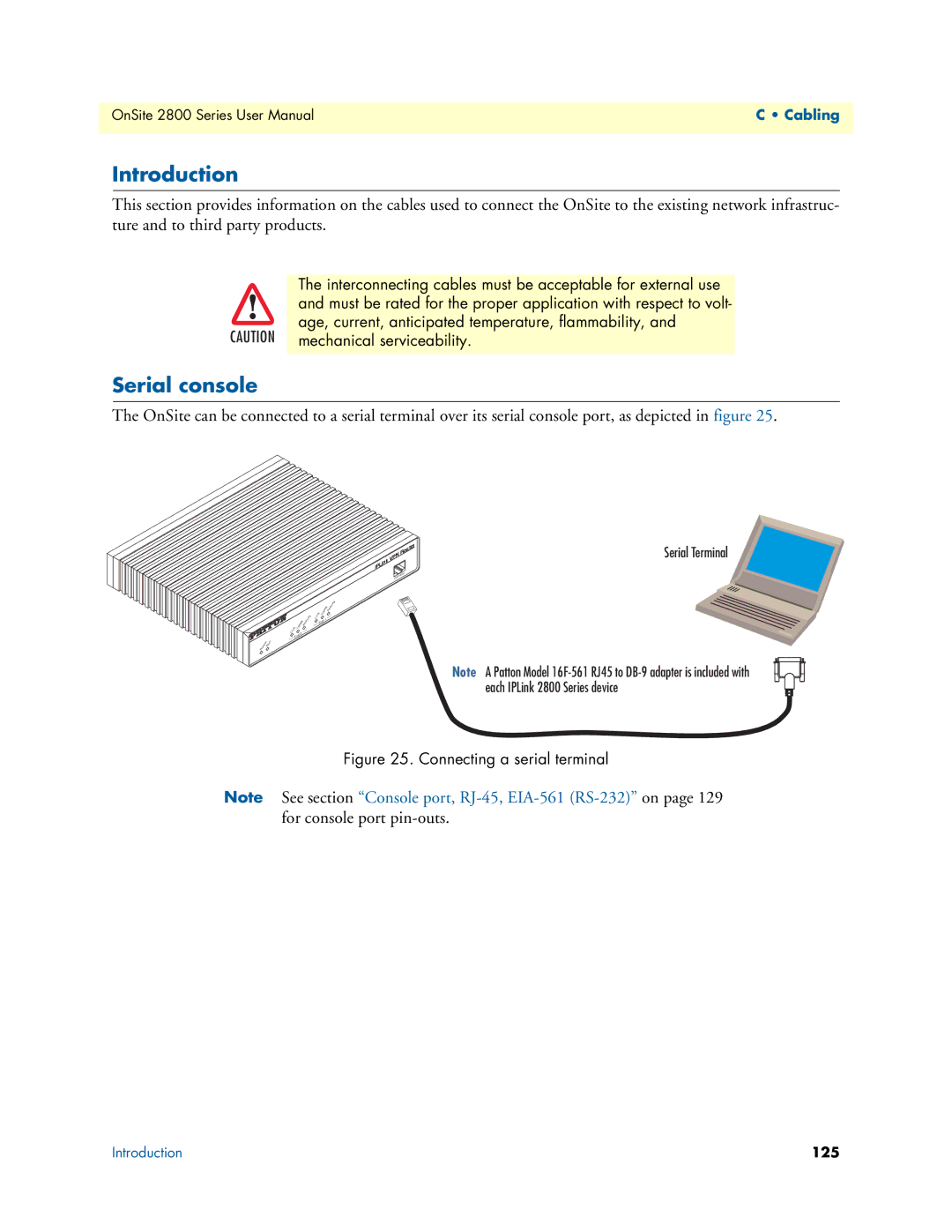
Serial console
Connecting a serial terminal
Ethernet cross-over
Ethernet 10Base-T and 100Base-T
Ethernet straight-through
Appendix D Port pin-outs
EIA-561 RJ-45 8-pin port RS-232 Console Port
Console port, RJ-45, EIA-561 RS-232
Sync serial port
Ethernet 10Base-T and 100Base-T port
Ethernet ports are auto-detect MDI-X
Serial port
21 Female DB-15 connector
Appendix E OnSite 2800 Series factory configuration
OnSite 2800 Series factory configuration
Appendix F Installation checklist
Installation checklist