10. Real-Time Clock RTCxR Data Registers
11. Real-Time Clock Control Register Rtccr adr =
Watchdog Timer
12. Watchdog Timer Control Register Wdtcr adr =
13. Watchdog Timer Test Register Wdttr adr =
System Reset
14. Rabbit 3000 Reset Sequence and State of I/O Pins
Pin Name Direction Reset Low Post-Reset† Recognized by CPU
Rabbit Interrupt Structure
15. Interrupts-Priority and Action to Clear Requests
External Interrupts
External Interrupt Line Logic
Reg Name Reg Address Bits 7,6 Bits 5,4 Bits 3,2 Bits 1,0
Interrupt Vectors INT0 EIR,0x00/INT1 EIR,0x08
16. Control Registers for External Interrupts
Bootstrap Operation
102 Rabbit 3000 Microprocessor
Pulse Width Modulator
Pulse Width LSBs 1st 2nd 3rd 4th
17. PWM LSB x Register
18. PWM MSB x Register
Input Capture
106 Rabbit 3000 Microprocessor
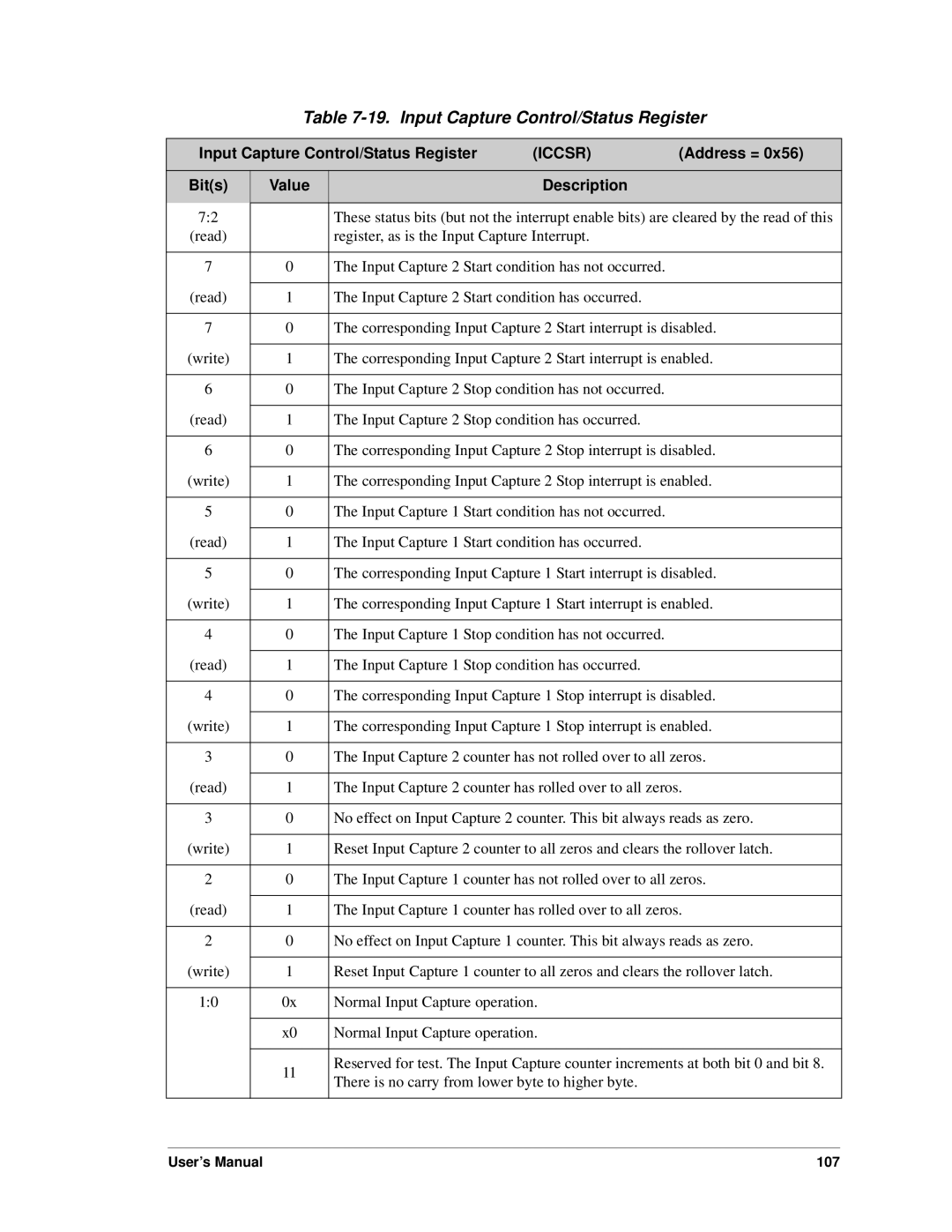
Iccsr
19. Input Capture Control/Status Register
Input Capture Control/Status Register
20. Input Capture Control Register
21. Input Capture Trigger x Register
Iccr
ICT1R
24. Input Capture MSB x Register
22. Input Capture Source x Register
23. Input Capture LSB x Register
Quadrature Decoder
Rejected
Qdcsr
25. Quadrature Decoder Control/Status Register
Quad Decode Control/Status Register
26. Quadrature Decoder Control Register
27. Quadrature Decoder Count Register
Qdcr
QDC1R
114 Rabbit 3000 Microprocessor
Memory Interface and Mapping
Interface for Static Memory Chips
RAM
Rabbit
Data Lines Static Address Lines Memory Flash
Processor Memory Mapping Unit Interface Memory Chips
Memory Mapping Overview
Memory-Mapping Unit
64K
Segment Registers
Segment Size Register
Segment Register Function
Memory Interface Unit
Memory Bank Control Registers
Memory Bank Control Register x MBxCR = 0x014 +
Optional A16, A19 Inversions by Segment /CS1 Enable
MMU Instruction/Data Register Mmidr =
MMU Instruction/Data Register
Mmidr
Memory Timing Control Register MTCR, adr =
MMU Expanded Code Register
Mecr
Memory Timing Control Register
Allocation of Extended Code and Data
Breakpoint/Debug Control Register BDCR, adr = 0x01C
Breakpoint/Debug Control Register
Bdcr
Instruction and Data Space Support
RAM
Use of Physical Memory Separate I & D Space Model
How the Compiler Compiles to Memory
128 Rabbit 3000 Microprocessor
Parallel Ports
Parallel Port a Data Register Bit Functions
Parallel Port a
Parallel Port a Registers
Parallel Port B Register Bit Functions
Parallel Port B
Parallel Port B Registers
Parallel Port C Register Bit Functions
Parallel Port C
Parallel Port C Registers
Parallel Port D
Parallel Port D Registers
PD7
Bits 7 Bits 5 Bits 3 Bits 1
Parallel Port D Register functions
Parallel Port D Control Register adr =
136 Rabbit 3000 Microprocessor
Parallel Port E
PE0
10. Parallel Port E Registers
11. Parallel Port E Register functions
12. Parallel Port E Control Register adr =
14. Parallel Port F Register Functions
Parallel Port F
13. Parallel Port F Registers
Using Parallel Port a and Parallel Port F
15. Parallel Port F Control Register adr = 0x03C
Serial Port Software Suggestions
Push AF IOI LD A,SCSR
Controlling an RS-485 Driver and Receiver
Transmitting Dummy Characters
Using a Serial Port to Generate a Periodic Interrupt
Transmitting and Detecting a Break
Parity, Extra Stop Bits with 7-Data-Bit Characters
Parity, Extra Stop Bits with 8-Data-Bit Characters
Stop bit Start bit Data bits 9th bit low
Stop bit
Data Framing/Modbus
Supporting 9th Bit Communication Protocols
Rabbit-Only Master/Slave Protocol
User’s Manual 197
198 Rabbit 3000 Microprocessor
Rabbit Slave Port
SRD SCS
Slave Port Read Cycle
Symbol Parameter Minimum Maximum
Following table explains the parameters used in Figure
Slaveattn PB7
Typical Connection Slave Rabbit to Master Rabbit
Hardware Design of Slave Port Interconnection
Slave Port Registers
Slave Port Registers
Register Mnemonic Internal Address External Address
Slave Port Control Register Spcr adr =
Bit Bits 6,5 Bit 3,2 Bits 1,0 Write Only Read Only
Slave Port Status Register Spsr adr =
Applications and Communications Protocols for Slaves
Slave Applications
Master-Slave Messaging Protocol
208 Rabbit 3000 Microprocessor
Rabbit 3000 Clocks
Rabbit 3000 Main Oscillator Circuit
Low-Power Design
EMI Control
Power Supply Connections and Board Layout
Using the Clock Spectrum Spreader
Spread Spectrum Enable/Disable Register
Spread Spectrum Mode Select
GCM0R
GCM1R
214 Rabbit 3000 Microprocessor
AC Timing Specifications
Memory Access Time
Access Enable Access MHz
Memory Requirements at 3.3 V, -40C to +85C, Adr Bus 60 pF
Normal Strong 30 pF 60 pF 90 pF No dbl/dbl
Data and Clock Delays VDD ±10%, Temp, -40C-+85C maximum
VDD
CSx
Time Delay Output Capacitance 30 pF 60 pF 90 pF
Memory Read Time Delays
Memory Write Time Delays
CLK A190 CSx WEx D70
Example
Clock Doubler Max-Min Clock Low Times
222 Rabbit 3000 Microprocessor
16.2 I/O Access Time
Bufen
I/O Read Time Delays
I/O Write Time Delays
Further Discussion of Bus and Clock Timing
Clock Doubler and Memory Timing
Maximum Clock Speeds
Maximum Clock Speeds at 3.3 V Preliminary
Conditions Commercial Ratings Industrial Ratings
Period Frequency
External Oscillator Buffer
Power and Current Consumption
User’s Manual 229
Rabbit 3000 System Current vs. Frequency at 3.3
11. Sleepy Mode Current Consumption
Current Consumption Mechanisms
Sleepy Mode Current Consumption
Memory Current Consumption
Battery-Backed Clock Current Consumption
Current is negligible for V 1.14
Reduced-Power External Main Oscillator
Voltage Current incl built-in buffer
Bios Services
Rabbit Bios and Virtual Driver
Bios
Bios Assumptions
Watchdog Timer Support
Virtual Driver
Periodic Interrupt
User’s Manual 239
240 Rabbit 3000 Microprocessor
Power Management Support
Other Rabbit Software
Reading and Writing I/O Registers
Using Assembly Language
Using Library Functions
Shadow Registers
Updating Shadow Registers
Interrupt While Updating Registers
Atomic Instruction
Non-atomic Instructions
Timer and Clock Usage
Write-only Registers Without Shadow Registers
Format of the structure used is the following
246 Rabbit 3000 Microprocessor
Rabbit Instructions
Summary
Spreadsheet Conventions
Flag Description
Symbols
Rabbit Z180 Meaning
Load Immediate Data
Load & Store to Immediate Address
19.3 8-bit Indexed Load and Store
19.4 16-bit Indexed Loads and Stores
19.5 16-bit Load and Store 20-bit Address
Register to Register Moves
19.9 16-bit Arithmetic and Logical Ops
Exchange Instructions
Stack Manipulation Instructions
19.10 8-bit Arithmetic and Logical Ops
ADD A,HL
19.11 8-bit Bit Set, Reset and Test
19.12 8-bit Increment and Decrement
19.13 8-bit Fast a Register Operations
19.14 8-bit Shifts and Rotates
Instruction Prefixes
Block Move Instructions
Control Instructions Jumps and Calls
Miscellaneous Instructions
Privileged Instructions
Following instructions are privileged
Differences Rabbit VS. Z80/Z180 Instructions
Z80/Z180 Instructions Dropped Rabbit Instructions to Use
IOI and IOE I Column Symbol Key
Flag Register Key
Rabbit Z180 Meaning
Z V C
EX AF,AF
LD A,BC
LDP HL,IX
RRA
268 Rabbit 3000 Microprocessor
Appendix A. the Rabbit Programming Port
Programming Port PIN Assignments
Use of the Programming Port as a Diagnostic/Setup Port
Alternate Programming Port
Suggested Rabbit Crystal Frequencies
Non-Stock Crystals
Appendix B. Rabbit 3000 Revisions
274 Rabbit 3000 Microprocessor
User’s Manual 275
Discussion of Fixes and Improvements
Table B-1. Summary of Rabbit 3000 Improvements and Fixes
Rabbit Description 3000 3000A
IL1T/IZ1T IL2T/IZ2T
Table B-2. Reset State of New Rabbit 3000A I/O Registers
Rabbit Internal I/O Registers
Iuer
Rabbit Register Name Mnemonic 3000 3000A Address Reset
Peripheral and ISR Address
On-Chip Peripheral Address Range ISR Starting Address
User’s Manual 281
Revision-Level ID Register
Table B-5. Rabbit 3000 Revision Identification Information
Processor Revision Package
Gcpu Grev
System/User Mode
Memory Protection
Table B-6. Write Protect Control Register
Write Protect Control Register
Wpcr
Wplr
Table B-7. Write Protect Low Register
Write Protect Low Register
Table B-8. Write Protect High Register
Table B-9. Write Protect Segment x Register
Wphr
Wpsar
Table B-10. Write Protect Segment x Low Register
Write Protect Segment x Low Register
Wpsalr
Wpsblr
Table B-11. Write Protect Segment x High Register
Write Protect Segment x High Register
Wpsahr
Wpsbhr
Stack Protection
Figure B-2. Simple Stack Protection Layout
Table B-14. Stack High Limit Register
Table B-12. Stack Limit Control Register
Table B-13. Stack Low Limit Register
RAM Segment Relocation
Table B-15. RAM Segment Register
RAM Segment Register
Ramsr
Secondary Watchdog Timer
Table B-16. Watchdog Timer Control Register-Updated
Table B-17. Secondary Watchdog Timer Register
Wdtcr
New Opcodes
Table B-18. New Rabbit 3000 Opcodes
Instruction Bytes Clks Operation
New UMA/UMS Opcodes
Table B-19. Rabbit 3000 Revision Block Copy Opcode Effects
New Block Copy Opcodes
Source Destination
IOI/IOE
Expanded I/O Memory Addressing
Table B-20. MMU Instruction/Data Register
External I/O Improvements
Table B-21 Bank x Control Register
Address = 0x000D
Table B-22. Global Power Save Control Register
Short Chip Select Timing for Writes
Table B-24. Clock Select Field of Gcsr
Clock Select and Power Save Modes
Table B-23. Global Control/Status Register
Short Chip Select Timing
Figure B-3. Short Chip Select Timing CLK/8, Read Operation
Figure B-4. Short Chip Select Timing CLK/6, Read Operation
Figure B-6. Short Chip Select Timing CLK/2, Read Operation
Figure B-7. Short Chip Select Timing 2 kHz, Read Operation
Figure B-9. Short Chip Select Timing 8 kHz, Read Operation
Figure B-11. Short Chip Select Timing 32 kHz, Read Operation
Figure B-12. Short Chip Select Timing CLK/8, Write Operation
Figure B-13. Short Chip Select Timing CLK/6, Write Operation
Figure B-15. Short Chip Select Timing CLK/2, Write Operation
Figure B-16. Short Chip Select Timing 2 kHz, Write Operation
Figure B-18. Short Chip Select Timing 8 kHz, Write Operation
310 Rabbit 3000 Microprocessor
Pulse Width Modulator Improvements
Figure B-21. PWM Interrupt and Output Timing
Table B-25. PWM LSB 0 Register
Table B-26. PWM LSB 1 Register
PWM LSB 0 Register
PWM LSB 1 Register
Address = 0x008E
Table B-27. PWM LSB 2 and 3 Registers
Address = 0x008C
Quadrature Decoder Improvements
Table B-28. Quadrature Decoder Control Register
Table B-29. Quadrature Decoder Count High Register
QDC1HR
User’s Manual 315
Pins with Alternate Functions
Serial Ports E/F
Table C-1. Differences Between System and User Modes
Appendix C. SYSTEM/USER Mode
System Mode User Mode
Instruction Bytes Clk Operation Priv
System/User Mode Opcodes
Table C-2. New System/User Mode Opcodes
System/User Mode Registers
Table C-3. System/User Mode I/O Registers
Table C-4. I/O Addresses Inaccessible in User Mode
Register Name Mnemonic Address
Figure C-1. Interrupt Handing in System/User Mode
Interrupts
Peripheral Interrupt Prioritization
Table C-5. Interrupts-Priority and Action to Clear Requests
Using the System/User Mode
Memory Protection Only
Mixed System/User Mode Operation
Figure C-3. System/User Mode Setup for Mixed Operation
Figure C-4. System/User Mode Setup for Operating System
Complete Operating System
Appendix D. Rabbit 3000A Internal I/O Registers
Table D-1 Rabbit 3000A Internal I/O Registers
Table D-1. Rabbit 3000A Internal I/O Registers
0x03C0 00000000 Serial Port E User Enable Register
0x006A Xxxxxxxx Port D Bit 3 Register
0x0082 00000000 Bank 3 Control Register
0x0098 Xx000000 Interrupt 1 Control Register
0x00D1 Xxxxxxxx Serial Port B Long Stop Register
334 Rabbit 3000 Microprocessor
User’s Manual 335
Page
Index
Numerics
Memory A16, A19 inversions /CS1
PWL2R, PWL3R
200