|
| Making Call Transfers Using QSIG |
|
|
|
Name Identification | This feature allows the Bfv API to see the text name of the user | |
| similar to Caller ID on an analog phone line. Therefore, if the | |
| network provides the calling party, the calling party’s name is | |
| reported through BfvLineWaitForCall/BfvCallWaitForSetup | |
| functions located in the res.calling_party_subaddress field of the | |
| args structures. | |
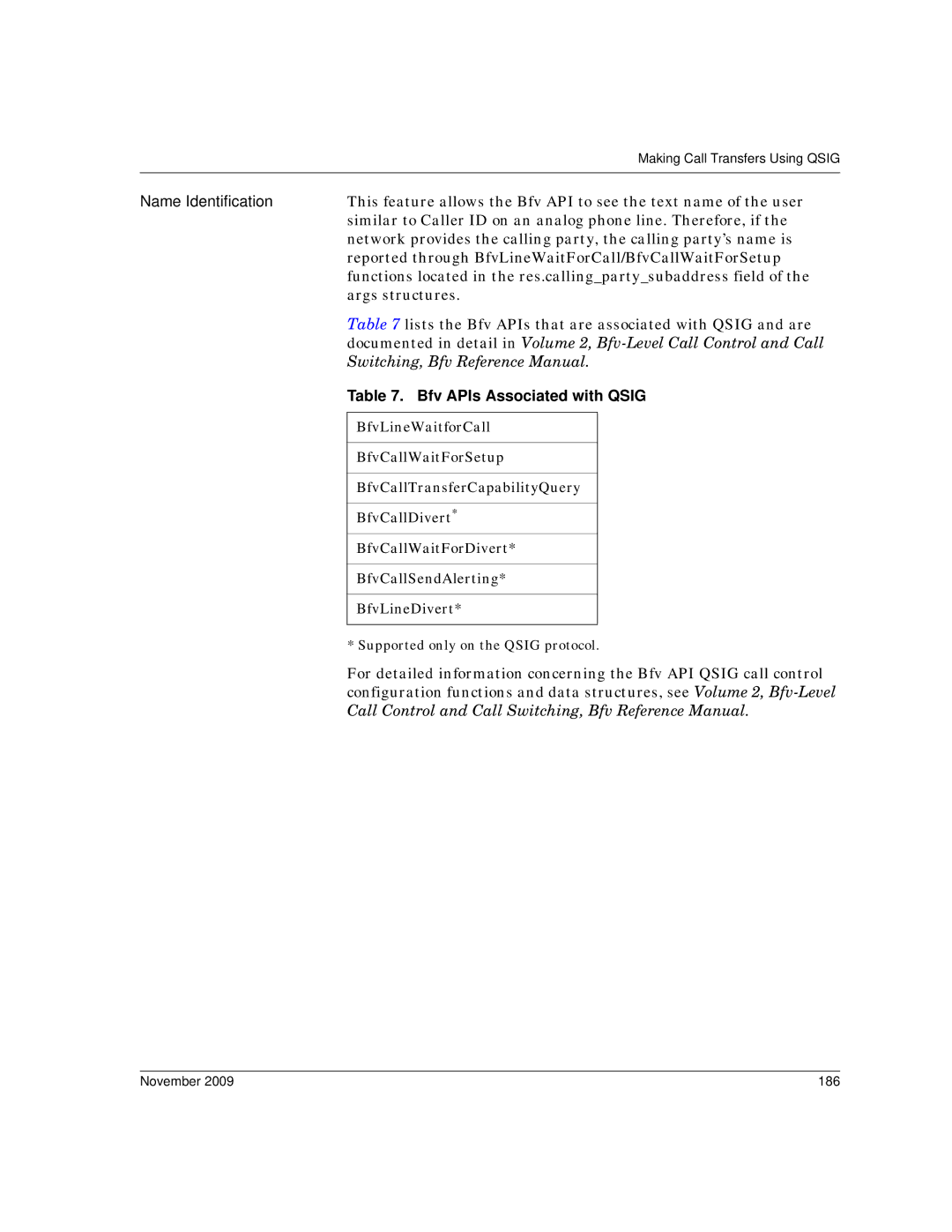
| Table 7 lists the Bfv APIs that are associated with QSIG and are | |
| documented in detail in Volume 2, | |
| Switching, Bfv Reference Manual. | |
| Table 7. Bfv APIs Associated with QSIG | |
|
|
|
| BfvLineWaitforCall |
|
|
|
|
| BfvCallWaitForSetup |
|
|
|
|
| BfvCallTransferCapabilityQuery |
|
|
|
|
| BfvCallDivert* |
|
| BfvCallWaitForDivert* |
|
|
|
|
| BfvCallSendAlerting* |
|
|
|
|
| BfvLineDivert* |
|
|
|
|
| * Supported only on the QSIG protocol. | |
| For detailed information concerning the Bfv API QSIG call control | |
| configuration functions and data structures, see Volume 2, | |
| Call Control and Call Switching, Bfv Reference Manual. | |
November 2009 | 186 |