Managing Calls Using IP Telephony
Incoming IP Calls
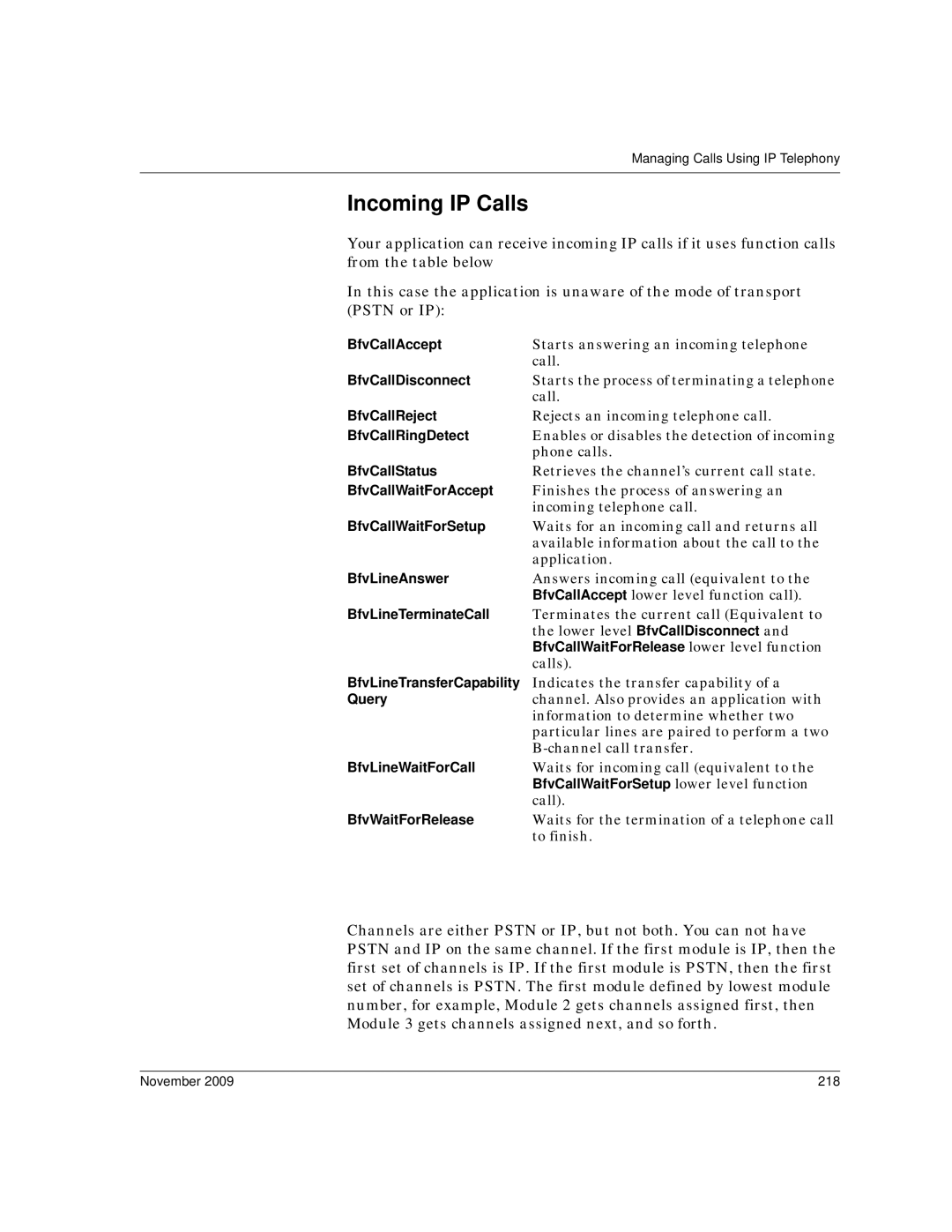
Your application can receive incoming IP calls if it uses function calls from the table below
In this case the application is unaware of the mode of transport (PSTN or IP):
BfvCallAccept | Starts answering an incoming telephone |
| call. |
BfvCallDisconnect | Starts the process of terminating a telephone |
| call. |
BfvCallReject | Rejects an incoming telephone call. |
BfvCallRingDetect | Enables or disables the detection of incoming |
| phone calls. |
BfvCallStatus | Retrieves the channel’s current call state. |
BfvCallWaitForAccept | Finishes the process of answering an |
| incoming telephone call. |
BfvCallWaitForSetup | Waits for an incoming call and returns all |
| available information about the call to the |
| application. |
BfvLineAnswer | Answers incoming call (equivalent to the |
| BfvCallAccept lower level function call). |
BfvLineTerminateCall | Terminates the current call (Equivalent to |
| the lower level BfvCallDisconnect and |
| BfvCallWaitForRelease lower level function |
| calls). |
BfvLineTransferCapability Indicates the transfer capability of a
Querychannel. Also provides an application with information to determine whether two particular lines are paired to perform a two
BfvLineWaitForCall | Waits for incoming call (equivalent to the |
| BfvCallWaitForSetup lower level function |
| call). |
BfvWaitForRelease | Waits for the termination of a telephone call |
| to finish. |
Channels are either PSTN or IP, but not both. You can not have PSTN and IP on the same channel. If the first module is IP, then the first set of channels is IP. If the first module is PSTN, then the first set of channels is PSTN. The first module defined by lowest module number, for example, Module 2 gets channels assigned first, then Module 3 gets channels assigned next, and so forth.
November 2009 | 218 |