Making Two-Channel Call Transfers (Tromboning)
Playing Back Voice Recordings
Voice playback during a
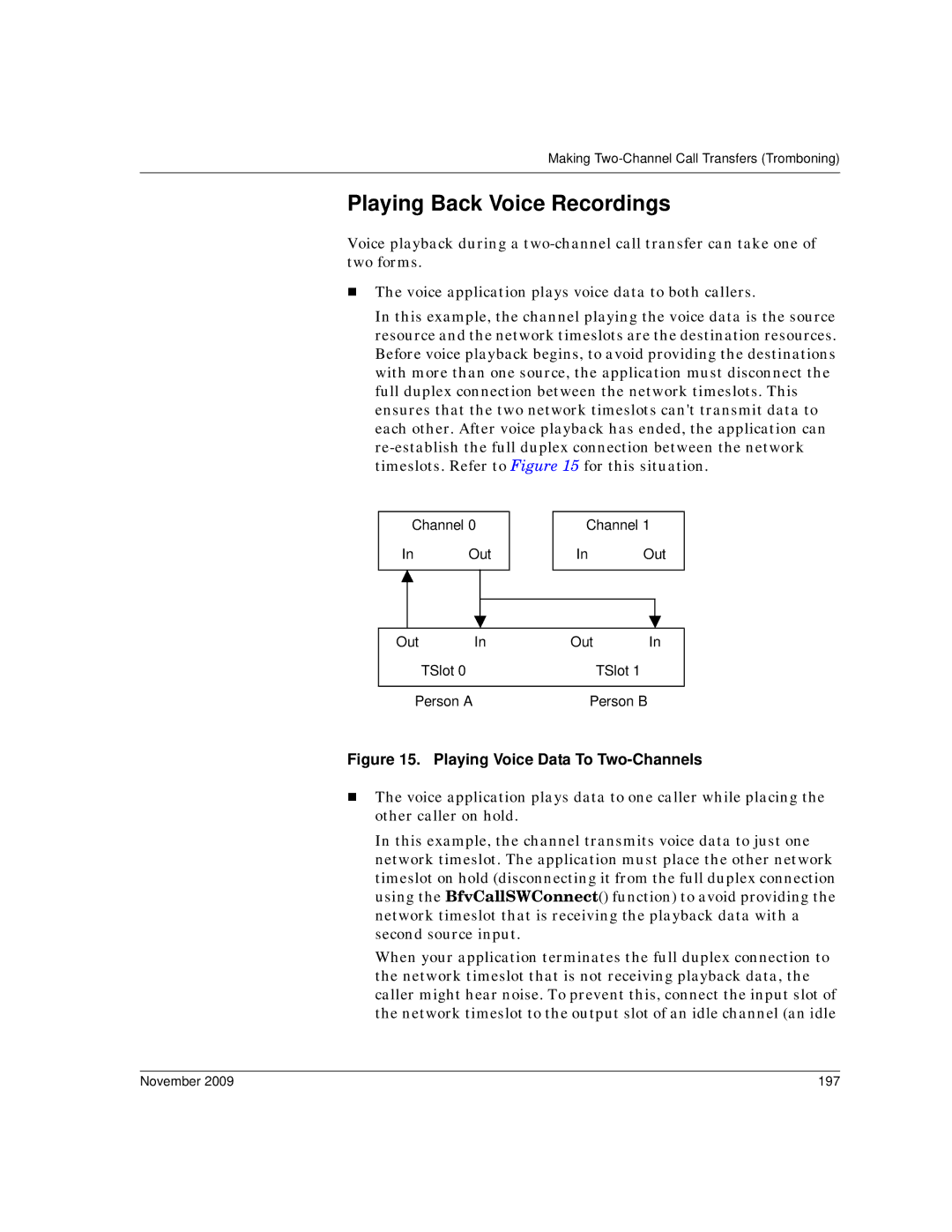
The voice application plays voice data to both callers.
In this example, the channel playing the voice data is the source resource and the network timeslots are the destination resources. Before voice playback begins, to avoid providing the destinations with more than one source, the application must disconnect the full duplex connection between the network timeslots. This ensures that the two network timeslots can't transmit data to each other. After voice playback has ended, the application can
Channel 0
In Out
Channel 1
In Out
|
|
|
|
|
Out | In | Out | In | |
| TSlot 0 |
| TSlot 1 |
|
|
|
|
|
|
| Person A |
| Person B |
|
Figure 15. Playing Voice Data To Two-Channels
The voice application plays data to one caller while placing the other caller on hold.
In this example, the channel transmits voice data to just one network timeslot. The application must place the other network timeslot on hold (disconnecting it from the full duplex connection using the BfvCallSWConnect() function) to avoid providing the network timeslot that is receiving the playback data with a second source input.
When your application terminates the full duplex connection to the network timeslot that is not receiving playback data, the caller might hear noise. To prevent this, connect the input slot of the network timeslot to the output slot of an idle channel (an idle
November 2009 | 197 |