Chapter
Understanding Security Features for Cisco Unified IP Phones
Table | Overview of Security Features (continued) | |
|
|
|
Feature |
| Description |
|
| |
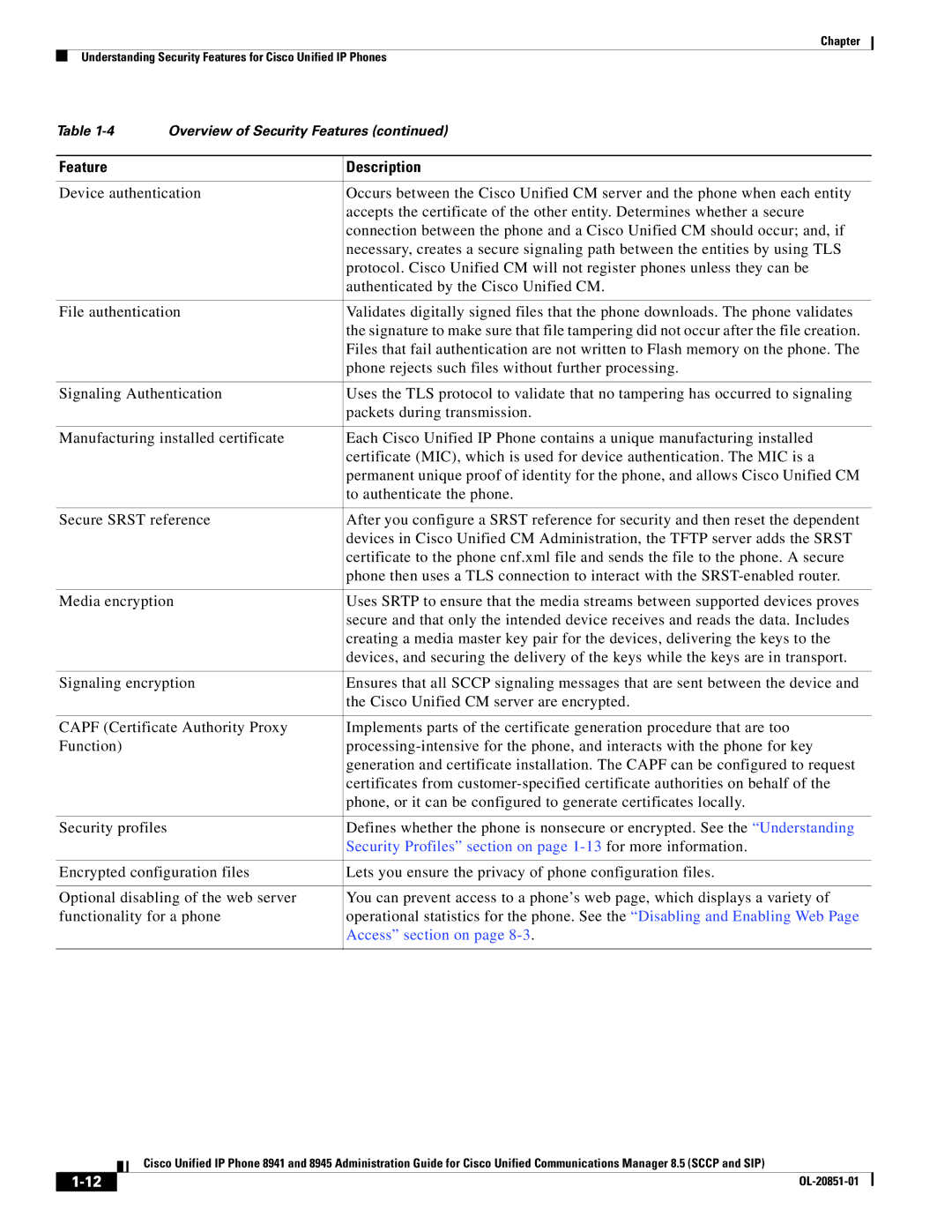
Device authentication | Occurs between the Cisco Unified CM server and the phone when each entity | |
|
| accepts the certificate of the other entity. Determines whether a secure |
|
| connection between the phone and a Cisco Unified CM should occur; and, if |
|
| necessary, creates a secure signaling path between the entities by using TLS |
|
| protocol. Cisco Unified CM will not register phones unless they can be |
|
| authenticated by the Cisco Unified CM. |
|
| |
File authentication | Validates digitally signed files that the phone downloads. The phone validates | |
|
| the signature to make sure that file tampering did not occur after the file creation. |
|
| Files that fail authentication are not written to Flash memory on the phone. The |
|
| phone rejects such files without further processing. |
|
| |
Signaling Authentication | Uses the TLS protocol to validate that no tampering has occurred to signaling | |
|
| packets during transmission. |
|
| |
Manufacturing installed certificate | Each Cisco Unified IP Phone contains a unique manufacturing installed | |
|
| certificate (MIC), which is used for device authentication. The MIC is a |
|
| permanent unique proof of identity for the phone, and allows Cisco Unified CM |
|
| to authenticate the phone. |
|
| |
Secure SRST reference | After you configure a SRST reference for security and then reset the dependent | |
|
| devices in Cisco Unified CM Administration, the TFTP server adds the SRST |
|
| certificate to the phone cnf.xml file and sends the file to the phone. A secure |
|
| phone then uses a TLS connection to interact with the |
|
| |
Media encryption | Uses SRTP to ensure that the media streams between supported devices proves | |
|
| secure and that only the intended device receives and reads the data. Includes |
|
| creating a media master key pair for the devices, delivering the keys to the |
|
| devices, and securing the delivery of the keys while the keys are in transport. |
|
| |
Signaling encryption | Ensures that all SCCP signaling messages that are sent between the device and | |
|
| the Cisco Unified CM server are encrypted. |
|
| |
CAPF (Certificate Authority Proxy | Implements parts of the certificate generation procedure that are too | |
Function) |
| |
|
| generation and certificate installation. The CAPF can be configured to request |
|
| certificates from |
|
| phone, or it can be configured to generate certificates locally. |
|
|
|
Security profiles |
| Defines whether the phone is nonsecure or encrypted. See the “Understanding |
|
| Security Profiles” section on page |
|
| |
Encrypted configuration files | Lets you ensure the privacy of phone configuration files. | |
|
| |
Optional disabling of the web server | You can prevent access to a phone’s web page, which displays a variety of | |
functionality for a phone | operational statistics for the phone. See the “Disabling and Enabling Web Page | |
|
| Access” section on page |
|
|
|
| Cisco Unified IP Phone 8941 and 8945 Administration Guide for Cisco Unified Communications Manager 8.5 (SCCP and SIP) |