AP3200
Lanier Worldwide, Inc. September
Printer Manager for Administra
Means Power OFF
Trademarks
Safety Information
Safety During Operation
Iii
Page
Low-power mode Energy Saver mode
Specifications
Energy Star Program
Manuals for This Printer
How to Read This Manual
Symbols
Table of Contents
Error & Status Messages on the Operation Panel
Sample Print
Locked Print
Locked Print Menu
Network Setup Menu 106 Maintenance Menu 108
Specifications 116
Job Control Menu
Changing default printer settings
PCL 6/5e Accessing the Printer Properties
Windows 95/98/Me Accessing the Printer Properties
Making printer settings from an application
Windows 2000 Accessing the Printer Properties
Changing default printer settings Printer Properties
Windows NT 4.0 Accessing the Printer Properties
Default Document Properties appear
PostScript Setting Up for Printing
Windows 95/98/Me Accessing the Printer Properties
Changing default printer settings Printer Properties
Windows NT 4.0 Accessing the Printer Properties
Properties
Setting up for printing from an application
Macintosh Setting Up for Printing
Making paper settings from an application
On the File menu, click Page Setup
Canceling a Print Job
Windows 95/98/Me Canceling a Print Job
Windows 2000 Canceling a Print Job
Windows NT 4.0 Canceling a Print Job
Macintosh Canceling a Print Job
Double-click the printer icon on the desk top
Windows 2000 Uninstalling the PCL 6/5e Printer Driver
Uninstalling the PCL 6/5e Printer Driver
Windows 95/98/Me Uninstalling the PCL 6/5e Printer Driver
Click Yes to uninstall the printer driver
Close all the applications that are currently running
Windows NT 4.0 Uninstalling the PCL 6/5e Printer Driver
Printer driver, log on under Full Control permission
Printers window appears
Uninstalling the PostScript Printer Driver
Windows 2000 Uninstalling the PostScript Printer Driver
Windows NT 4.0 Uninstalling the PostScript Printer Driver
Macintosh Uninstalling the PostScript Printer Driver
Close all applications that are currently running
Paper and Other Media Supported by This Printer
Paper Types and Sizes
Paper and Other Media
Paper and Other Media Supported by This Printer
10.12 ⋅ 27 ⋅ 11.69 ⋅
Paper and Other Media Supported by This Printer
297
Custom Size PCL 6/PS only 267 ⋅ 16K 195 ⋅
10.12 ⋅ 27 ⋅ 11.69 ⋅
Paper weight and number of sheets to be set
Storing paper
Paper Recommendations
Loading paper
Types of paper and other media
OHP Transparencies
Adhesive Labels
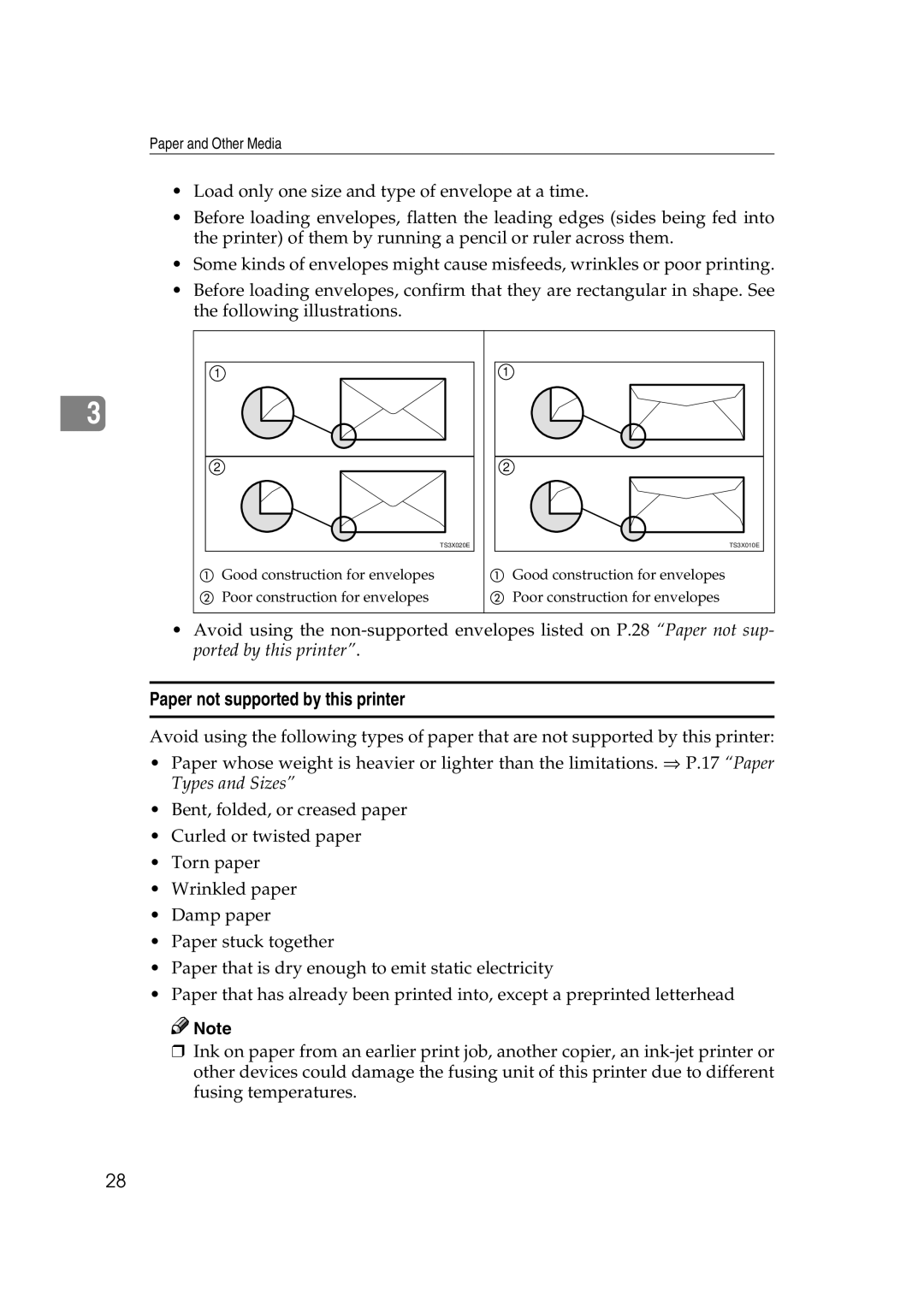
Envelopes
Paper not supported by this printer
Paper and Other Media Supported by This Printer
Printable Area
Slide the paper tray out until it stops
Loading Paper and Other Media
Loading Paper in the Paper Tray
Slide the tray into the printer un- til it stops
Changing the Paper Tray Size
Set the paper guide lock to the locked position
Loading Thick Paper Envelopes or OHP Transparencies
Loading Paper in PS420 Paper Feed Unit
Loading Paper in Bypass Tray Type
Open the bypass tray
Lift the paper guide lever a
Press T or U until the fol- lowing message appears
Push down the paper guide lever
Press Menu Following message appears
Press Enter #
Press T or U until the follow- ing message appears
Press T or U to select the standard size Press Enter #
Press Menu
Press Enter # After the panel display chang- es, press Menu
Horizontal size Vertical size
Press U or T to set the vertical value Press Enter #
Paper and Other Media
Replacing the Toner Bot
Error & Status Messages on the Operation Panel
Ples
Tle
Troubleshooting
Error & Status Messages on the Operation Panel
Job Control Menu
Placing the Toner Bottle
Moving Misfed Paper
Sample Print
Print
Removing Misfed Paper
Cleaning the Registration Roll
Photoconductor Unit
Job Control Parameters
Getting Printer Information over the Network
Printer current status
Telnet
Error & Status Messages on the Operation Panel
Form Feed Tray
Placing the Toner Bottle
Photoconductor Unit
Job Control Parameters
Printer configuration
Input Tray Name
Input Tray Page Size
Paper size Description
Input Tray Status
Output Tray Name
Output Tray Status
Possible Cause Solutions
Printer Does Not Print
Windows 95/98/Me
Windows
Windows NT
Eration panel. ⇒ P.93 Using the Operation Panel
Macintosh
That Require Options
If the printer is using I/O Timeout
Allel cable
Network connection
Other Printing Problems
Page, see P.93 Using the Operation Panel
Dirty. ⇒ P.82 Cleaning the Friction Pad and P.80 Cleaning
Operation panel. ⇒ P.93 Using the Operation Panel
Paper Recommendations
For more information about configuring options for
Open lower right cover
When Misfeed a Appears
Removing Misfed Paper
Remove the misfed paper from inside of lower right cover
Open the duplex unit by lifting the catch
When Misfeed B Appears
Close lower right cover
Open the right cover by lifting the catch
When the interchange unit is installed
When Misfeed C Appears
When the interchange unit is not installed
Close the upper right cover before closing the right cover
When Misfeed D Appears
When Remove Misfeed from Mailbox Appears
When Remove Misfeed From Finisher Appears
SR510 500-sheet finisher
Close the front cover of the finish- er
When Misfeed Y Appears
SR720 1000-sheet finisher
Remove the misfed paper inside of the cover
When Remove Misfeed from Duplex Unit Appears
Open the rear cover of the fin- isher
Adding Staples
Remove the empty cartridge
Open the front cover of the fin- isher
Reinstall the cartridge. It should click into place
Pull out the ribbon used for bun- dling staples
Close the front cover of the fin- isher
Removing Jammed Staples
Remove the cartridge
Open the face plate of the car- tridge
Reinstall Cartridge Should click into place
Remove the jammed staples
Close the face plate of the car Tridge
Replacing the Toner Bottle
Open the front cover
Lift the green handle
Close the front cover
Replacing the Photoconductor Unit
Turn off the printer
Open the right cover of the print- er by lifting the catch
ZAEM330E
Push the unit into the printer unit it clicks into place
Close the right cover of the print- er
Turn on the printer
Cleaning the Paper Feed Roller
Wipe the rubber of the paper feed roller with a dry cloth
Cleaning the Paper Feed Roller
Cleaning the Friction Pad
Slide tray 2 out until it stops
Wipe the top of the friction pad with a dry cloth
Cleaning the Pad inside of the Tray
Cleaning the Registration Roller
Wipe the registration roller by turning with a dry cloth
Close the right cover and duplex unit
From an application, select the menu command to print
Sample Print
Printing a Sample Print File
Deleting a Sample Print File
On the operation panel of the printer, press Menu
Checking the Error Log
EFGH5678 Delete? Yes=#
Password box, type a pass- word of four digits
Locked Print
Printing a Locked Print File
Locked Print 1800 asdf7894
Deleting a Locked Print File
Press Menu Press Enter #
Locked Print Error Files
Sample Print/Locked Print
Menu
Menu Chart
⇒ P.97 Sample Print
⇒ P.98 Locked Print
Up Menu
⇒ P.108 Maintenance
⇒ P.106 Network Set
⇒ P.110 List Print
Accessing the Main Menu
Making Printer Settings with the Operation Panel
Search for the desired menu with Tor U
Press Enter # Search for the desired menu with Tor U
Sample Print Menu
Sample Print Parameters
Locked Print Menu
Locked Print Parameters
Job Control Menu
Job Control Parameters
Paper Input1/3
Tray
Default A4 Metric version or 8 1/2 ⋅ 11 Inch version
Paper Input 2/3
Tray 3 option
Paper Input 3/3
Default Plain Paper
Default Standard Tray
Duplex
Print Quality
Default 30 minutes
Default 30 seconds
Default 10 minutes
System 1/2
Default Default depends on Metric or Inch version
System 2/2
PCL Menu 1/2
PCL Menu 2/2
Network Setup Menu
Network Setup 1/2
Default
Network Setup 2/2
Default Auto select
Default All Active
Menu Reset
Maintenance Menu
Maintenance Parameters
Restart Printer
Registration
List Print Menu
List Print Parameters
List Print
Language Menu
112
Appendix
Functions That Require Options
Moving and Transporting the Printer
Transporting the printer
Paper Feed Unit PS420 or PS440
Sheet finisher SR510
Moving the Printer Close by
Mailbox CS370
Sheet finisher SR720
Specifications
Mainframe
Power Consumption
Paper Weight
Power Source
Dimensions
Memory
Paper Input Capacity
Paper Output Capacity
Options Equipment
PS440 1000-sheet paper feed unit Paper Size
Dimensions W ⋅ D ⋅ H
Options
Paper Capacity
Bypass Tray Type Paper Size
Interchange Unit Type Paper Size
AD380 duplex unit Paper Size
CS370 mailbox Paper Size
Paper Weight Proof Tray
Paper Weight Bridge to the finisher
Stack Capacity
Staple Paper Size
SR510 500-sheet Finisher Paper Size
Staple Capacity
Staple Position
Compatible
SR720 1000-sheet Finisher Paper Size
Memory Unit TypeB
Printer Hard Disk Type Storage Capacity Formatted
Index
Cancel a print job PCL 6/5e, properties
Uninstall, PCL 6/5e Uninstall, PostScript
Photoconductor unit, 77 toner bottle
Customer Vision Our commitment to your Complete satisfaction


 Note
Note