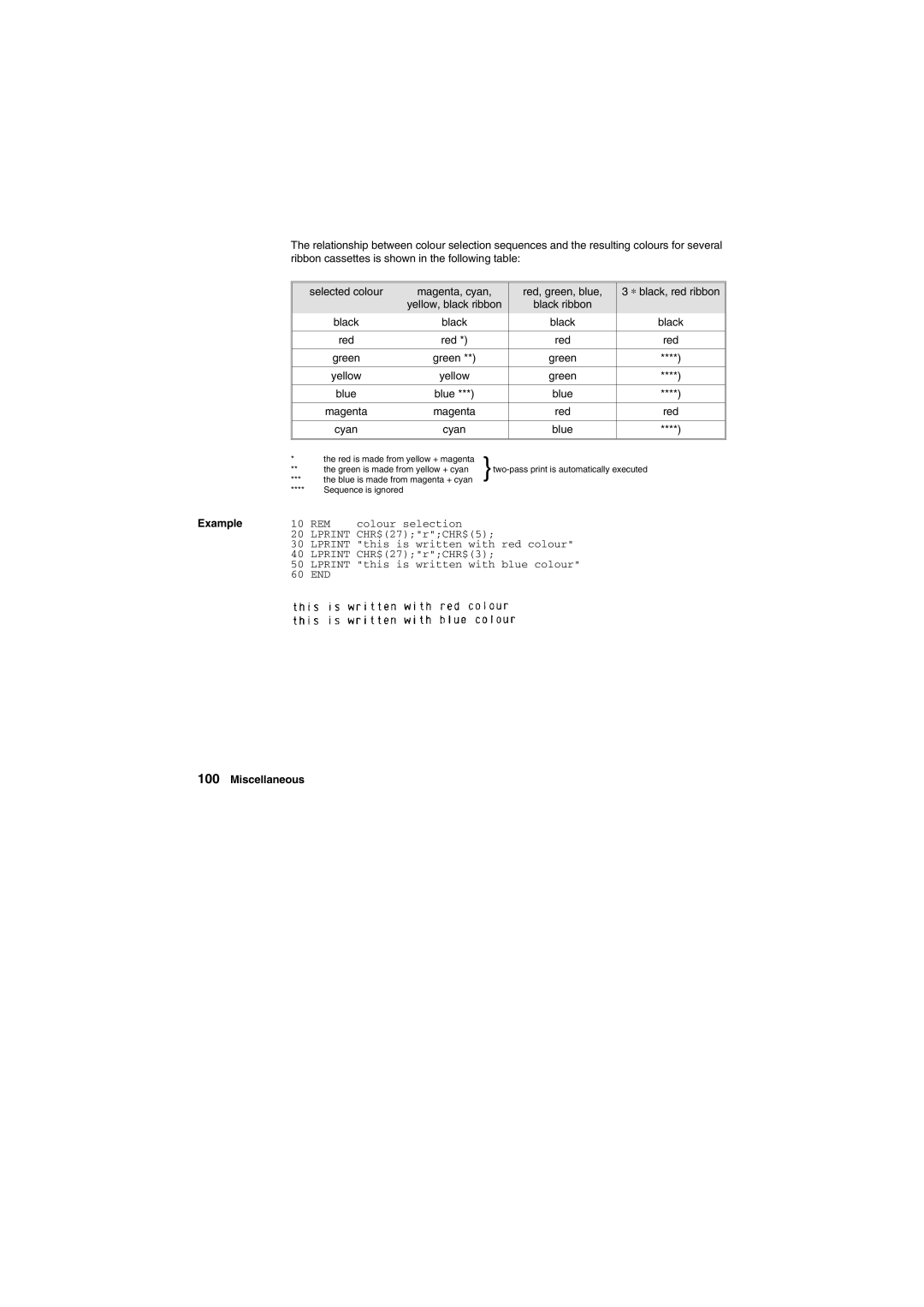
The relationship between colour selection sequences and the resulting colours for several ribbon cassettes is shown in the following table:
| selected colour | magenta, cyan, | red, green, blue, | 3 ∗ black, red ribbon | |
|
| yellow, black ribbon | black ribbon |
| |
| black | black |
| black | black |
|
|
|
|
|
|
| red | red *) |
| red | red |
|
|
|
|
|
|
| green | green **) |
| green | ****) |
|
|
|
|
|
|
| yellow | yellow |
| green | ****) |
|
|
|
|
|
|
| blue | blue ***) |
| blue | ****) |
|
|
|
|
|
|
| magenta | magenta |
| red | red |
|
|
|
|
|
|
| cyan | cyan |
| blue | ****) |
|
|
|
|
| |
|
|
|
|
| |
* | the red is made from yellow + magenta | ||||
** | the green is made from yellow + cyan | ||||
***the blue is made from magenta + cyan
****Sequence is ignored
Example | 10 REM | colour selection | |
| 20 | LPRINT | CHR$(27);"r";CHR$(5); |
| 30 | LPRINT | "this is written with red colour" |
| 40 | LPRINT | CHR$(27);"r";CHR$(3); |
| 50 | LPRINT "this is written with blue colour" | |
| 60 | END |
|