Print Code Area Expansion ON
Print Code Area Expansion OFF
CSI ? 53 h CSI ? 53 l
Data Structure ASCII | CSI | "?" | "5" | "3" | "h" | [A] | print code area expansion on | ➊ |
hex. | 9B | 3F | 35 | 33 | 68 |
|
|
|
dec. | 155 | 63 | 53 | 51 | 104 |
|
|
|
ASCII | CSI | "?" | "5" | "3" | "l " | [A] | print code area expansion off | ➋ |
hex. | 9B | 3F | 35 | 33 | 69 |
|
|
|
dec. | 155 | 63 | 53 | 51 | 105 |
|
|
|
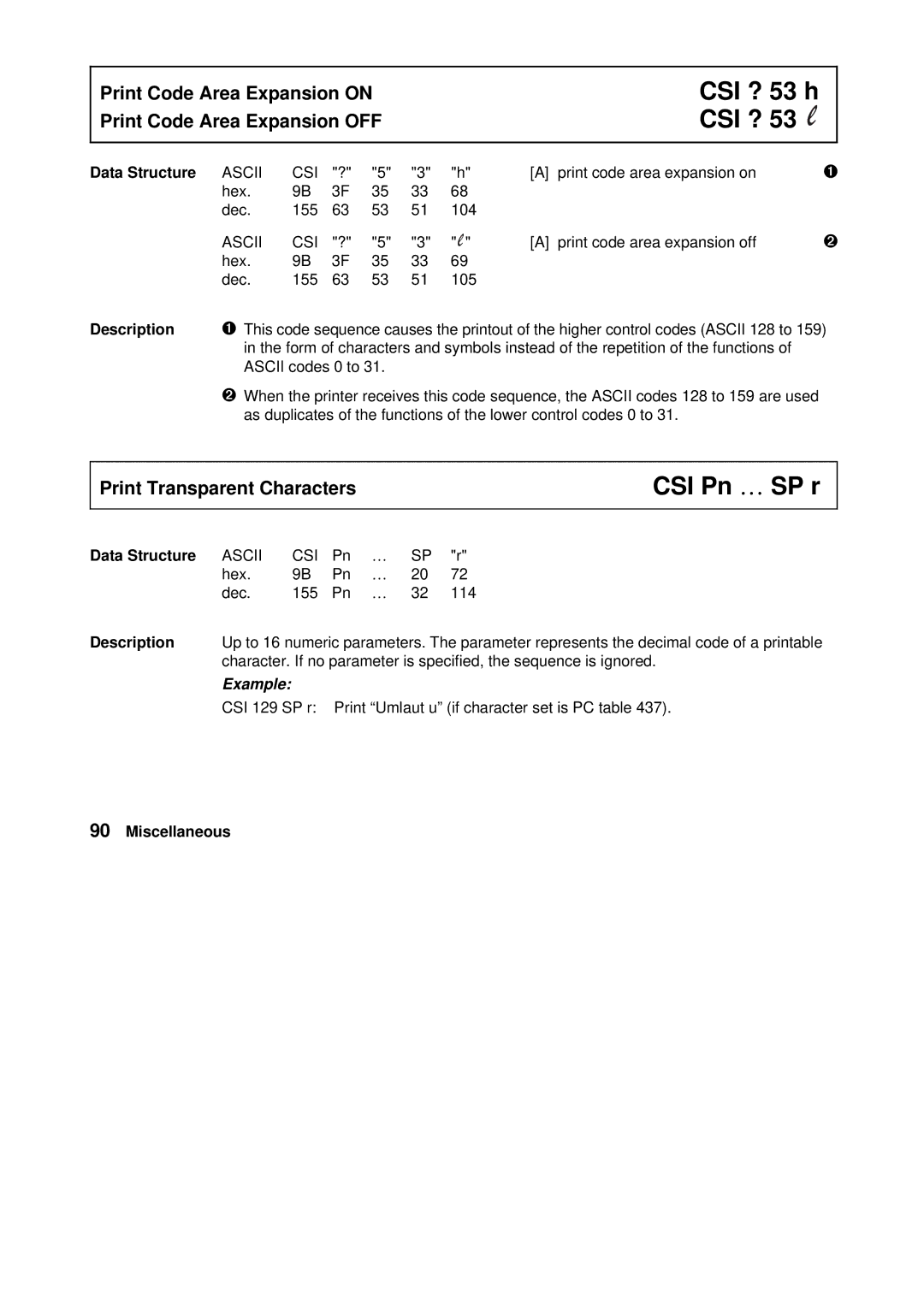
Description ➊ This code sequence causes the printout of the higher control codes (ASCII 128 to 159) in the form of characters and symbols instead of the repetition of the functions of ASCII codes 0 to 31.
➋When the printer receives this code sequence, the ASCII codes 128 to 159 are used as duplicates of the functions of the lower control codes 0 to 31.
Print Transparent Characters
CSI Pn … SP r
Data Structure ASCII | CSI | Pn | … | SP | "r" |
hex. | 9B | Pn | … | 20 | 72 |
dec. | 155 | Pn | … | 32 | 114 |
Description Up to 16 numeric parameters. The parameter represents the decimal code of a printable character. If no parameter is specified, the sequence is ignored.
Example:
CSI 129 SP r: Print “Umlaut u” (if character set is PC table 437).