Link DFL-500
Regulatory Compliance
Table of Contents
Firewall configuration
IPSec VPNs
Logging and reporting
Page
Introduction
NAT/Route mode and Transparent mode
NAT/Route mode
Transparent mode
Customer service and technical support
For more information
DFL-500 QuickStart Guide DFL-500 CLI Reference Guide
Package contents
Getting started
Mounting
Powering on
Connecting to the web-based manager
Initial configuration
Connecting to the command line interface CLI
DFL-500 login
Bits per second
Next steps
Data bits Parity
Stop bits Flow control
NAT/Route mode installation
Preparing to configure NAT/Route mode
NAT/Route mode settings
Reconnecting to the web-based manager
Using the setup wizard
Using the command line interface
Starting the setup wizard
Set system route number 1 gw1
Connecting to your networks
DFL-500 NPG network connections
Configuring your internal network
Completing the configuration
Setting the date and time
Transparent mode settings Administrator Password
Transparent mode installation
Preparing to configure Transparent mode
Changing to Transparent mode
Set system management ip 10.10.10.2
Configuring the Transparent mode management IP address
Setting the date and time
Connecting to your network
Configure the Transparent mode default gateway
DFL-500 network connections
Default policy
Firewall configuration
Adding NAT/Route mode policies
Changing to NAT/Route mode
Go to Firewall Policy
VPN Tunnel
Source Destination Schedule Service Action
Authentication
Dynamic IP Pool Fixed Port
Web filter
Content filtering
Adding Transparent mode policies
Source Destination Schedule Service
Adding a NAT/Route Int -Ext policy
Log Traffic Authentication Web filter
Configuring policy lists
Adding a Transparent mode Int -Ext policy
Policy matching in detail
Addresses
Changing the order of policies in a policy list
Enabling and disabling policies
Adding a firewall address
Adding addresses
Deleting addresses
Go to Firewall Address
Adding an internal address group
Services
Organizing addresses into address groups
Go to Firewall Address Group
Go to Firewall Service Custom
Predefined services
Providing access to custom services
Grouping services
Go to Firewall Schedule One-time
Adding a service group
Schedules
Creating one-time schedules
Go to Firewall Schedule Recurring
Virtual IPs
Creating recurring schedules
Adding a schedule to a policy
Adding static NAT virtual IPs
Go to Firewall Virtual IP
Static NAT Port Forwarding
Adding a static NAT virtual IP
Using port forwarding virtual IPs
Source
Adding policies with virtual IPs
Go to Firewall Policy Ext Int
Adding a Port Forwarding virtual IP
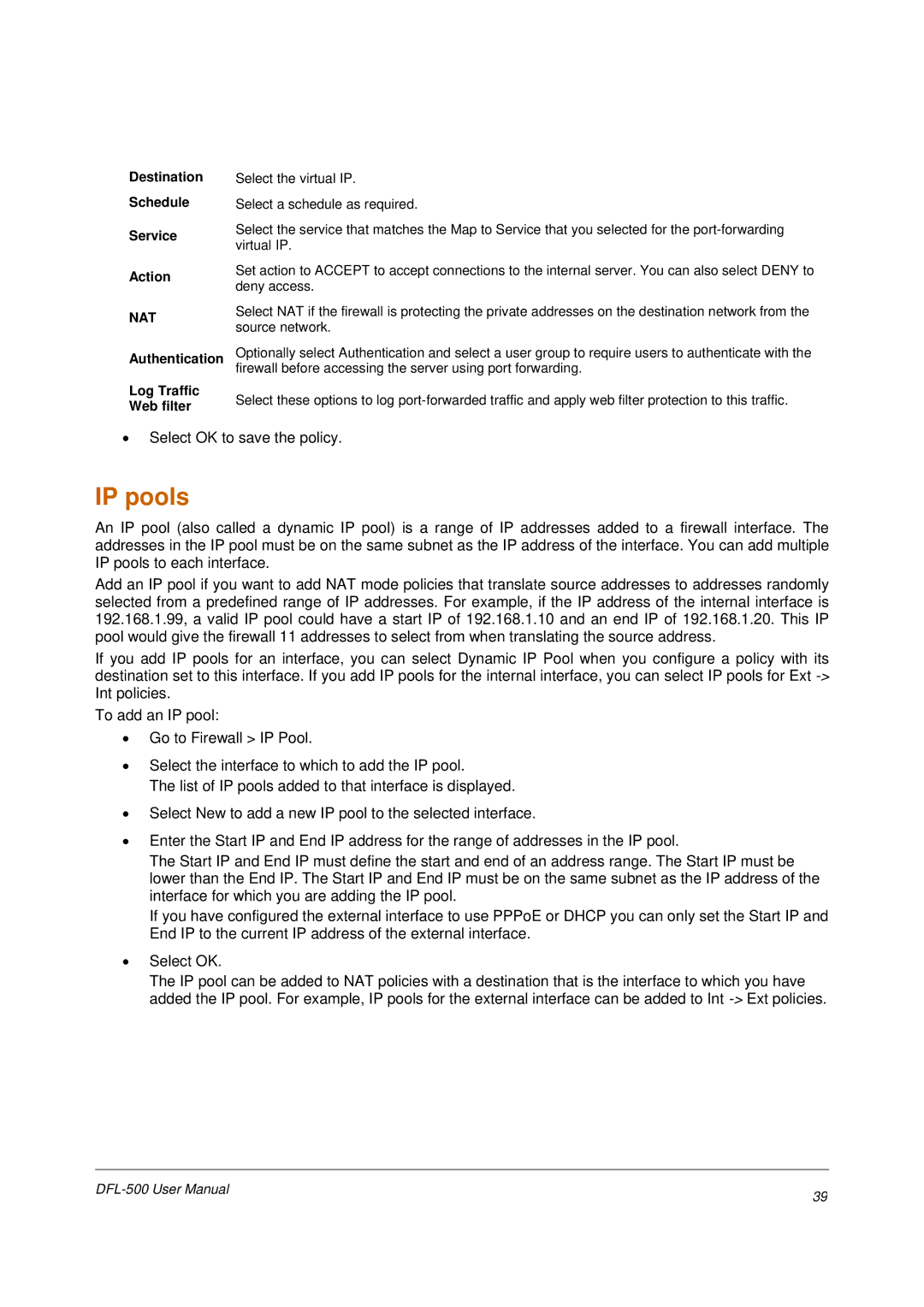
Destination Schedule Service Action
Authentication Log Traffic Web filter
IP pools
Adding an IP Pool
Go to Firewall IP/MAC Binding Setting
IP/MAC binding
Go to Firewall IP/MAC Binding Static IP/MAC
Adding IP/MAC addresses
Configuring IP/MAC binding for packets going to the firewall
Go to Firewall IP/MAC Binding Dynamic IP/MAC
IP/MAC settings
Viewing the dynamic IP/MAC list
Enabling IP/MAC binding
Adding user names and configuring authentication
Users and authentication
Setting authentication time out
Adding user names and configuring authentication
Disable
Deleting user names from the internal database
Adding a user name
Deleting Radius servers
Configuring Radius support
Example Radius configuration
Adding Radius servers
Adding user groups
Configuring user groups
Adding a user group
Deleting user groups
Interoperability with IPSec VPN products
IPSec VPNs
See Adding a remote gateway
Configuring AutoIKE key IPSec VPN
Configuring manual key IPSec VPN
Configuring dialup VPN
Configuring a VPN concentrator for hub and spoke VPN
Configuring the member VPNs
Configuring the VPN concentrator
Configuring IPSec redundancy
Adding a remote gateway
Go to VPN Ipsec Remote Gateway
Local ID
About dialup VPN authentication
Nat-traversal Keepalive Frequency
Adding a remote gateway Dialup User selected
Main mode with no user group selected
Key
About DH groups
About the P1 proposal
Local ID Empty
Adding an AutoIKE key VPN tunnel
About NAT traversal
Go to VPN Ipsec AutoIKE Key
Adding an AutoIKE key VPN tunnel
About the P2 proposal
About replay detection
Autokey Keep Alive Concentrator
Adding a manual key VPN tunnel
About perfect forward secrecy PFS
Go to VPN Ipsec Manual Key
Adding a manual key VPN tunnel
Adding a VPN concentrator
Adding a VPN concentrator
Adding an encrypt policy
Go to Firewall Policy Int-Ext
Adding an encrypt policy
VPN Tunnel Allow inbound
Allow outbound Inbound
Viewing VPN tunnel status
Testing a VPN
Viewing dialup VPN connection status
AutoIKE key tunnel status
Page
Pptp and L2TP VPNs
Pptp VPN configuration
Configuring the DFL-500 NPG as a Pptp gateway
Go to VPN Pptp Pptp Range
Pptp VPN between a Windows client and the DFL-500 NPG
Source Destination Service Action
Example Pptp Range configuration
L2TP VPN between a Windows client and the DFL-500 NPG
L2TP VPN configuration
Configuring the DFL-500 NPG as an L2TP gateway
Go to VPN L2TP L2TP Range
Sample L2TP address range configuration
Configuring content filtering
Web content filtering
Enabling web content Filtering
Blocking web pages that contain unwanted content
Changing the content block message
Clearing the banned word list
Backing up and restoring the banned word list
Blocking access to URLs
Configuring URL blocking
Go to Web Filter URL Block
Uploading a URL block list
Clearing the URL block list
Changing the URL block message
Downloading the URL block list
Exempting URLs from content or URL blocking
Removing scripts from web pages
Go to Web Filter Script Filter
Go to Web Filter Exempt URL
Adding URLs to the Exempt URL List
Clearing the Exempt URL list
Downloading the Exempt URL list
Uploading an Exempt URL list
Recording logs on a remote computer
Configuring Logging
Go to Log&Report Log setting
Logging and reporting
Configuring alert email
Example log settings
Selecting what to log
Go to System Network DNS
Configuring alert email
System status
Administration
Execute ping
Upgrading the DFL-500 NPG firmware
Enter Tftp Server Address
Enter Local Address
Enter File Name image.out
Displaying the DFL-500 NPG serial number
Backing up system settings
Restoring system settings
Restoring system settings to factory defaults
Changing to Transparent mode
Restarting the DFL-500 NPG
Shutting down the DFL-500 NPG
System status monitor
Protocol From IP From Port To IP To Port Expire Clear
Network configuration
System status monitor
CPU usage Memory usage Up time Total Number of Sessions
Go to System Network Interface
Configuring the internal interface
Configuring the external interface
Configuring the internal interface
Configuring the external interface with a static IP address
Configuring the external interface
Configuring the external interface for PPPoE
Https Ping SSH Snmp
Adding routing gateways
Configuring routing
Configuring the management interface Transparent mode
Setting DNS server addresses
Adding a default route
Adding routes to the routing table
Go to System Network Routing Table
Go to System Network Routing
Configuring the routing table
Adding routes Transparent mode
Enabling RIP server support
Starting IP Ending IP Netmask Lease Duration Domain
Providing Dhcp services to your internal network
Default Route Exclusion Range
Go to System Network Dhcp
System configuration
Sample Dhcp settings
Example Dynamic IP list
Setting system date and time
Go to System Config Time
Example date and time setting
Read Write Only
Adding and editing administrator accounts
Go to System Config Admin
Changing web-based manager options
Go to System Config Snmp
Configuring Snmp
100
101
Glossary
102
103
104
Index
105
CLI
106
Dhcp
107
Snmp
108
PFS
109
Transparent mode manual key Adding VPN tunnel IPSec VPN
110
NTP
111
Pptp
112
Smtp
113
VPN
114
IPSec VPN Remote Gateway user groups Deleting
115
116
Technical Support
117
Registration Card
118
119
Limited Warranty
120
121
122
Registration