Contents
Contents
Safety Instructions
Safety
Important Information About This Receiver
Welcome
About this Receiver
Remote Controls
Overview
Conventions
Fixed Images
Overview
Dish Network Logo
Ordering Your Programming
Getting Started
Quick Tour of Basic Features
Quick Tour of Basic Features
Finding Programs to Watch
Chapter
Quick Tour of the Menus
Quick Tour of the Menus
Chapter
Quick Tour of the Menus
Chapter
Quick Tour of the Menus
Quick Tour of Digital Video Recorder Features
Quick Tour of Digital Video Recorder Features
When the Record Remainder of this Event displays, select
Quick Tour of Digital Video Recorder Features
Quick Tour of Watching One Program While Recording Others
Quick Tour of Picture-in-Picture PIP
Quick Tour of Picture-in-Picture PIP
Satellite Television
Satellite Signal Quality
Rain and Snow Fade
Solar Interference
Receiver Front Panel
TV1 Connections
Receiver Back Panel
TV CH 3-4 Out
RCA Out
Remote Controls
Remote Controls
Types of Remote Controls
Low Battery Warning
Installing or Changing the Batteries
Attach a UHF Antenna for optional accessory
Batteries
Coaxial Cable Connections
Connecting the Receiver to Your Nearby TV
Confirm Remote Control Operation
Connecting the Receiver to Your Nearby TV
RCA and S-Video Connections TV1
Confirming IR/UHF Pro Remote Control Operation
Programming the Recover Button
Programming the Recover Button for Your TV
Removing the Recover Button Channel Programming
Changing the TV1 Output Channel
Connecting the Receiver to the Phone Line
Changing the TV1 Output Channel
Phone Line Connection
Phone System Setup
Connecting the Receiver to a Dish Antenna System
Connecting the Receiver to a Dish Antenna System
Chapter
Optional Connecting to an Over-the-Air Antenna or Cable
Optional Connecting VCRs to the System
Optional Connecting VCRs to the System
Connecting a VCR to the Nearby TV
Confirming the Remote Control Address
Optimize Your Remote Controls
Change the Address
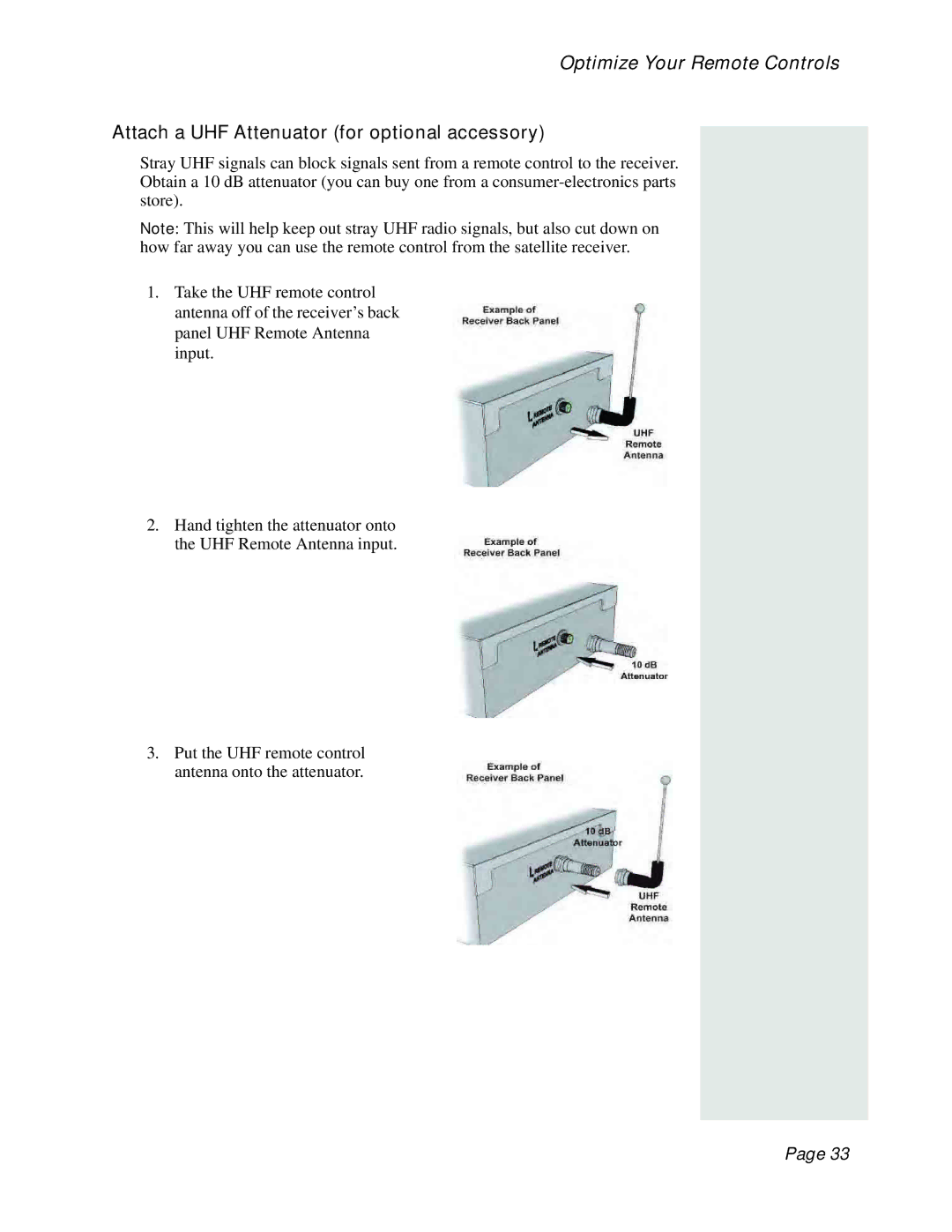
Attach a UHF Attenuator for optional accessory
Optimize Your Remote Controls
Setting Up TV1 to Operate in UHF Pro
Setting Up TV1 to Operate in IR default
Setting Up TV1 to Operate in IR default
Chapter
Using Picture-In-Picture
Using the Two Satellite Tuners
Two Tuners
SAT Mode Button
Using the Remote Control
Using the Remote Control
Select Button
TV/Video Button
Recall Button
Info Button
View Live TV Button
Cancel Button
Dish Button
Number Pad Buttons
Star Button
Recover Button
Zero Button
Pound Button
Using the Menus
Using the Menus
Open and Close Menus
Selecting Menu Options
Highlighting Menu Options
List of Choices in the Menus
Highlighting a Choice in a Menu List
Canceling a Procedure
Selecting a Choice in a Menu
Using Text Fields
Using Text Fields
Using the Virtual Keyboard
Using the Number Pad
Changing Channels
Using the Program Guide
Changing the Channel in the Program Guide
Using the Program Guide
Scrolling Through the Program Guide
Program Banner
Displaying Program Information
Browse Banner
Displaying Program Information
Using the Browse Banner
Ordering Pay-Per-View Programs
Using Favorites Lists
Creating or Changing a Favorites List
Using Favorites Lists
Naming a Favorites List
Using Timers
Making a Favorites List Active
Event Timer Frequency
Event Timer Types
Event Timer Options
Before an Event Timer Operates
Using Quick Record
Setting Up a Manual Event Timer
Setting Up an Automatic Event Timer
Setting Up a DishPASS Timer
Overlapping Timers
Reviewing and Editing Event Timers
Maximum Number of Event Timers
Special Considerations When Using Event Timers
Deleting an Event Timer
Using Two Tuners to Record
Event Timer Performance when the Receiver is Off
Watching One Program While Recording Another
Watching One Program While Recording Another
Using Auto Recording
Using More DVR Features
Auto Recording
Quick Recording
Using More DVR Features
Start Recording a Program
Using Quick Recording
Stop Recording a Program
Use the DVR Events Menu
While Playing Back or Recording an Event
Chapter
Play Back a Recorded Event and Record Another Event
More About the DVR Features Auto Recording
Copy Recordings to Videotape
Using Themes and Search
Using Themes and Search
Themes
Search
Search History
How to Set Locks a Two-Step Process
Using Locks
When You Have Locked the Receiver
Locking and Unlocking the Receiver
Creating or Changing Rating Content Code Locks
Using Locks
Creating or Changing Channel Locks
Locking and Unlocking Pay-Per-View Channels
Locking and Unlocking the Receiver Front Panel
Chapter
Hiding and Showing Adult Channels
Changing the Receiver Password
Chapter
Personal Identification Numbers
Using Caller ID
Personal Identification Numbers
Caller ID Screens
Turning Caller ID On and Off
Resetting Receiver to Factory Default Settings
Changing Audio Languages for Programs
Changing Audio Languages for Programs
Receiver Updates
Control Other Devices with the Remote Control
Control Other Devices with the Remote Control
Remote Control Modes
Limited Mode
For AUX mode setup only
Set Up the Remote Control
Scan for Device Codes
Check the Device Codes
Control a TV or a Second TV TV Mode Button
Remote Control Buttons Control the Receiver
Power Button
Number Buttons
Up and Down Arrow Buttons
Control a VCR or a Second VCR or DVD Player
VCR Mode Button
Up and Down Buttons
VCR Buttons
Control a Tuner or Amplifier
AUX Mode Button
Amp
Testing the System
Testing the System
Starting a Test
Telephone Connection Test
Chapter
Reference
Troubleshooting Tables
001
On-Screen Messages
013
Troubleshooting Tables
074
Using the Remote Control
Hearing a Program
What Is Possible Reason What to Do
Watching a Program
Using the Menus
Using Locks
Using the Program Guide or the Browse Banner
Changing Channels
Using Favorites Lists
Buying a Pay-Per-View Program
What Is Possible Reason What to Do Happening
Using the Telephone for Voice/Data/FAX
Tune to the channel
Using Event Timers
What’s What’s Wrong What You Can Do Happening
Using DVR Features
Chapter
TV Codes
Device Codes
NEC
VCR Codes
ASA
Device Codes
DVD Player Codes
TV/VCR Combo
Tuner/Amplifier Codes
TV/DVD Combo Codes
TV/VCR/Tuner Combo Codes
DVD/VCR Combo Codes
TV/VCR Combo Codes
Chapter
What the Warranty Covers
Limited Warranty
What the Warranty Does Not Cover
Legal Limitations
Residential Customer Agreement
Accessory Warranty
If You Need Assistance
Advance Exchange Program
Residential Customer Agreement
Monthly Fees
Residential Customer Agreement
Cancellation of Service
Leased Equipment
Transfer of ACCOUNT, Services or Equipment
General
FCC Compliance
Staying Legal
Telephone Communication
Connecting to an Over-the-Air Antenna
Signal Strength Present at the Television
Radio Interference
Page
Index
Index
Selecting Options
Index
TV Channel Settings
Remote Control Settings
Receiver Information