SCPI Data Types These paragraphs explain the data types available for parameters and response data. They list the types available and present examples for each type. SCPI defines different data formats for use in program messages and response messages. It does this to accommodate
the principle of forgiving listening and precise talking. Recall that forgiving listening means instruments are flexible, accepting commands and parameters in various formats. Precise talking means an instrument always responds to a particular query in a predefined, rigid format. Parameter data types are designed to be flexible in the spirit of forgiving listening. Conversely, response data types are defined to meet the requirements of precise talking.
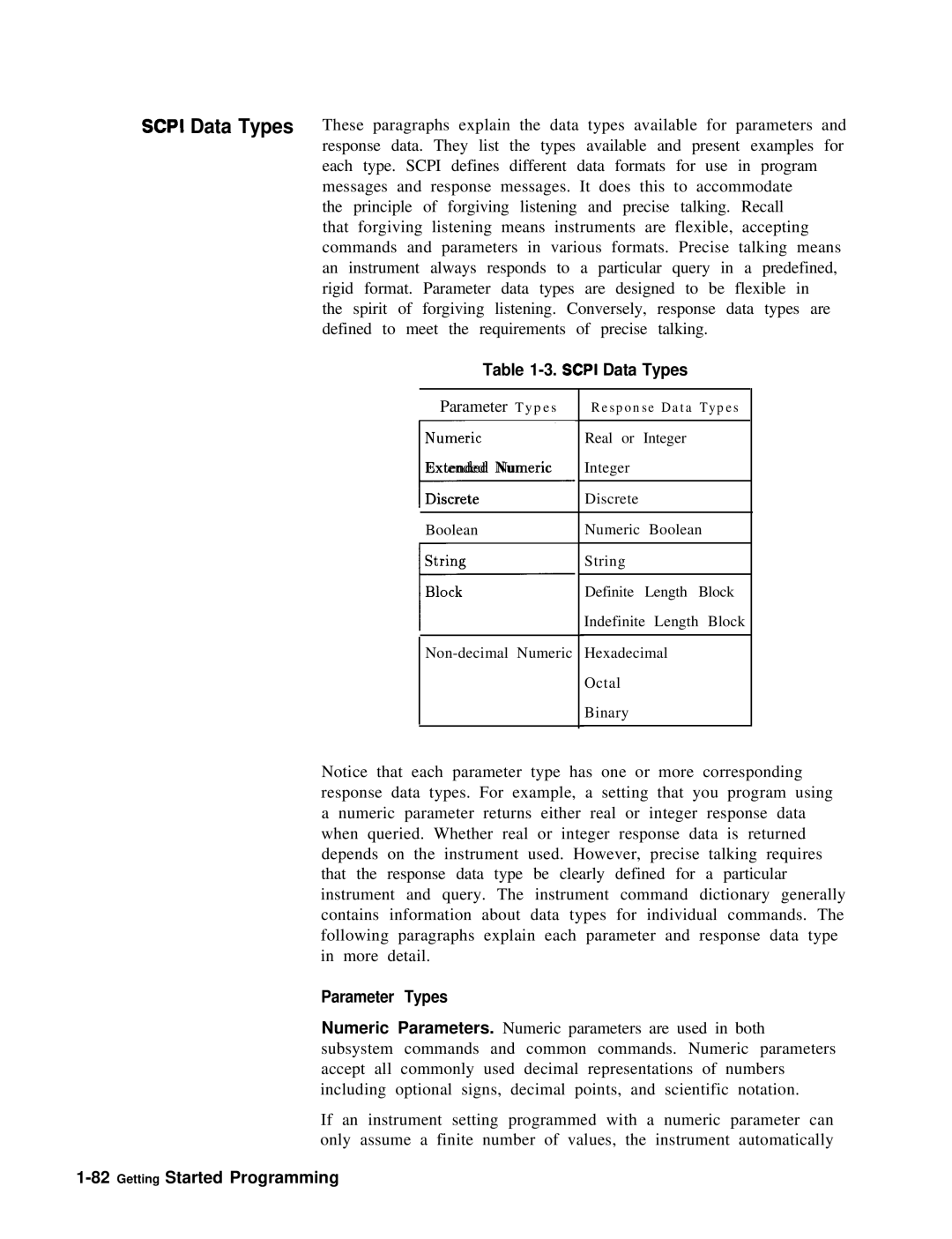
Table 1-3. SCPI Data Types
Discrete |
| Response Data Types | |
Parameter Types |
| ||
Numeric |
| Real or | Integer |
Extended Numeric | Integer |
| |
|
| Discrete |
|
|
|
|
|
Boolean |
| Numeric | Boolean |
|
|
| |
| String |
| |
|
|
|
|
|
| Definite | Length Block |
| Indefinite Length Block | ||
|
| ||
Hexadecimal | |||
| Octal |
| |
| Binary |
| |
|
|
|
|
|
|
|
|
Notice that each parameter type has one or more corresponding response data types. For example, a setting that you program using a numeric parameter returns either real or integer response data when queried. Whether real or integer response data is returned depends on the instrument used. However, precise talking requires that the response data type be clearly defined for a particular instrument and query. The instrument command dictionary generally contains information about data types for individual commands. The following paragraphs explain each parameter and response data type in more detail.
Parameter Types
Numeric Parameters. Numeric parameters are used in both subsystem commands and common commands. Numeric parameters accept all commonly used decimal representations of numbers including optional signs, decimal points, and scientific notation.
If an instrument setting programmed with a numeric parameter can only assume a finite number of values, the instrument automatically