Multiserver 5000
|
|
|
| COMMAND |
|
|
|
| FACILITY |
|
|
|
| TERMINAL DATA |
|
|
|
| INPUT HERE. |
|
| 1 |
| 2 |
| MODEM | MODEM | FOX |
|
REMOTE |
| LOCAL | ||
|
|
| ||
TERMINAL | FEEDER MUX |
| LOCAL | TERMINAL |
|
|
|
MULTISERVER
LEGEND:
FOX TEST (ONLY ONE LOCAL OR REMOTE NODE/CHANNEL MAY BE SELECTED).
INPUT MESSAGE (ONLY ONE LOCAL OR REMOTE NODE/CHANNEL MAY BE SELECTED).
INPUT DATA APPEARS ON COMMAND FACILITY SCREEN.
FOX FOX MESSAGE GENERATOR
1THE REMOTE TEST OUTPUTS TO A REMOTE TERMINAL.
2THE LOCAL TEST OUTPUTS TO THE LOCAL TERMINAL.
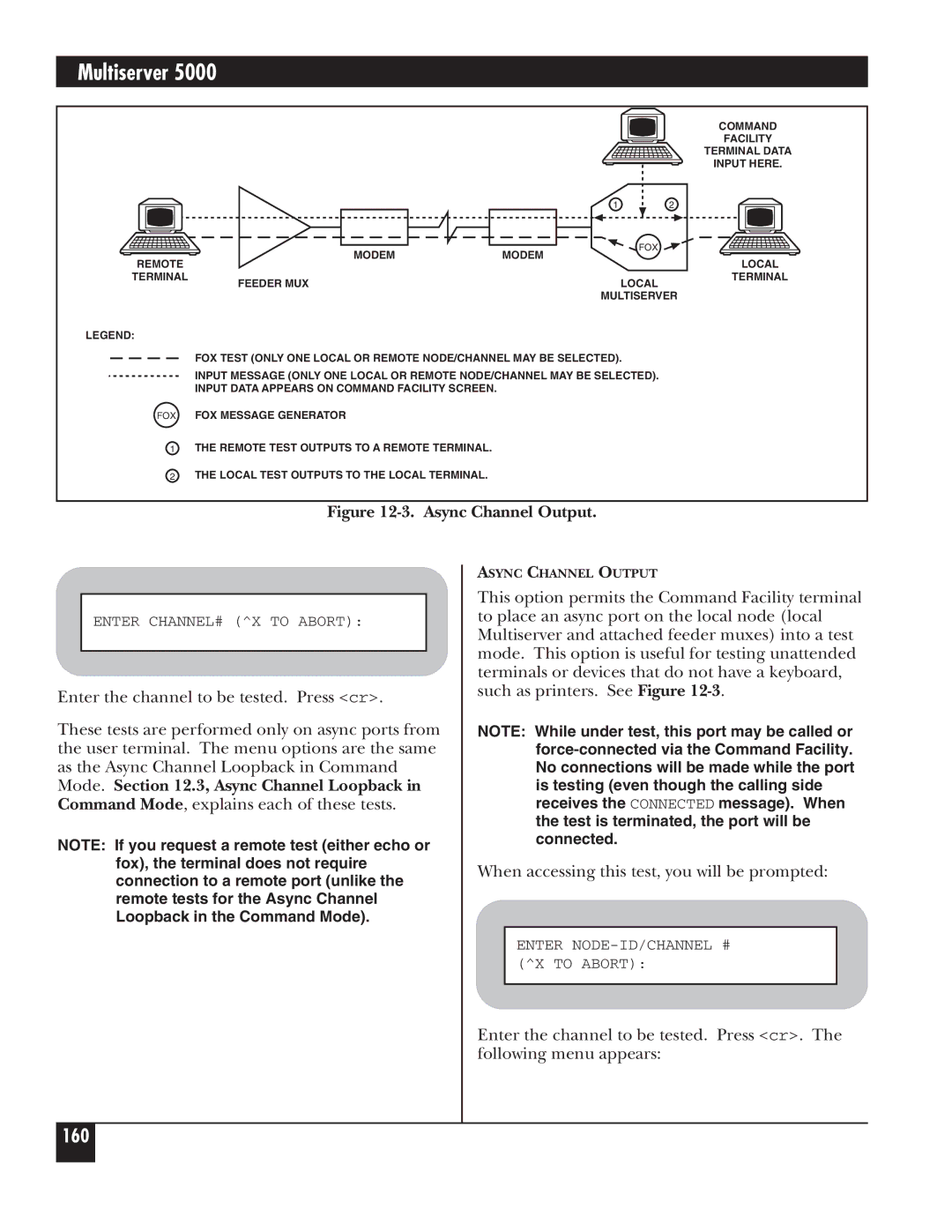
Figure 12-3. Async Channel Output.
ENTER CHANNEL# (^X TO ABORT):
Enter the channel to be tested. Press <cr>.
These tests are performed only on async ports from the user terminal. The menu options are the same as the Async Channel Loopback in Command Mode. Section 12.3, Async Channel Loopback in Command Mode, explains each of these tests.
NOTE: If you request a remote test (either echo or fox), the terminal does not require connection to a remote port (unlike the remote tests for the Async Channel Loopback in the Command Mode).
ASYNC CHANNEL OUTPUT
This option permits the Command Facility terminal to place an async port on the local node (local Multiserver and attached feeder muxes) into a test mode. This option is useful for testing unattended terminals or devices that do not have a keyboard, such as printers. See Figure
NOTE: While under test, this port may be called or
When accessing this test, you will be prompted:
ENTER
Enter the channel to be tested. Press <cr>. The following menu appears: