6.3 The Command Facility
The Command Facility contains menus to configure the ports, node, and data channels. You will need to access the Command Facility often during the configuration process. When an ASCII terminal is connected, the screen is blank except for the cursor position. From here you can enter the Command Facility in one of two ways:
•Via the Command Mode using ^X <break>. The advantage of ..this method is that when you are required to perform a reset, you are returned to the Command Facility rather than disconnected.
•Via $CMD. The advantage of this method is that you completely bypass the Command Mode and enter directly into the Command Facility. However, you are disconnected after a reset. Use this method if your terminal is configured as DTR connect protocol.
Either method can be used to enter and reenter the Command Facility.
NOTE: If your keyboard does not have a <break>
key, use the $CMD access method.
If you have the optional NMS module installed, refer to MS1 NMS Module User’s Manual for information about accessing the Command Facility.
The Command Mode can be accessed by two channels (in addition to the Command Port connector on the optional NMS module) at the same time. The Command Facility menus can be accessed by only one user at a time.
ACCESS THE COMMAND FACILITY VIA THE COMMAND
CHAPTER 6: Getting Started
MODE BY USING ^X <break>
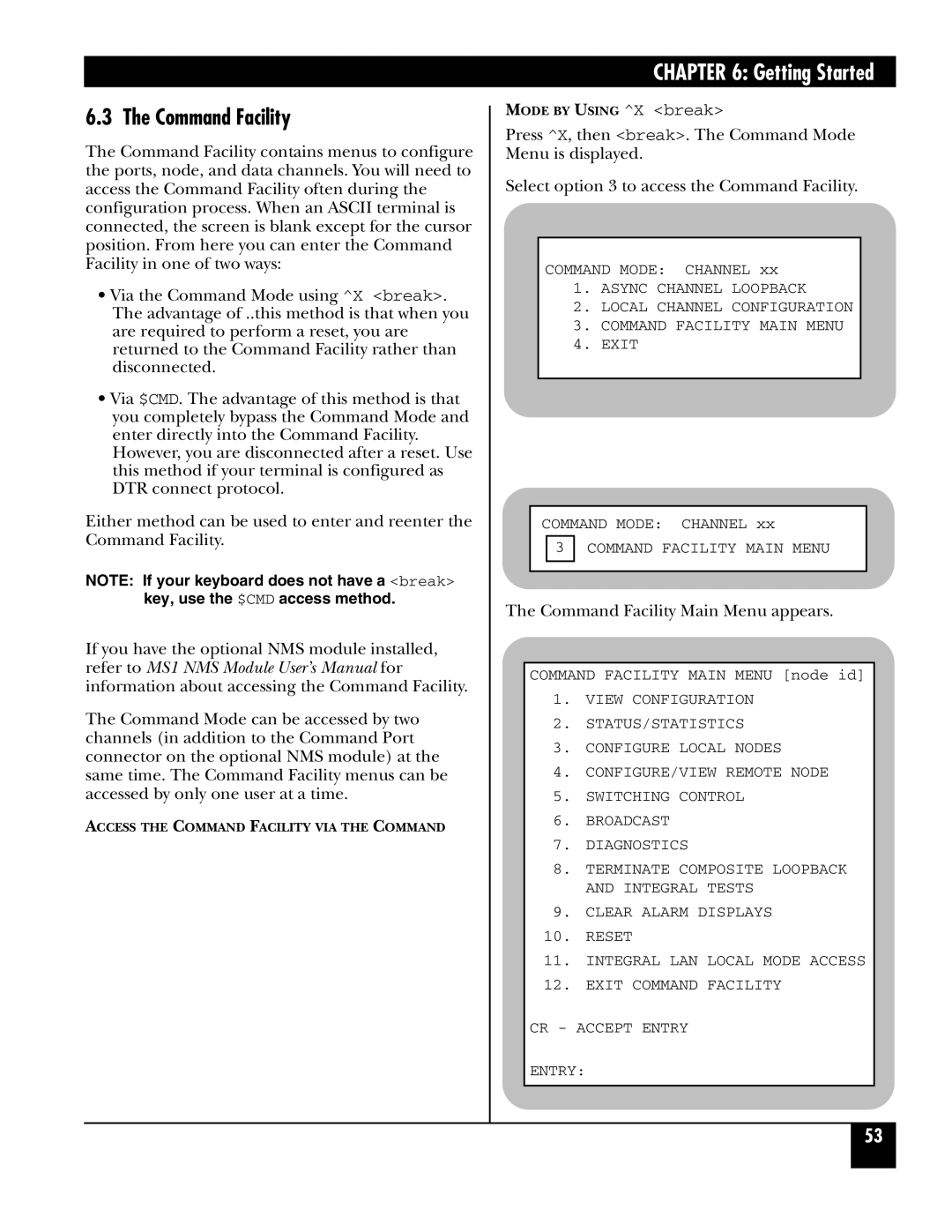
Press ^X, then <break>. The Command Mode Menu is displayed.
Select option 3 to access the Command Facility.
COMMAND MODE: CHANNEL xx
1.ASYNC CHANNEL LOOPBACK
2.LOCAL CHANNEL CONFIGURATION
3.COMMAND FACILITY MAIN MENU
4.EXIT
COMMAND MODE: CHANNEL xx
3 COMMAND FACILITY MAIN MENU
The Command Facility Main Menu appears.
COMMAND FACILITY MAIN MENU [node id]
1.VIEW CONFIGURATION
2.STATUS/STATISTICS
3.CONFIGURE LOCAL NODES
4.CONFIGURE/VIEW REMOTE NODE
5.SWITCHING CONTROL
6.BROADCAST
7.DIAGNOSTICS
8.TERMINATE COMPOSITE LOOPBACK AND INTEGRAL TESTS
9.CLEAR ALARM DISPLAYS
10.RESET
11.INTEGRAL LAN LOCAL MODE ACCESS
12.EXIT COMMAND FACILITY
CR - ACCEPT ENTRY
ENTRY:
53