Serial Interface 221
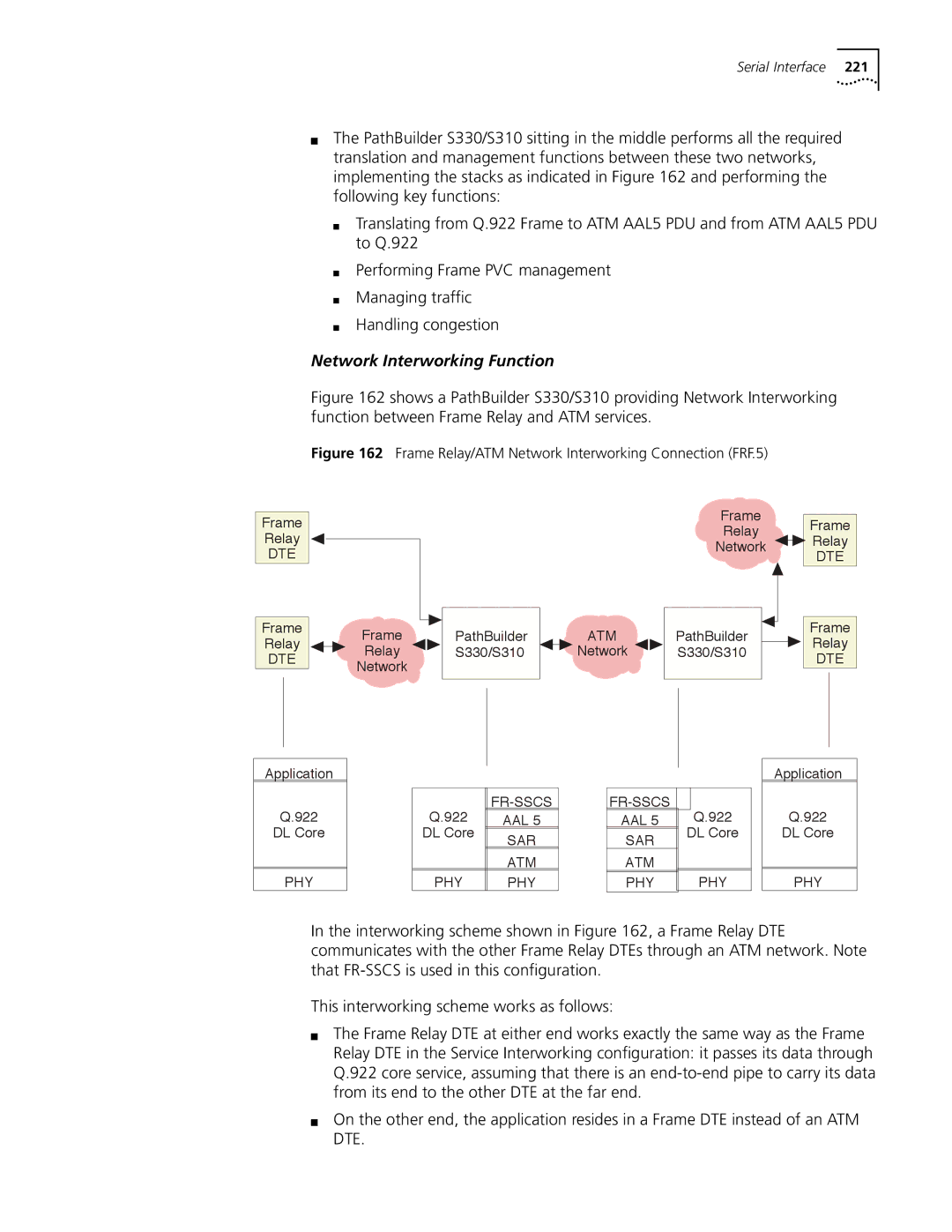
■The PathBuilder S330/S310 sitting in the middle performs all the required translation and management functions between these two networks, implementing the stacks as indicated in Figure 162 and performing the following key functions:
■Translating from Q.922 Frame to ATM AAL5 PDU and from ATM AAL5 PDU to Q.922
■Performing Frame PVC management
■Managing traffic
■Handling congestion
Network Interworking Function
Figure 162 shows a PathBuilder S330/S310 providing Network Interworking function between Frame Relay and ATM services.
Frame
Relay
DTE
Figure 162 Frame Relay/ATM Network Interworking Connection (FRF.5)
Frame
Relay Frame
Network 
 Relay
DTE
Frame
Relay
DTE
Application
Q.922
DL Core
PHY
Frame PathBuilder
Relay S330/S310
Network
Q.922 | ||
| ||
AAL 5 | ||
DL Core |
| |
SAR | ||
| ||
|
| |
| ATM | |
|
| |
PHY | PHY |
ATM | PathBuilder |
Network | S330/S310 |
|
|
| Q.922 | ||
|
| ||
AAL 5 |
| ||
| DL Core | ||
SAR | |||
|
| ||
ATM |
|
| |
|
|
| |
|
| PHY | |
PHY |
| ||
|
|
| |
Frame
Relay
DTE
Application
Q.922
DL Core
PHY
In the interworking scheme shown in Figure 162, a Frame Relay DTE communicates with the other Frame Relay DTEs through an ATM network. Note that
This interworking scheme works as follows:
■The Frame Relay DTE at either end works exactly the same way as the Frame Relay DTE in the Service Interworking configuration: it passes its data through Q.922 core service, assuming that there is an
■On the other end, the application resides in a Frame DTE instead of an ATM DTE.