Services Reserved for Attendants
Lx ÖÔ
Operations for General Calls in Day Mode
As an attendant, your role is to process your facility’s general calls during your shift.
When we refer to “Day mode”, we are referring to the mode that is automatically activated when you assume your duties (or when the first attendant does so), and remains applicable as long as your status (or at least one attendant’s status) remains in active general calls acceptance mode (see details to follow).
Your facility’s general calls are, firstly, all of the external calls received on your facility’s general number – not those that are initially routed to a specific user.
Secondly, they are the calls that are directly addressed to joint DID (Direct Inward Dialling) users that are automatically
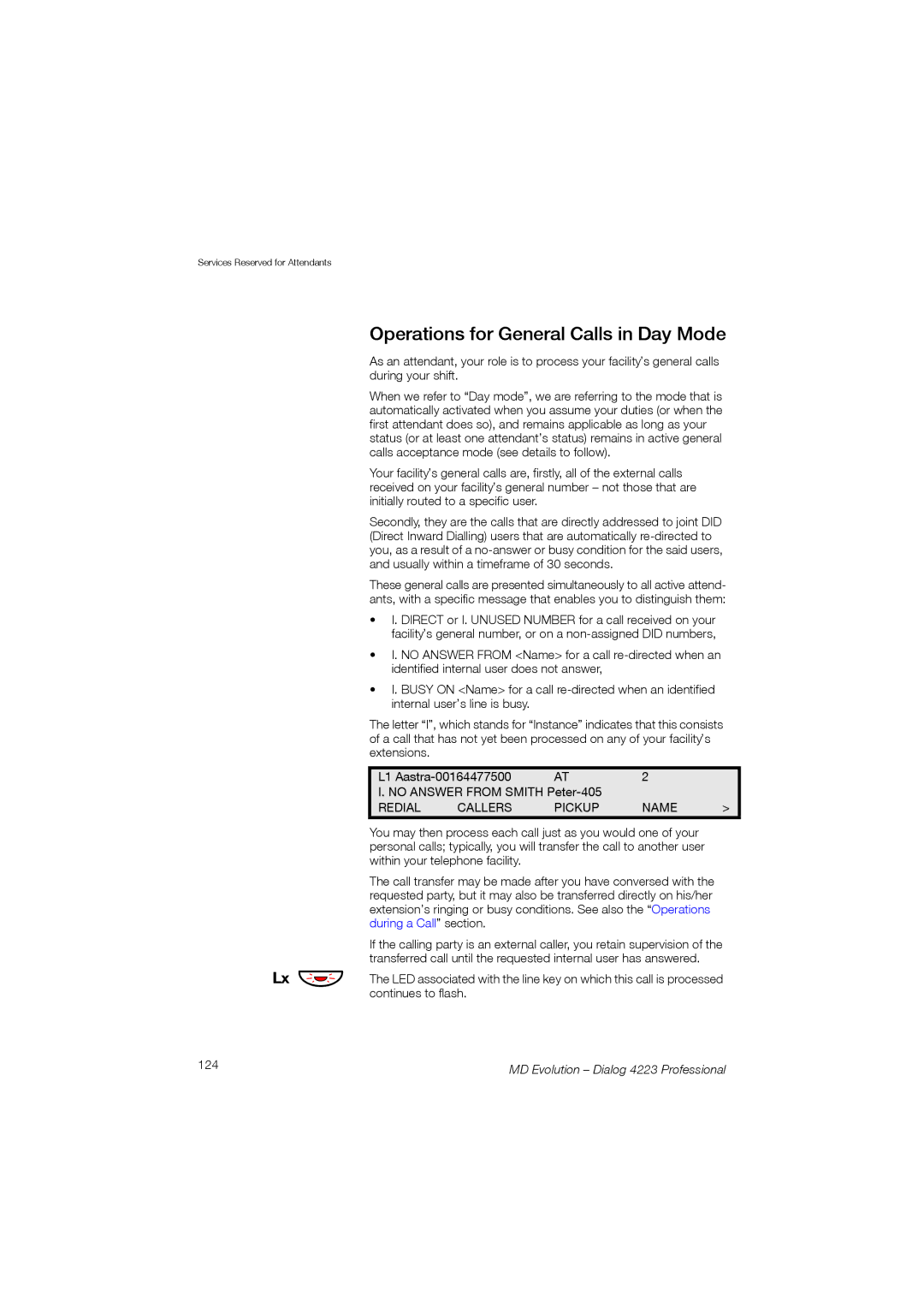
These general calls are presented simultaneously to all active attend- ants, with a specific message that enables you to distinguish them:
•I. DIRECT or I. UNUSED NUMBER for a call received on your facility’s general number, or on a
•I. NO ANSWER FROM <Name> for a call
•I. BUSY ON <Name> for a call
The letter “I”, which stands for “Instance” indicates that this consists of a call that has not yet been processed on any of your facility’s extensions.
L1 | AT | 2 |
| |
I. NO ANSWER FROM SMITH |
|
| ||
REDIAL | CALLERS | PICKUP | NAME | > |
You may then process each call just as you would one of your personal calls; typically, you will transfer the call to another user within your telephone facility.
The call transfer may be made after you have conversed with the requested party, but it may also be transferred directly on his/her extension’s ringing or busy conditions. See also the “Operations during a Call” section.
If the calling party is an external caller, you retain supervision of the transferred call until the requested internal user has answered.
The LED associated with the line key on which this call is processed continues to flash.
124 | MD Evolution – Dialog 4223 Professional |
|