HBAnyware Utility
Last Updated January 25
Page
Known Issues
Viewing Target Mapping Linux
Restoring the ACG to Its Last Saved Configuration 105
Introduction
Feature/Task Windows Solaris Linux VMware ESX
HBAnyware Features and Tasks Cross-Reference
Emlxs SFS Server
Known Issues
Installing the HBAnyware Utility
Installing HBAnyware Components
Tar xvf ElxLinuxApps-AppsRevDriverRev.tar
Mime type application/x-java-jnlp-file File Extension jnlp
Installing the HBAnyware Utility with Web Launch
Srv/www/htdocs
Installing the HBAnyware Utility Security Configurator
Select Emulex HBAnyware Security ConfiguratorChange/Remove
Uninstalling the HBAnyware Security Configurator
Uninstalling the Utility Package
Uninstalling HBAnyware Web Launch Only
Rpm -e AppsRevDriverRev.rpm
Starting the HBAnyware Utility
Starting the HBAnyware Security Configurator
Starting HBAnyware with Web Launch
Examples of Modifications
Starting HBAnyware from the Command Line
HBAnyware Utility window
HBAnyware Utility Window Element Definitions
Sort Toolbar Buttons
Menu Bar
Toolbar
Toolbar Buttons
Discovery-Tree Icons
Discovery-Tree
Status Bar
Property Tabs
Management Mode dialog box
Changing Management Mode
Reset Warning
Resetting HBAs
General tab
Changing HBA Names
Discovering HBAs
Remote SAN Management Using TCP/IP Access Protocol
Automatic Fibre Channel Discovery
Adding a Range of Hosts
Adding a Single Host
Add Range of IP Hosts dialog box
Removing Hosts
Configuring Discovery Settings
Sort by Fabric ID
Sorting HBA Information
Viewing Remote and Local HBAs
Sort by Host Name
Viewing Discovery Information
Viewing HBA Information
Host Information Tab
Viewing Host Information
Driver Parameters tab
Driver Parameters Tab
Viewing General HBA Attributes
Viewing Detailed HBA Information
Adapter Details tab
Select the Adapter Details tab
Viewing Fabric Information
Target Information tab
Viewing Target Information
LUN Information
Viewing LUN Information
LUN Masking tab with LUN Masking Disabled
LUN Masking tab
Viewing Port Statistics
Click the Statistics tab
Firmware tab
Viewing Firmware Information
Target Mapping tab
Viewing Target Mapping Linux
Select the Target Mapping tab
Authentication tab
Changing Your Password
Viewing or Changing Authentication Configuration
Click Password on the Authenticate tab
Prerequisites
Updating Firmware
Firmware Download dialog box for Windows
Updating Firmware Batch Mode
Click Start Download
Selecting HBAs to Update screen for Windows
Mapping and Masking
Performance Testing Examples
Automapping Scsi Devices Windows
Mapping and Masking Window Defaults
Mapping and Masking Defaults Windows
Field Function Default Description Window
Select the Target Mapping tab. All targets are displayed
#vi /kernel/drv/sd.conf
Adding New Targets Using sd.conf for Solaris
Introduction
Creating the Access Control Group
Designating a Master Security Client
Access Control Groups
Introduction
Access Control Group tab on an MSC System
Access Control Group Tab on the MSC
ACG Icons
Access Control Group Tab on a Non-MSC
Generating New Security Keys
Adding a Server to the ACG
Deleting a Server from the ACG
Removing Security from all Servers in the ACG
Restoring the ACG to Its Last Saved Configuration
Access Sub-Groups
Accessing a Switch
ASG Icons
Click the Access Sub-Groups tab
Creating an ASG
Reserved Indices Examples
New Access Sub-Group dialog box
Editing an ASG
Restoring an ASG to Its Last Saved Configuration
Adding a Server to an ASG
Deleting an ASG
Click Edit. The Edit Access Sub-Group dialog box appears
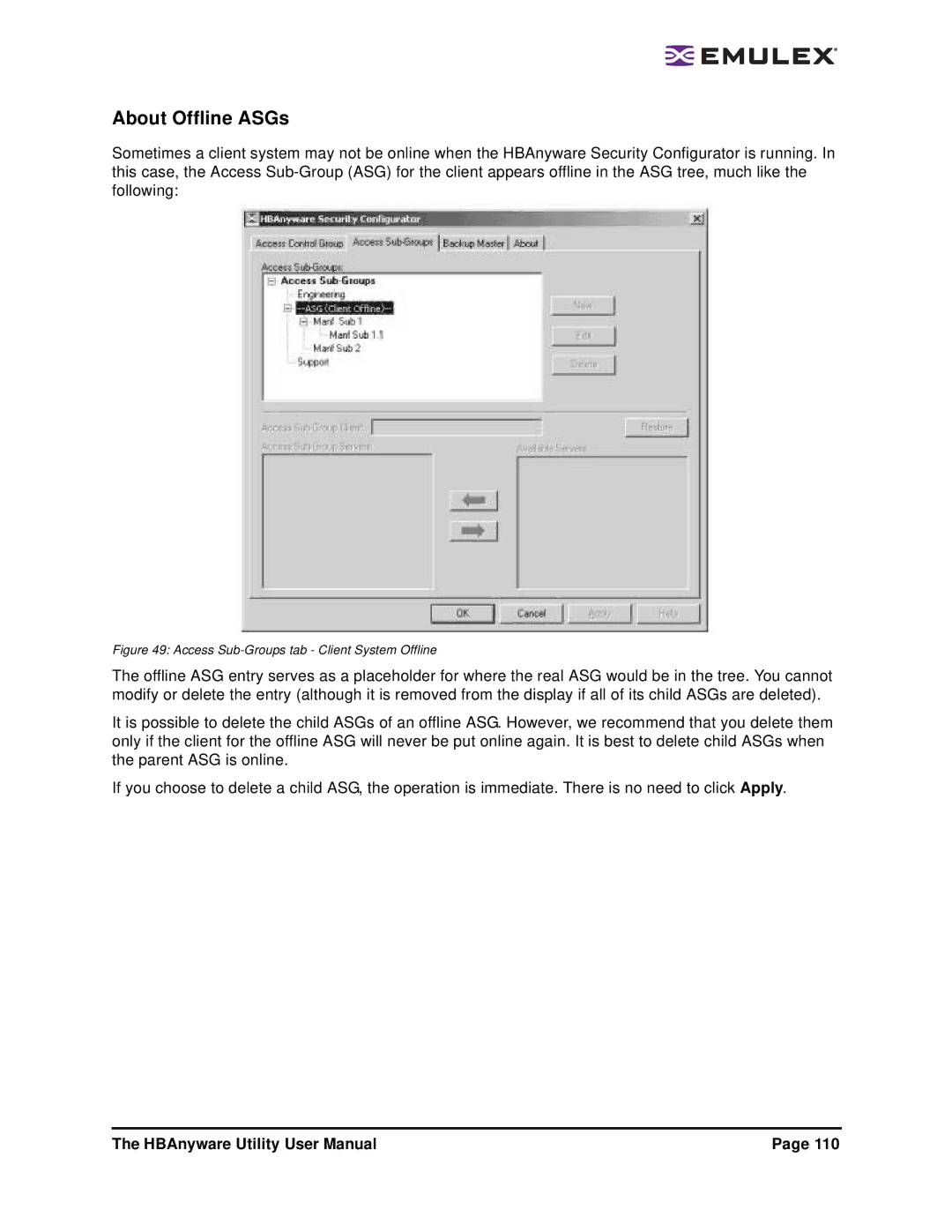
About Offline ASGs
Access Sub-Groups tab Client System Offline
Backup Master Eligible Systems
Backup Masters
Creating a Backup Master
Backup Master Tab and Controls
Backup Master Warning dialog box
Reassigning a Backup Master as the New MSC from the Old MSC
Page
Performing Diagnostic Tests
Diagnostics
Using Beaconing
Running a Power On Self Test Post
Running a Quick Test
Diagnostic Dump dialog box
Creating Diagnostic Dumps
Displaying PCI Registers and Wakeup Information
Running Advanced Diagnostic Tests
Running Loopback Tests
Error Action
Loopback Test Combinations
Test Status
Procedure
Test Cycles
Test Pattern
Select Echo Test Target window
Running End-to-End Echo Tests
Example of DiagTestLog window
Saving the Log File
Syntax Rules
Using the CLI Client
ListHBAs
CLI Client Command Reference
Help
Version
PortStatistics
SaveConfig
HBAAttributes
PortAttributes
GetLunList
Reset
TargetMapping
Download
AllNodeInfo
GetLunUnMaskbyTarget
RescanLuns
SetLunMask
SetPersistentBinding
PersistentBinding
RemoveAllPersistentBinding
SetBindingSupport
RemovePersistentBinding
BindingCapabilities
BindingSupport
SetDriverParam
DriverConfig
GetDriverParams
GetDriverParamsGlobal
SetBootBios
SetDriverParamDefaults
GetAuthConfig
SetPassword
SetAuthConfig
DeleteAuthConfig
LoopMap
InitiateAuth
PCIData
Wakeup
Loopback
SetBeacon
PostTest
EchoTest
GetDumpDirectory
Dump
GetRetentionCount
SetRetentionCount
General Situations
General Situations
Cannot access formerly accessible
Situation Resolution SAN Management Workstation Does Not
HBAnyware Security Configurator
Software package will not install. An error
Emulex Driver for Solaris Lpfc and HBAnyware Situations
Emulex Driver for Windows and HBAnyware Situations
Emulex Driver for Linux and HBAnyware Situations
BootBIOS from the lputil Boot Bios
Situation Resolution Some cases, after loading an OEM
Supplied combined firmware/OpenBoot
Image you will not be able to enable
No module lpfc found for kernel error
Situation Resolution Loading lpfc or lpfcdfc driver on Sles
System panics when booted with a failed
HBA installed Lpfc driver unload on Sles 9 causes
Ramdisk for a custom built kernel
Situation Resolution HBAnyware software package will not
LUNs when more are present
Emulex driver for Linux does not load
Unwanted Remote Servers Appear
Situation Resolution Cannot See Other HBAs or Hosts
HBAnyware
Security Configuration Situations Access Sub-Groups ASG
Security Configurator Situations Access Control Groups ACG
Access Control Groups Situations
Not All Servers are available to an ASG
Situation Resolution ASG tree of the Access Sub-Groups
Tab, one or more of the names of the ASGs
Is displayed as ASG Client Offline
HBAnyware Security Configurator Backup Masters Situations
HBAnyware Security Configurator Situations Backup Masters