Administrator’s Guide
Trademark Information
About this Guide
Administrator’s Guide for the V500 System
Contents
Designing the User Experience
Safety and Legal Notices Index
Administrator’s Guide for the V500 System Viii
What’s in this Chapter?
Introducing the V500 System
Enhanced User Experience
Key Features
Industry-Leading Audio and Video Quality
Rich Conference Experience
Security and Network Management
Easy Installation
Name Component Description
Standard System Components
Optional System Components
Administrator’s Guide for the V500 System
Setting Up Your System Hardware
To connect a monitor to the system
Connecting the Monitor
Positioning the System
To position the system
To connect the system to the LAN
Connecting the System to the Network
Connecting the LAN Cable
LAN connector
To connect headphones to the system
Connecting Headphones
Connecting the BRI Network Interface
To install the BRI network interface
To connect power and power on the system
Installing Batteries in the Remote Control
Connecting Power
To install batteries in the remote control
Administrator’s Guide for the V500 System
Configuring Network Use
Running the Setup Wizard
Using the Setup Wizard
Establishing an Administrator Password
Go to System Admin Settings LAN Properties
Configuring Your IP Connection
Configuring LAN Properties
To configure LAN properties
Obtain IP Address Automatically Select this if the system
Setting Description
Calling Within an Intranet
Setting Up Your IP Network Connection
Calling Through a Cable or DSL Modem
Port Function TCP or UDP
Configuring Router Port Forwarding
NetGear Routers
To configure a NetGear router
Linksys Routers
To configure a Linksys router
Link Routers
To configure a D-Link router
Go to System Admin Settings Network IP Firewall
Configuring Firewall and NAT Properties
To set up the V500 system to work with a firewall and NAT
Calling Through a Router, Using a DMZ
Configuring H.323 Settings
Configuring IP Network Support
Go to System Admin Settings Network IP H.323 Settings
To configure H.323 settings
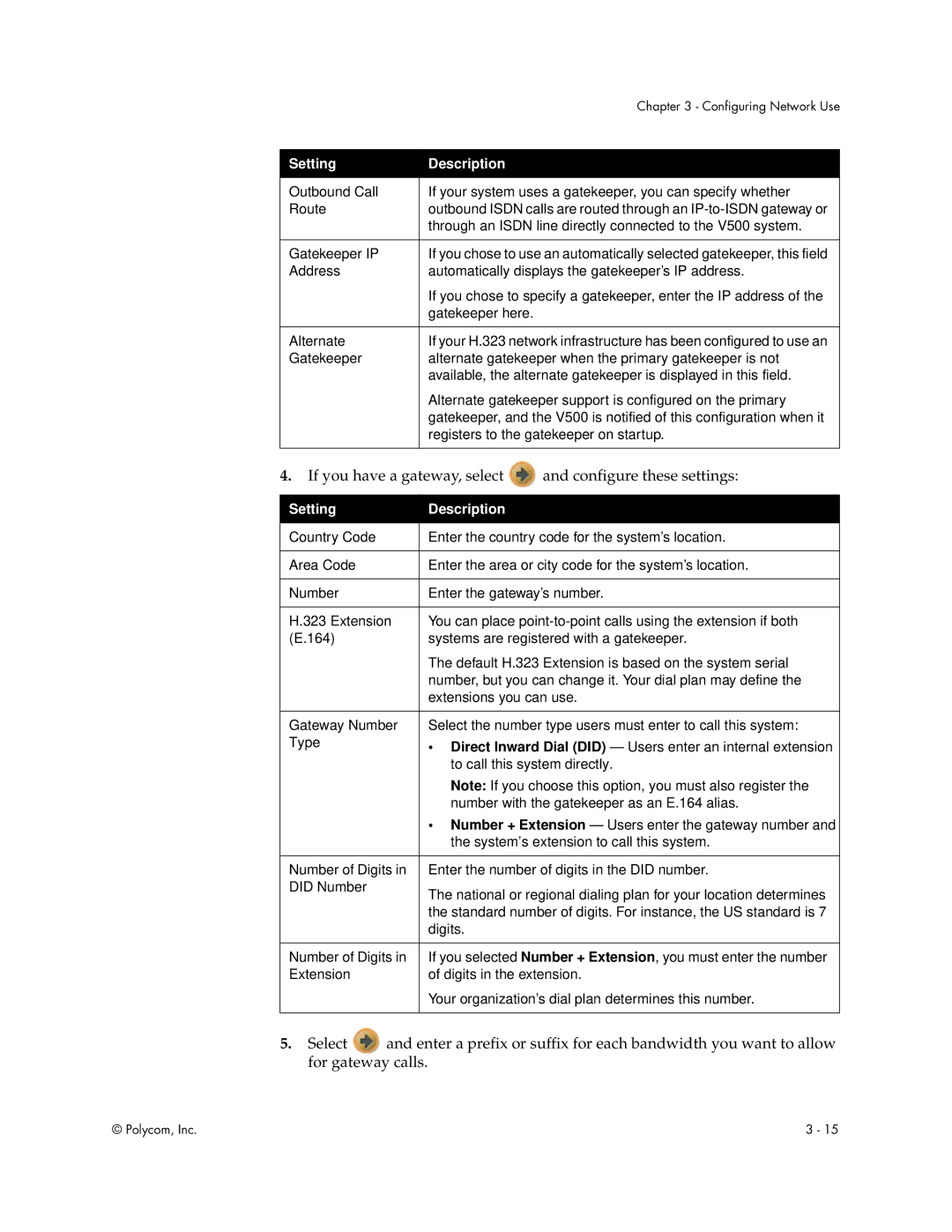
If you have a gateway, select and configure these settings
Go to System Admin Settings Network IP SIP Settings
To configure the SIP settings if your network supports SIP
Go to System Admin Settings Network IP Quality of Service
To configure the Quality of Service QOS options
Go to System Admin Settings Network Isdn
Configuring Your Isdn Connection
Configuring the Isdn Network Interface
To configure the Isdn network interface settings
Select and configure these settings
Go to System Admin Settings Network Call Preference
Configuring Call Preferences
To configure your call preferences
Preferred Speed for
To configure the Directory Server settings
Configuring the Global Directory
Configuring the Directory Server Settings
To set the dialing rules
Setting the Dialing Rules
Go to System Admin Settings Global Services Dialing Rules
Placing a Test Call
To get information about a status message
Go to System Diagnostics System Status
Checking System Status
To view System Status information
Keeping your Software Current
To upgrade your software via the Internet
Administrator’s Guide for the V500 System
Designing the User Experience
Go to System Admin Settings General Settings Security
Managing User Access to Settings and Features
Setting the Admin Password
To set or change the Admin Password
Select Reset System
Screens that Require the Admin Password for Access
To reset a forgotten Admin Password
Go to System Diagnostics Reset System
To allow users to customize the workspace
Letting Users Customize the Workspace
Limiting What Users Can Do With the System
Using the System for Specialized Applications
Designing Video Behaviors
Go to System Admin Settings Camera
Configuring Camera Settings
To configure camera settings
Go to System Admin Settings Monitor
Configuring the TV Monitor
To configure the TV monitor
Near site presses PIP
Using Dual Monitor Emulation
Setting Up
Select Dual Monitor Emulation Using in a Call Call connects
Go to System Diagnostics Video
Adjusting the Monitor’s Color Balance
Displaying Content with People+Content IP
To adjust the monitor for natural color
To install People+Content IP on a computer
To enable People+Content IP on a V500 system
Designing Audio Behaviors
To configure general audio settings
Go to System Admin Settings Audio
Designing General System Behaviors
Configuring Call Settings
To configure call settings
To configure system settings
Configuring Remote Control Behavior
Configuring Directory Settings
To configure remote control behavior
Enabling AES Encryption
Setting the Call Answering Mode
To set the call answering mode
To enable AES encryption
To set passwords and security options
Setting Passwords and Security Options
To set the date, time, and location
Setting Date, Time, and Location
Go to System Admin Settings General Settings Location
Customizing the Workspace Appearance
Advanced Users
Infrequent Users Kiosk Mode
Designing the Home Screen
New Users
To design the home screen
To add sites on the Home screen
Adding Sites to the Home Screen
Adding On-screen Instructions
To enter screen saver text
Click System Setup Utilities Screen Saver and enter
Changing System Appearance
To enter marquee text
To set the V500 system internal ringer
Configuring Closed Captioning
Setting Ring Tones and Alert Tones
To set ring tones and alert tones
V500 System
Go to System Setup Utilities Closed Caption
Audio Options for Closed Captioners
Options for Supplying Closed Captions to Conferences
Providing Captions Via a Telnet Session
Getting Started with Calling
Administrator’s Guide for the V500 System
Managing the System Remotely
To access the system using the V500 web interface
Using the V500 Web Interface
Accessing the V500 Web Interface
To configure your browser to use the V500 web interface
To view a room
To enable room monitoring
Go to System Setup Utilities Web Director
Room Monitoring with the V500 Web Interface
To upload a profile
Managing System Profiles with the V500 Web Interface
To store a profile
To upload V500 system directory entries
Managing Directories with the V500 Web Interface
To download a V500 system directory to your PC
To view the management servers list
Configuring Global Services
Viewing the Management Servers List
Requiring an Account Number for Calls
To require an account number for calls
Go to System Admin Settings Global Services My Information
Adding My Information
Your request for help has been acknowledged
To download the Polycom MIBs
Setting Up Snmp
Go to System Setup Admin Settings Global Services Snmp
Downloading MIBs
To configure the V500 system for Snmp management
Configuring for Snmp Management
System Usage and Statistics
To view the Call Summary screen
Call Summary
This screen Displays this information
Go to System Diagnostics Call Statistics and then select
Call Statistics
To view the Call Statistics screen
To view the Call Status screen
Go to System Diagnostics Call Statistics
Call Status
To view the Recent Calls screen
Go to System Admin Settings Network Recent Calls
Recent Calls
Data Description
Call Detail Report
Information in the Call Detail Report
To view and download the CDR via the V500 web interface
System Usage and Statistics
Moment at which a sample was taken. This value does not
To get an archived CDR
Call Detail Report Archives
Administrator’s Guide for the V500 System
Diagnostics and General Troubleshooting
To send a message via the V500 web interface
Go to System Setup Diagnostics Send a Message
Sending a Message
System Screens Quick Reference
Go to System Setup Diagnostics
Diagnostic Screens
To access the Diagnostics screens on the system
Go to System Diagnostics
Call Statistics screen
Select Diagnostics Call
Call Status screen
Call Statistics
Near End Loop
Error Log files
Network Tools
Near End Loop test
Color Bar test
Select Diagnostics Video
Select Diagnostics Audio
Video and Audio Tools
Select Reset System
Reset
Reset System
Select Diagnostics Reset
Symptom Problem Corrective action
General Troubleshooting
Power and Start-up
 and configure these settings:
 and enter a prefix or suffix for each bandwidth you want to allow for gateway calls.