Type | Native Data Capacity | Recording Format |
|
|
|
Ultrium 3 | 400 GB (800 GB at 2:1 | Reads and writes data on 704 |
| compression) | tracks, sixteen tracks at a time |
|
|
|
Ultrium 2 | 200 GB (400 GB at 2:1 | Reads and writes data on 512 |
| compression) | tracks, eight tracks at a time |
|
|
|
Ultrium 1 | 100 GB (200 GB at 2:1 | Reads and writes data on 384 |
| compression) | tracks, eight tracks at a time |
|
|
|
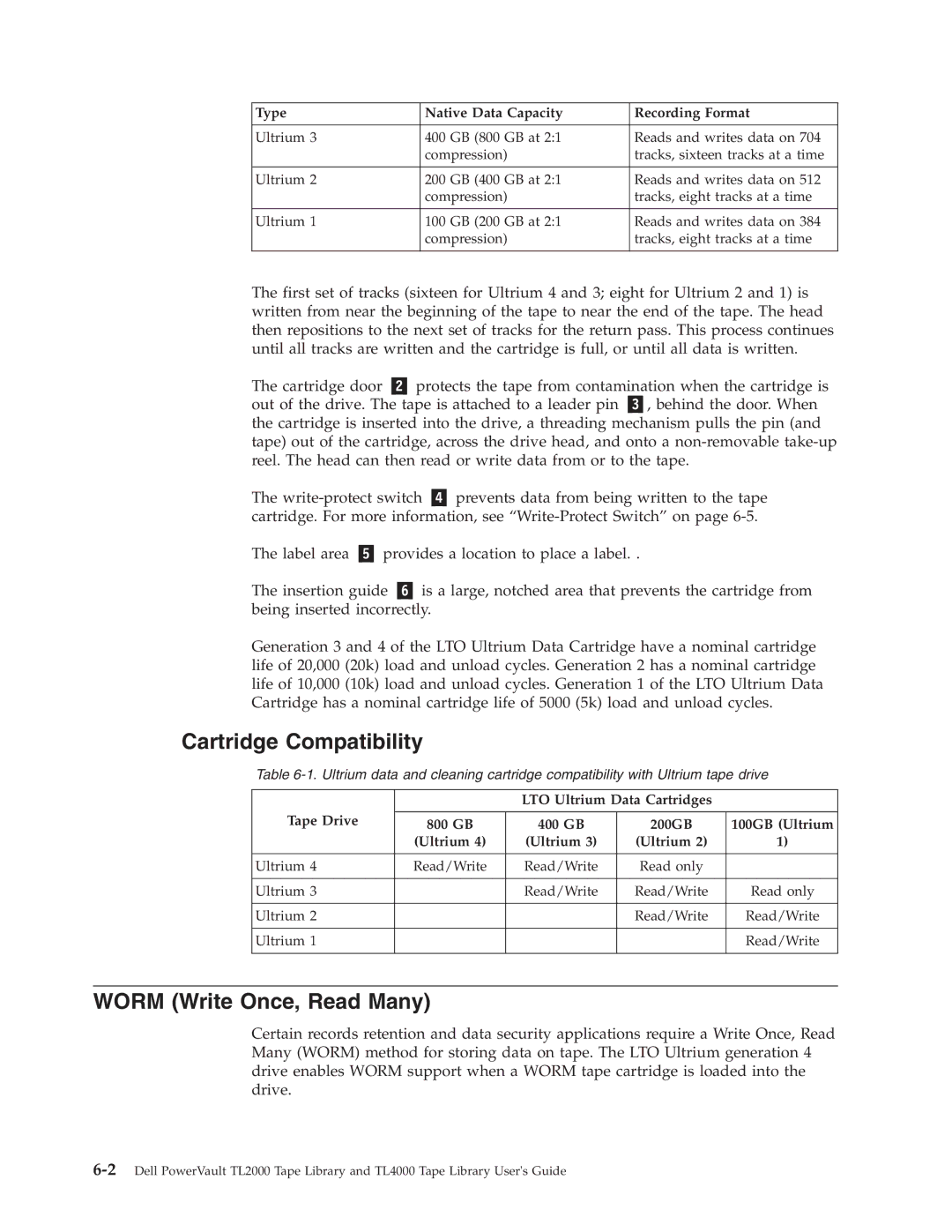
The first set of tracks (sixteen for Ultrium 4 and 3; eight for Ultrium 2 and 1) is written from near the beginning of the tape to near the end of the tape. The head then repositions to the next set of tracks for the return pass. This process continues until all tracks are written and the cartridge is full, or until all data is written.
The cartridge door | protects the tape from contamination when the cartridge is | |
out of the drive. The tape is attached to a leader pin | , behind the door. When | |
the cartridge is inserted into the drive, a threading mechanism pulls the pin (and tape) out of the cartridge, across the drive head, and onto a
The | prevents data from being written to the tape | ||
cartridge. For more information, see | |||
The label area | provides a location to place a label. . | ||
The insertion guide | is a large, notched area that prevents the cartridge from | ||
being inserted incorrectly. |
| ||
Generation 3 and 4 of the LTO Ultrium Data Cartridge have a nominal cartridge life of 20,000 (20k) load and unload cycles. Generation 2 has a nominal cartridge life of 10,000 (10k) load and unload cycles. Generation 1 of the LTO Ultrium Data Cartridge has a nominal cartridge life of 5000 (5k) load and unload cycles.
Cartridge Compatibility
Table
|
| LTO Ultrium Data Cartridges |
| |
Tape Drive |
|
|
|
|
800 GB | 400 GB | 200GB | 100GB (Ultrium | |
| (Ultrium 4) | (Ultrium 3) | (Ultrium 2) | 1) |
|
|
|
|
|
Ultrium 4 | Read/Write | Read/Write | Read only |
|
|
|
|
|
|
Ultrium 3 |
| Read/Write | Read/Write | Read only |
|
|
|
|
|
Ultrium 2 |
|
| Read/Write | Read/Write |
|
|
|
|
|
Ultrium 1 |
|
|
| Read/Write |
|
|
|
|
|
WORM (Write Once, Read Many)
Certain records retention and data security applications require a Write Once, Read Many (WORM) method for storing data on tape. The LTO Ultrium generation 4 drive enables WORM support when a WORM tape cartridge is loaded into the drive.