Assigning Ports to VLANs
Understanding Mobile Port Properties
OmniSwitch 6600 Family Network Configuration Guide
April 2006
page 7-13
Understanding Mobile Port Properties
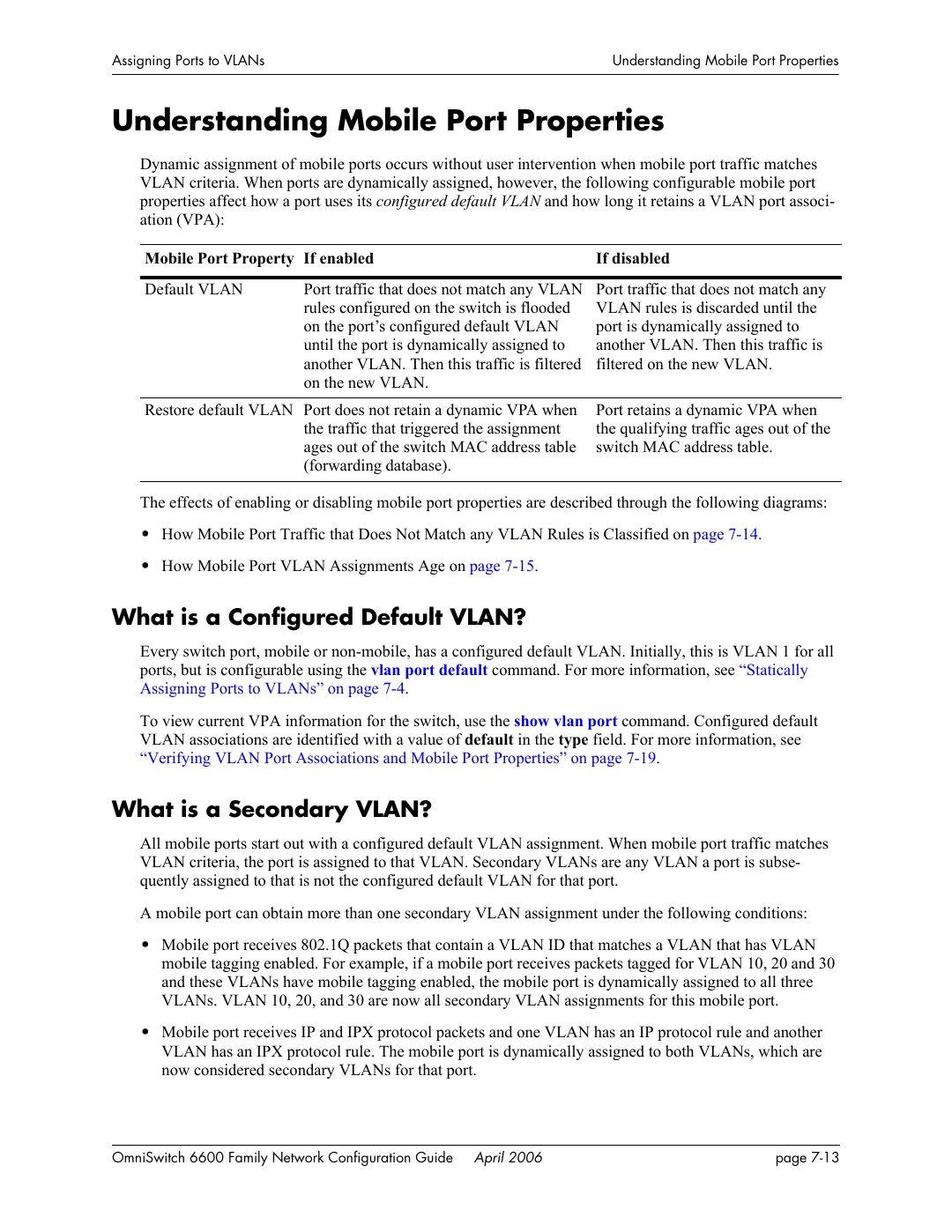
Dynamic assignment of mobile ports occurs without user intervention when mobile port traffic matches
VLAN criteria. When ports are dynamically assigned, however, the following configurable mobile port
properties affect how a port uses its
configured default VLAN
and how long it retains a VLAN port associ-
ation (VPA):
The effects of enabling or disabling mobile port properties are described through the following diagrams:
•
How Mobile Port Traffic that Does Not Match any VLAN Rules is Classified on
.
•
How Mobile Port VLAN Assignments Age on
What is a Configured Default VLAN?
Every switch port, mobile or non-mobile, has a configured default VLAN. Initially, this is VLAN 1 for all
ports, but is configurable using the
command. For more information, see
Assigning Ports to VLANs” on page 7-4
.
To view current VPA information for the switch, use the
command. Configured default
VLAN associations are identified with a value of
default
in the
type
field. For more information, see
“Verifying VLAN Port Associations and Mobile Port Properties” on page 7-19
What is a Secondary VLAN?
All mobile ports start out with a configured default VLAN assignment. When mobile port traffic matches
VLAN criteria, the port is assigned to that VLAN. Secondary VLANs are any VLAN a port is subse-
quently assigned to that is not the configured default VLAN for that port.
A mobile port can obtain more than one secondary VLAN assignment under the following conditions:
•
Mobile port receives 802.1Q packets that contain a VLAN ID that matches a VLAN that has VLAN
mobile tagging enabled. For example, if a mobile port receives packets tagged for VLAN 10, 20 and 30
and these VLANs have mobile tagging enabled, the mobile port is dynamically assigned to all three
VLANs. VLAN 10, 20, and 30 are now all secondary VLAN assignments for this mobile port.
•
Mobile port receives IP and IPX protocol packets and one VLAN has an IP protocol rule and another
VLAN has an IPX protocol rule. The mobile port is dynamically assigned to both VLANs, which are
now considered secondary VLANs for that port.
Mobile Port Property If enabled
If disabled
Default VLAN
Port traffic that does not match any VLAN
rules configured on the switch is flooded
on the port’s configured default VLAN
until the port is dynamically assigned to
another VLAN. Then this traffic is filtered
on the new VLAN.
Port traffic that does not match any
VLAN rules is discarded until the
port is dynamically assigned to
another VLAN. Then this traffic is
filtered on the new VLAN.
Restore default VLAN Port does not retain a dynamic VPA when
the traffic that triggered the assignment
ages out of the switch MAC address table
(forwarding database).
Port retains a dynamic VPA when
the qualifying traffic ages out of the
switch MAC address table.